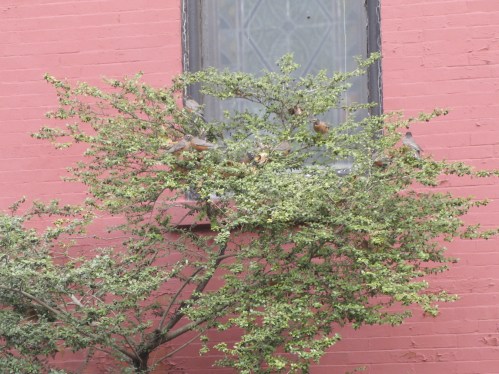
 Not all of our American Robins live up to their species name, Turdus migratorius. They will stick around through the winter as long as there is available food and water. Nearly a dozen were scouring berries from this tree the other day. They’ll eat hawthorne, dogwood, chokecherries, and sumac berries, among others, and are said to particularly like fruit that’s maggoty, rich with insect protein. After all, they are best known as carnivores, policing lawns for worms, in particular, and other insects.
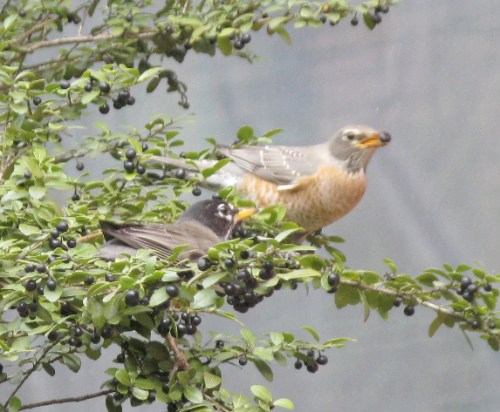 The American Robin is a species of thrush. The reddish-orange breast is usually credited with inspiring home-sick English immigrants to the New World in naming it after the European Robin (Erithacus rubecula), a.k.a. Robin Redbreast, which is quite a different bird, unless you’re desperate for something that reminds you of home and/or aren’t very observant.
Red Robins
9 responses to “Red Robins”
-
Hi Matthew,
Back when I was young, when the local dinosaurs used to pull my sled, we never saw robins in the winter (south NJ, near Philadelphia). They really were the harbingers of spring then. Nowadays, I go by flocks of grackles.
Elizabeth-
A century ago — well before your dinosaurs, Elizabeth — nobody around here would have seen a Cardinal. They reached Long Island around the 1930s, moving up from the south, and now seem the quintessential winter bird here.
-
We had the cardinals all my life – known to us as “Mr. and Mrs. Cardinal” – the only birds that received marital status from my family. But I do remember how envious my aunt in Massachusetts was that we had them as regular visitors to our feeders. She didn’t get them until much later.
-
Nature never stops moving.
-
-
Hi Matthew,
Apparently, robins eat fish as well! At a well-known conservation here in Ottawa, where robins and waxwings have been known to spend the winter, there is one spot in the pond that is open all year-round. One day last winter I noticed the water continuously rippling, and on closer inspection I realized there were lots of tiny silver fish coming up to the surface. A couple of robins hopped onto a branch above the water, and at first I thought they just wanted a drink. I was so surprised when one dipped its beak into the water and came up with a fish instead and then ate it! I wonder if the fish looked like aquatic worms to the robin?
-
Wow. I’ve never seen that. Sounds like a good adaptation to the circs. Red-breasted kingfisherobins.
-
I’d never heard of it before, either. Nature never fails to surprise (and inspire awe in) me!
-
Matthew, the robin in your photo has so much white mixed with his red breast feathers!
-
Females are generally lighter in color, and males tend to be brightest at breeding periods, less so off season. Also, there is a good amount of variation in general amongst these birds, and enough instances of leucism, or reduced pigment, to be noticed, probably because there are so many robins about and they are easy to see and observe, as in a locally famous example https://matthewwills.com/2011/04/24/two-birds/. (Plus, they chased all the Reds of Brooklyn in the 1950s.)
 Backyard and Beyond
Leave a reply to mthew Cancel reply