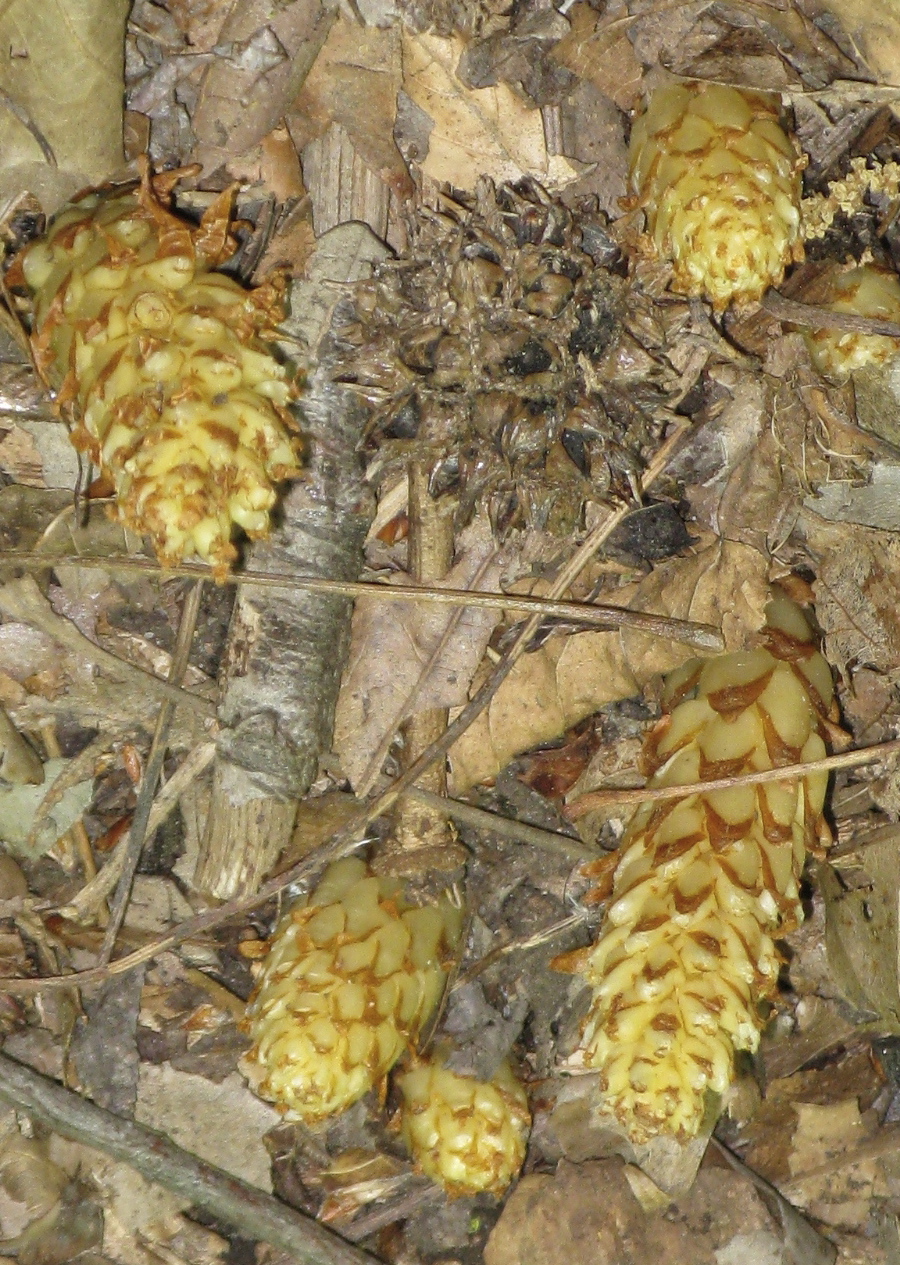
 One of the stranger wildflowers of the eastern forests is Conopholis americana, also known as squawroot, American cancer-root, and bearcorn. It looks like a fungus popping up out of the ground. But it’s a plant, and a good reminder that not all wildflowers are, well, wildflowery. This particular flower doesn’t photosynthesize; it lives by parasitizing the roots of trees, sucking the necessary nutrients out. (To the botanists, it’s an “achlorophylous obligate root parasite of Quercus spp.”) The picture above was taken in May in the Native Flora Garden of the Brooklyn Botanic Garden. The picture below, in the Catskills a couple of weeks ago, after the flowers had bloomed and the seeds set. Click on images for larger views.
 Two of the common names suggest the plant has been used for medicinal purposes, going back to indigenous peoples; “bearcorn” that bears like to eat it. The plant is listed as “exploitably vulnerable” in New York State, meaning “likely to become threatened in the near future throughout all or a significant portion of their range within the state if causal factors continue unchecked.”
An Unusual Wildflower
3 responses to “An Unusual Wildflower”
-
I don’t think we have that plant out here in the Midwest, but in any case, is that photo upside down.
We do have Indian Pipes, which I think are a similar kind of parasite.
-
Yes, it is upside down, but it refuses to right itself for some unknown reason
These things are found in the Midwest, at least east of the Mississippi, and Iowa, according to one range map.
-
-
What wonderful photos of the “Squawroot”! Is that photo upside down?…Oh, I see I’m not the first to notice that. We have quite a lot of it in the oak woods on Terrace Mountain in the Raystown Lake Region of Central-Western PA. They are fascinating plants growing from a light, tender condition like a fungus would, to dry, rough and brown almost like a pine cone. “Bearcorn” is certainly a neat alternate name, as we do have quite a few black bear here in the same vicinity. Our Friends of Raystown Lake non-profit organization thanks you for your clear, beautiful photos with informative captions which we used to answer a question tonight at our meeting. You’re welcome to come and see us anytime!
 Backyard and Beyond
Leave a reply to mthew Cancel reply