Near the dog bathing beach at the Upper Pool in Prospect Park, I found a couple of noteworthy birds the other day: The most common bird species in the park is surely the American robin, Turdus migratorius, which you can find on the meadows and in the woods and everywhere in between. This particular one stands out because it has a good amount of leucism, which is reduced and/or absence of pigmentation in the feathers. (This is technically different from albinism, which is an absence of melanin, and usually also includes the melanin in the eyes.) This bird, or one very like it, has been around the park for a couple of years now. (It’s an American robin because it’s not a European robin; they don’t look much alike, but English settlers wanted to believe they were similar.)
UPDATE 5/5/11: this bird was feeding at least three nestlings today. The feathers do not seem to prevent pair bonding and breeding.
Apropos white feathers: I once saw a completely white European starling, at a bird rehab center in New Jersey. It was positively freaky-deaky. My man Herman Melville would have included it in his “Whiteness of the Whale” chapter.
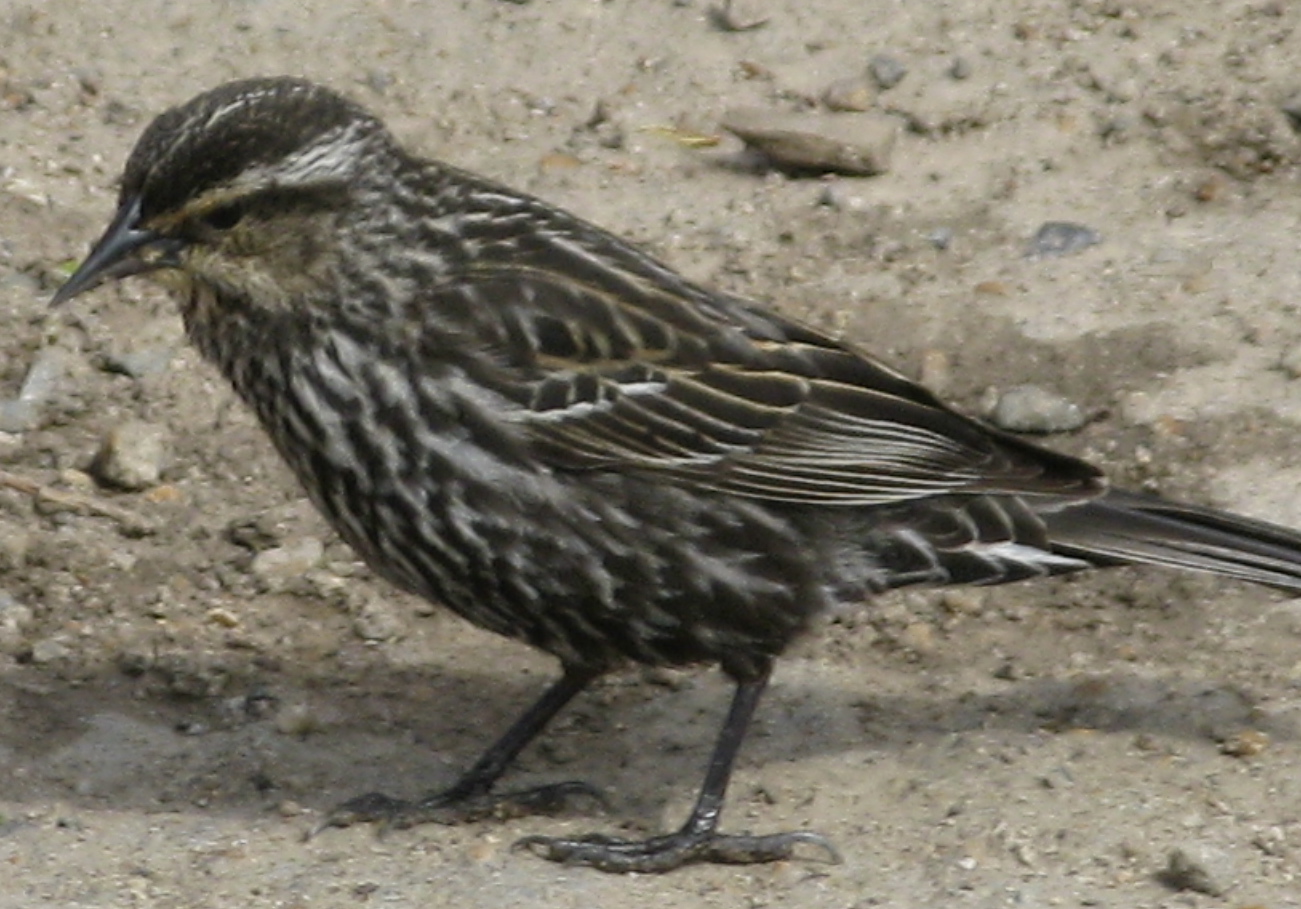 Looking somewhat like an overgrown, heavily streaked sparrow, this bird isn’t exactly rare, but you don’t run into one every day. It’s a female red-winged blackbird, Agelaius phoeniceus. The species, whose common name obviously comes from the male, is found all around all the park’s water bodies. The males are all black except for their colorful red and orange shoulder patches, quite a different looking animal; this is an extreme case of sexual dimorphism. The males are also loud and territorial, announcing themselves from the top of reeds, while the females are usually tucked away in the reeds on nests. It’s a nice illustration of how evolutionary pressures can work: the females need to be cryptically marked, so that they can’t be easily seen on their nests, where they are particularly vulnerable; while the males need to be boldly patterned so that they are seen, by both potential mates and other males.
(One sure fire way of not getting this confused with any sparrow is that long, sharp, very unsparrow, beak.)
 Backyard and Beyond
Leave a reply to meemsnyc Cancel reply