Backyard and Beyond

Starting out from Brooklyn, an amateur naturalist explores our world.

As John Burroughs said, “The place to observe nature is where you are.”

Cardinals

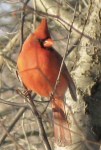
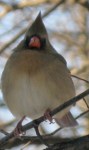
I’m betting that an awful lot of people who say they don’t know their birds can recognize the cardinals. The Northern Cardinal, Cardinalis cardinalis, is one of our most distinctive year-around birds. They are particularly obvious in winter, when the red male sticks out like a tropical flower in the snow. The female, although less colorful, is unusual in that she is also sings. (In most bird species, it’s usually only the males who sing.) The birds are very vocal and their what cheer and cheer cheer cheer is a good place to start in your explorations of the wide world of bird sound. (Also, it’s awfully cheering on a cold day.) Pairs tend to stick together, so if you see one, the other should be nearby. They may also move about in small flocks.

A century ago, you would have been hard pressed to see Cardinals in the New York City region. They are a southern U.S. species who have moved north with the rising temperatures. They reached Long Island by the 1930s. This is a nice example of the way we think about the wild with our primate brains: what we see around us during our lives is what we suppose has always been the case and will always be the case, but this is only because our frame of reference is so terribly limited.

Note that the “Northern” in the common name is in relation to the Tropics, where vividly colored birds are the norm and there are many other kinds of cardinals. The word “cardinal,” both noun (the Catholic rank, color, type of number, etc.) and adjective (meaning important), can be traced quite far back, and is related to the Sanskrit word for springing, turning, leaping.

And here, days away from leaping, a brand new Cardinal we saw in a Columbia St. community garden last August.

3 responses to “Cardinals”

  1. These are our most reliable feeder birds. They’re the first ones out in the morning, and the last to still be pecking around for seeds after the sun has gone down.

  2. At my father’s feeder in Mass., I find them in packs; I presume extended family units.

  3. […] Northern Cardinal (Cardinalis cardinalis) on her eggs. Cardinals are year-around residents of the city, and one of […]

Leave a reply to Joy K. Cancel reply