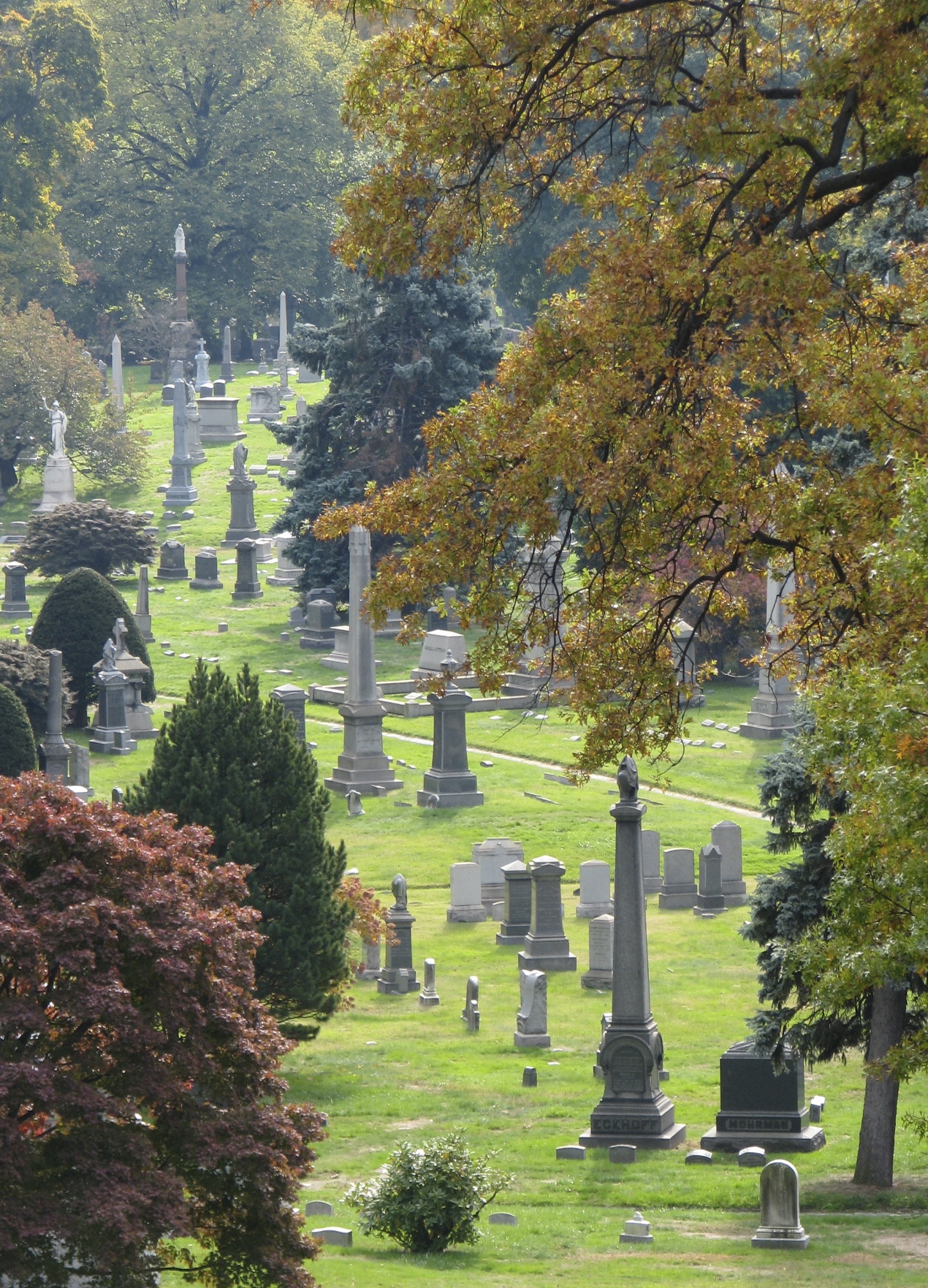
I have a confession to make: I’ve been cheating on Prospect Park. Yes, yes, I know, I know — how could I? Olmsted & Vaux & Stranahan’s great park, which beats the knickers off Central, is so lovely and sweet, but I guess Man isn’t made to be park-monogamous. It’s not like I feel good about it. No, not at all, but I can’t help it.
Oh, hell, actually I feel fine about. Sue me. I blame my genes, my animal nature. An amateur naturalist isn’t made for just one swath of urban green. One just isn’t enough.

After all, how could anybody resist the charms of Green-Wood Cemetery this time of year. The leaves, the wind, the wonderful silence, the blue sky from atop the Harbor Hill Moraine?
Wandering among the Victorian marvels of the hilly cemetery, lost in Brooklyn, listening to the bluejays, nuthatches, kinglets, cardinals, mockingbirds, and flickers, I am at peace.
And all those permanent residents, they’re just so damn nice and quiet. They don’t bother you at all. So much nicer than the wanker who lives upstairs. There are tens of thousands of them, and they are mostly good people (hmmm, maybe not so much you, Joey Gallo), even though it is sad to visit with some of them: all those 19th century infants, and the Civil War’s legions, and, now, those youngsters killed in Bush’s (and now that damn fool Obama’s) wars.

What, death in a cemetery? Underneath a bigleaf magnolia (Magnolia macrophylla), I found clumps of feathers: it looks like it might have been a female cardinal or perhaps a thrush of some kind. Most of the meat on a bird is on the breast, and raptors pluck away the contour feathers there before eating.
I practically walked into this American kestrel (Falco sparverius) a little bit later. It probably wasn’t the predator in question, however, since these, our smallest raptors, generally prey on smaller things than thrushes and cardinals.
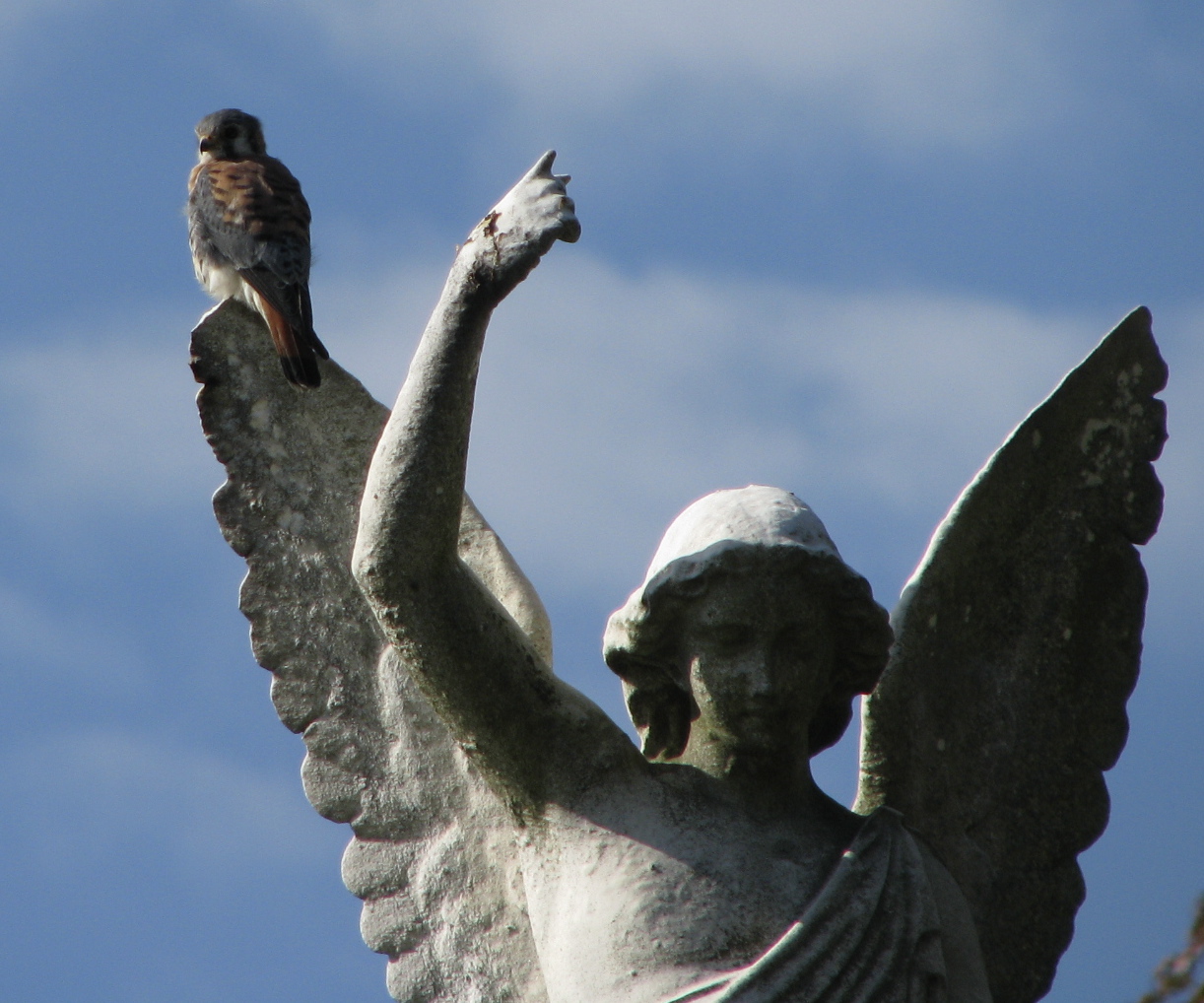
This is a male; note the tell-tale blue-gray on the wings. Roughly blue jay-sized, and certainly the most colorful of our raptors, kestrels are found throughout the city — for they’ve discovered that 19th century cornices make excellent nest sites. They’re the city’s most common bird of prey, but being small and swift-moving, they’re easily overlooked in an aerial world dominated by showboaty red-tailed hawks and peregrine falcons.

Actually, the cemetery’s been a raptor paradise this fall: I’ve seen red-tail hawk, sharp-shinned hawk, Cooper’s hawk, kestrel, merlin, peregrine, and osprey. That wind in the air isn’t a ghost.
(Not that I want you to visit. You’ll have to find your own mistress.)
 Backyard and Beyond
Leave a comment