 A Downy woodpecker (Picoides pubescens) working the bark for delicious invertebrate prey. The stiff tail feathers of a woodpecker help her (this is a female, lacking the red patch on the back of the head, trust me on this) balance on the vertical. Her feet have a zygodactyl pattern, two toes forward, two back, also good for grasping bark as she moves up and down trees. The majority of birds are perching birds, with anisodactyl feet, three toes forward, one back.
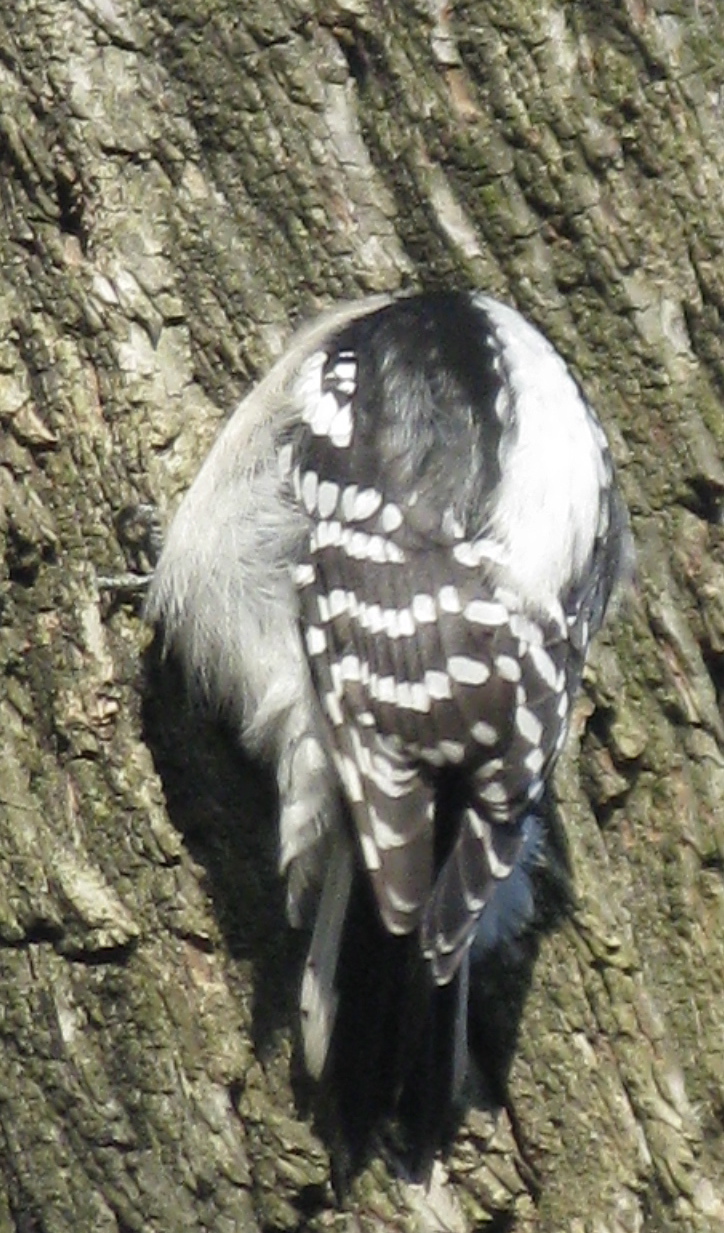 The white stripe on the back and the spots on the wings are a dead giveaway for identifying this common species, found in our parks and occasionally on our blocks.
The larger Hairy woodpecker (Picoides villosus) looks very similar, as you might suspect for a genus mate, but since they prefer larger tracks of woodlands, they are rarer in the city. The way to tell these species apart is to compare the bill size in relation to the head size. In a Downy, the length of the bill in profile is smaller than the length of the head front to back. In a Hairy, the bill is as long as the head. Subtle, but your eye gets used to looking for this.
The leafless season is a good time to see four species of woodpeckers in the city: Downy, Hairy, Red-bellied woodpecker, and Yellow-bellied sapsucker. A fifth species, the yellow-shafted Northern Flicker, is more likely seen during the breeding and migration months. A sixth species, the Red-headed woodpecker, makes only very rare appearances, and then generally in the less spectacular juvenile phase, before the head is red.
 Backyard and Beyond
Leave a comment