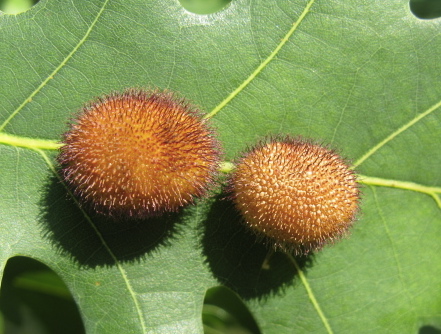
 Hedgehog gall, caused by a tiny cynipid wasp, Acraspis erinacei, on leaves of White Oak (Quercus alba) in Green-Wood Cemetery.
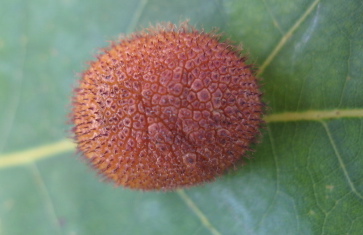 There are three to five larval cells in each of these galls. Only female adults will emerge from these in the late fall, and lay eggs (without mating) on leaf buds. These eggs over-winter, hatching in early spring. The resulting larvae will then develop in other galls, and emerge as adults of both sexes, who mate. Mated females then lay eggs on leaves. When these eggs hatch, they stimulate (annoy?) the tree to form these furry galls, which protect the larvae.
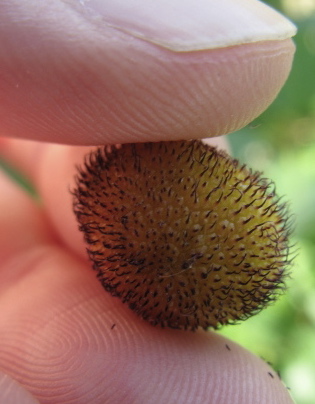 Before he got bogged down the relatively simple complexities of human sexuality, Alfred Kinsey was a cynipid wasp expert. There are thousands of gall-forcing organisms, wasps, mites, fungi. Oak species are associated with hundreds of them.
Hedgehog Gall
7 responses to “Hedgehog Gall”
-
Cool! I’ve never seen these.
-
[…] them just before, or just as, new leaf growth begins to bud.So I got to take another look at the hedgehog galls I noticed back in August. They’ve lost their lurid coloring. The exit holes: the female wasps […]
-
[…] the tree, two weeks later, in Green-Wood. It’s been a spectacular fall. Same tree, with some Hedgehog Galls. I also explore these fuzzy galls a little more […]
-
[…] this is the third year I’ve noted these hedgehog galls on this White Oak (Quercus alba) in Green-Wood. This year there is a bumper crop of them.A Multicolored Asian Ladybug (Harmonia axyridis) on the […]
-
[…] Hardly! Oak-apples are one of many interesting growths on our woody plants. This oak-apple and a hedgehog gall, were both found on white oak. Each is caused by a different species of gall wasp that lays its […]
-
I’ve got these!! How do I get rid of them or do I even need to worry about them??
-
Most galls are mostly harmless. Commercial tree/fruit growers may differ in their opinion regarding some galls, but for the rest of us, we shouldn’t worry. Indeed, keeping away from pesticides and the like should encourage more insect (there are parasites on gall wasps…) and other life-forms.
Here’s UNL’s take on this particular gall: “Hedgehog gall wasps are dependent upon their host tree for survival so cause, at most, minor damage” http://entomology.unl.edu/scilit/K%20Larsen%20Hedgehog%20Gall%20Wasp.pdf
-
 Backyard and Beyond
Leave a comment