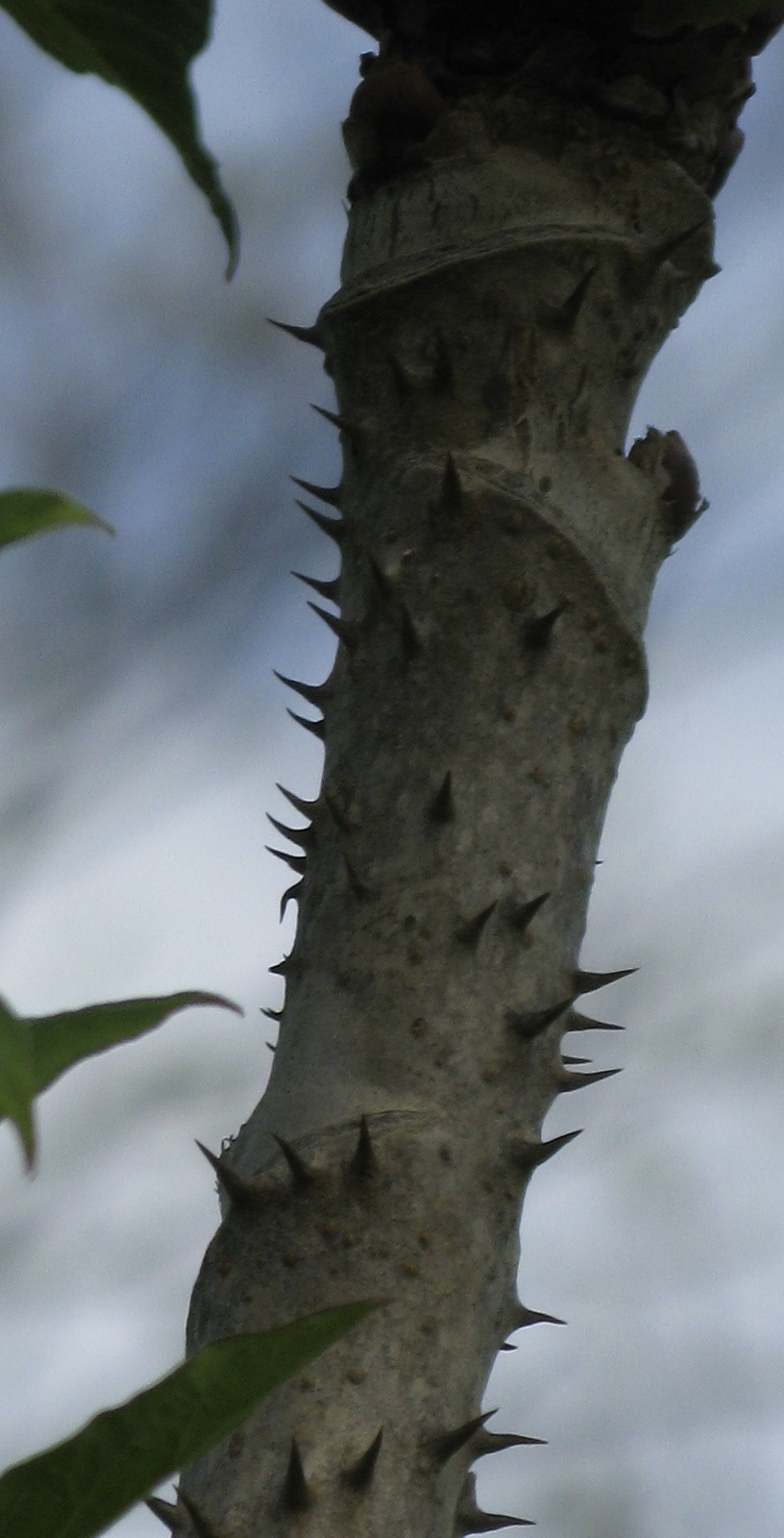
 What a great name, and perfectly understandable when you get a look at the young shoots and stems. Aralia spinosa is a native understory shrub, sometimes a small tree, of the East Coast, particularly the South. You can find it in all the boroughs; this patch was along the north end of the loop around Jamaica Bay Wildlife Refuge. And it is a patch; the plant will grow by clonal offshoot and makes an awesome natural border. It’s also known as Hercules Club and Prickly Ash, but this is where common names get confusing since those names are also used for the unreleated Southern Prickly Ash (Zanthoxylum clava-herculis).
UPDATE: Or maybe it’s Aralia elata, the Japanese Angelica tree that is very similar, and in the same genus, and invasive. Reader Jessica (see comments) suggests further study is needed.
 A large photograph for a large leaf (click to open a larger version). It is in fact the largest leaf in our woods, reaching up to 5 feet long. That’s because these leaves are bipinnately compound, that is, made up of leaflets divided into subleaflets (as distinct from a simple leaf). Picture a maple leaf: the slightly swollen end of it’s leafstalk or petiole, where it attaches to the stem, makes that a simple leaf. The leafstalk of these big bipinnately compound leaves also ends in a swollen joint, which are correspondingly quite large for these large leaves, but the leaflets do not:
  You can also see (smaller) bipinnately compound leaves on Honeylocust, Golden Rain-tree, and Kentucky Coffee-tree, all found on Brooklyn’s streets.
 Backyard and Beyond
Leave a reply to jessica Cancel reply