Backyard and Beyond

Starting out from Brooklyn, an amateur naturalist explores our world.

As John Burroughs said, “The place to observe nature is where you are.”

Ouroboros

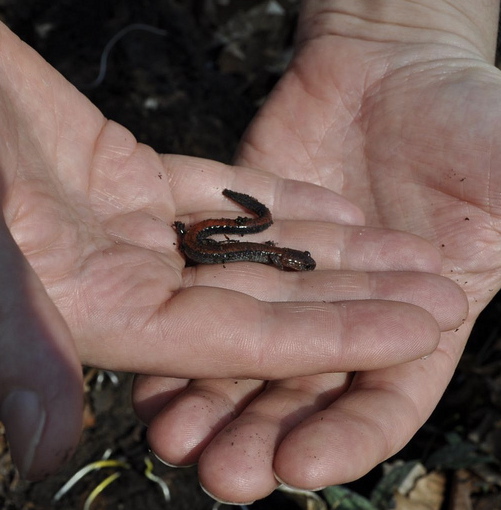
Photo by Marielle Anzelone
Every twenty years or so, my dander gets up and I write a letter to the New York Times. In the mid-1980s, I did it to spank Edward Teller, who poo-pooed the concept of nuclear winter in an Op-Ed, with a reminder of the global climate effects of “Eighteen Hundred and Froze to Death.” That was the year (1816) without a summer, following the ejection into the atmosphere of human-historically unprecedented amounts of volcanic crap from Tambora in Indonesia. Although best known among the literate as that gloomy Swiss summer the Shelleys, Byron, and Polidori stayed indoors and made up some ghost stories, they were the lucky ones. The poor of Europe, following the long disaster of the Napoleonic wars, were walloped; it’s been called the last great subsistence crisis in that part of the world. The U.S. (we only had one coast then) was hard hit, too, forcing many people out of New England and westwards into New York and beyond, including the family of Joseph Smith. (Did a volcano gave birth to Mormonism? The Second Great Awakening started earlier, but the traumatic memory of starvation and forced migration may have fired further the kindling of the Burnt Over District. Discuss amongst yourselves.) A student of Nantucket history, I quoted in my letter the Argument Settlers, a collection of historic newspaper items from August 1816: “Ice made in pails.” In the middle of summer, it was so cold water froze overnight. So bite me, Dr. Strangelove.

In the mid 2000s, I wrote to the Times again to protest the dispossession of a red-tailed hawk, popularly known as “Pale Male,” by the plutocrats of 5th Avenue — although, since I wanted it published, I didn’t use the word “plutocrat.” (Since then, I’ve decided I’m totally against naming wild animals, a grossly Adamic practice, imperialistically anthropocentric, the cute side of the pernicious exploitation of the natural world, but I know I’m fringy on this; the mob is deeply desirous of turning celebrity or marquee animals into pets.) But, my point, and, patience, Little Grasshopper, I am digressing towards it, is that today is the first time my hands have ever been in the Times.

Last week I tagged along with Marielle and Hugh on their weekly trip to Staten Island for Marielle’s Spring Time series, being published every Thursday until the start of summer. I wanted to see some amphibians. I turned over a piece of wood to see what we could see. Behold, some pale orange ants, scurrying millipeds, and a Red-backed salamander, Plethodon cinereus. Now, the Americas have more species of salamanders than the rest of the world combined, although the animals seem to have originated in Eurasia. In North America, species range in size from barely two inches long to nearly three feet long. Some, like the big hellbenders, are fully aquatic, others mostly subterranean – the Spotted Salamander can live up to a dozen years, but will spend less than six months of that above ground, emerging to migrate to vernal pools and wetlands to reproduce – but all depend on moisture; the terrestrial species usually only emerge from cover at night or after rains. The Red-backed is a member of the family Plethodontidae, which is exclusively New World and includes about 230 of the 380-odd known species of salamanders on the planet. Plethodontidae are lungless and breath through their skin, hence their imperative to stay moist. The presence of this animal is a good sign of the health of this particular patch of wetland/woodlands.

Unlike lizards, salamanders have moist smooth or warty skin, not scales, and lack claws. Like lizards, their tails can snap off and then a new tail regenerate, but never quite as well as the original, so if handled they must be handled carefully, without grabbing the tail. Another distinction between lizard and salamander is that it’s very hard to catch a lizard, but not so hard to catch a salamander.

And it’s easy to kill them. They must run gauntlets of cars on roads through their territory; they must survive silted, dammed, and polluted water bodies, drained and “developed” habitats; acid rain and other toxins; and etc. (the damned et ceteras we make!). They are not nearly as abundant as they once were. The great hellbenders, gloriously unusual creatures, in particular have been hard hit and are endangered in several states.

Salamanders have long been associated with fire, probably because they often shelter under bark, and when that bark was lit aflame, they fled, thus looking like they were “created” by fire. Cf. Aristotle and Pliny. Besides being actual animals, salamanders have become legendary, particularly in alchemy, with its obsession with transformation and transmutation. The word itself is ultimately derived from the Greek via the Latin, but may stem from sources further east. “Salamander” has also over time meant a fire-eater, a woman who lives chastely amid the fires of temptation, and a soldier who exposes himself to battle-fire. Today, it’s also a restaurant kitchen broiler.

When this particular Red-backed salamander curled into a ring in the palm of my hand, I thought of Ouroboros, the mythic serpent or dragon that swallows its own tail, a symbol of eternity and infinity, a symbol of the cycles of the natural world.

10 responses to “Ouroboros”

  1. alphonsegaston

    A native of the Burnt Over District salutes your post. Nothing to discuss, I guess, except that I had forgot about the volcanic Nuclear Winter of the 19th century. Yes, perhaps it is responsible for Mormonism.

    Congratulations of getting your hands into the NYT. I am too squeamish to appreciate the creepy crawlies, but I know they are around and try to avoid them, like when digging out my wood chip pile.

    On cute names for creatures, one of my late colleagues, a specialist in crayfish, was a fanatic on the subject. I plead no contest, as I did not even know what a crayfish was until l stepped into his little “museum.”
    I admit to having three white squirrels in my woods, all of whom are called “Whitey,” but then I call my garden wagons by names, like Greenie or Big Black, because at my age I can’t get the whole description out before my son runs out of time waiting to hear what I want.

    My major visits to NYC were three internships during the early 50s, and I am really enjoying the side of NYC I am seeing in your blog, as well as Forgotten New York and imjustwalkin’.

    1. Glad you’re enjoying your virtual visits. Lots of changes since the Fifties, as you know and can imagine. Hadn’t heard of white squirrels, found this http://www.thewildclassroom.com/biomes/speciesprofile/deciduousforest.html about some mapped locations for them.

      1. Thanks for the link. I tried to send in my sightings but the e-mail address did not work. I recall that I tried to report them another time and the site had disappeared.

  2. alphonsegaston

    But somehow Rob got back to me anyway. “My” white squirrels are on the map.

    1. Great. The internet is good for something.

  3. […] Ellen is the NYC Parks & Rec Principal Research Ecologist and involved in a study monitoring Eastern Red-backed salamanders (Plethodon cinereus). How do they respond to stressed, invasive-filled woodlands, as compared to […]

  4. Reblogged this on Backyard and Beyond and commented:

    It goes around and around…

  5. […] it meant serpent and seems to have been interchangeable with dragon. Hence Great Worms and the Worm Ouroboros. But not the Diet of […]

  6. […] years. This seems to be a female, and gravid as all get out. She curled around this vegetation. Ouroboros! It looked like she almost got stuck. Was she laying an egg? She’ll do one egg at a time, […]

Leave a reply to mthew Cancel reply