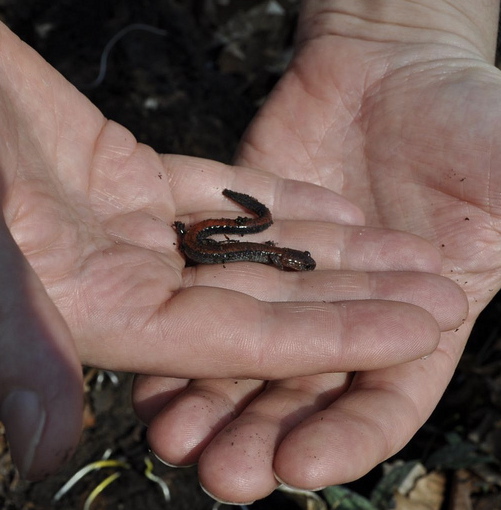
In the mid 2000s, I wrote to the Times again to protest the dispossession of a red-tailed hawk, popularly known as “Pale Male,” by the plutocrats of 5th Avenue — although, since I wanted it published, I didn’t use the word “plutocrat.” (Since then, I’ve decided I’m totally against naming wild animals, a grossly Adamic practice, imperialistically anthropocentric, the cute side of the pernicious exploitation of the natural world, but I know I’m fringy on this; the mob is deeply desirous of turning celebrity or marquee animals into pets.) But, my point, and, patience, Little Grasshopper, I am digressing towards it, is that today is the first time my hands have ever been in the Times.
Last week I tagged along with Marielle and Hugh on their weekly trip to Staten Island for Marielle’s Spring Time series, being published every Thursday until the start of summer. I wanted to see some amphibians. I turned over a piece of wood to see what we could see. Behold, some pale orange ants, scurrying millipeds, and a Red-backed salamander, Plethodon cinereus. Now, the Americas have more species of salamanders than the rest of the world combined, although the animals seem to have originated in Eurasia. In North America, species range in size from barely two inches long to nearly three feet long. Some, like the big hellbenders, are fully aquatic, others mostly subterranean – the Spotted Salamander can live up to a dozen years, but will spend less than six months of that above ground, emerging to migrate to vernal pools and wetlands to reproduce – but all depend on moisture; the terrestrial species usually only emerge from cover at night or after rains. The Red-backed is a member of the family Plethodontidae, which is exclusively New World and includes about 230 of the 380-odd known species of salamanders on the planet. Plethodontidae are lungless and breath through their skin, hence their imperative to stay moist. The presence of this animal is a good sign of the health of this particular patch of wetland/woodlands.
Unlike lizards, salamanders have moist smooth or warty skin, not scales, and lack claws. Like lizards, their tails can snap off and then a new tail regenerate, but never quite as well as the original, so if handled they must be handled carefully, without grabbing the tail. Another distinction between lizard and salamander is that it’s very hard to catch a lizard, but not so hard to catch a salamander.
And it’s easy to kill them. They must run gauntlets of cars on roads through their territory; they must survive silted, dammed, and polluted water bodies, drained and “developed” habitats; acid rain and other toxins; and etc. (the damned et ceteras we make!). They are not nearly as abundant as they once were. The great hellbenders, gloriously unusual creatures, in particular have been hard hit and are endangered in several states.
Salamanders have long been associated with fire, probably because they often shelter under bark, and when that bark was lit aflame, they fled, thus looking like they were “created” by fire. Cf. Aristotle and Pliny. Besides being actual animals, salamanders have become legendary, particularly in alchemy, with its obsession with transformation and transmutation. The word itself is ultimately derived from the Greek via the Latin, but may stem from sources further east. “Salamander” has also over time meant a fire-eater, a woman who lives chastely amid the fires of temptation, and a soldier who exposes himself to battle-fire. Today, it’s also a restaurant kitchen broiler.
When this particular Red-backed salamander curled into a ring in the palm of my hand, I thought of Ouroboros, the mythic serpent or dragon that swallows its own tail, a symbol of eternity and infinity, a symbol of the cycles of the natural world. 
 Backyard and Beyond
Leave a reply to alphonsegaston Cancel reply