Small islands are tight confines for birds, particularly when the mix of habitats (dry and moist forests, mangrove, salt pond, shoreline) on them is only a portion of the whole. There are just a handful of resident songbird species on St John. [See under: mongoose.] The ubiquitous Bananaquit is one: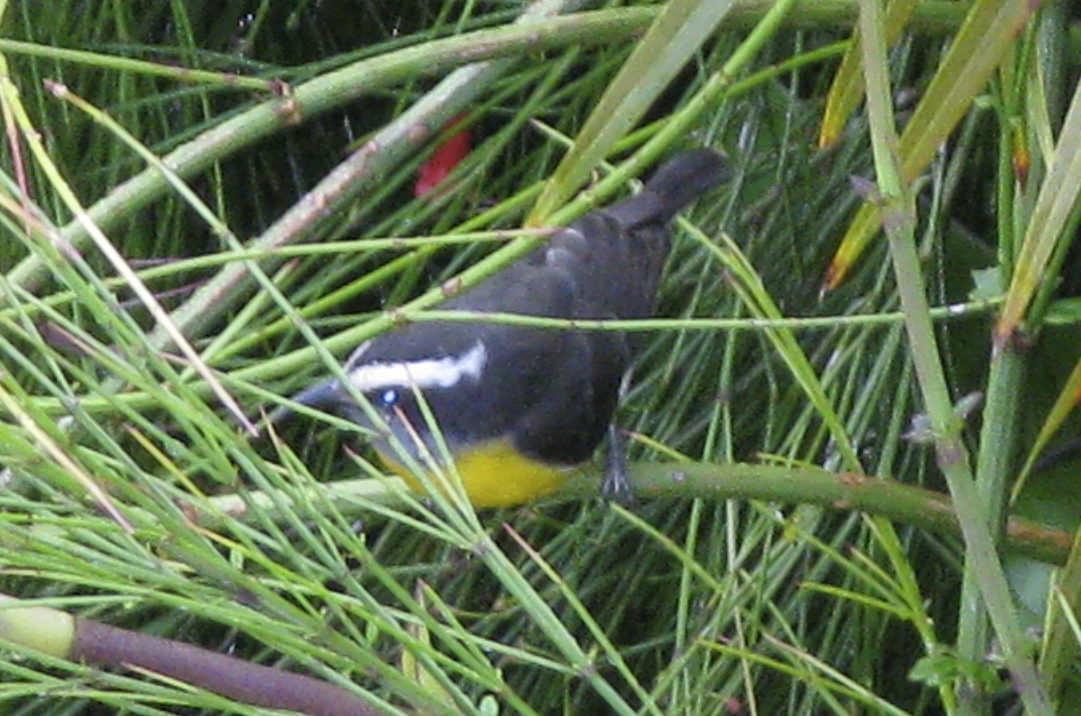 Its whistle songs enlivening mornings and evenings. Another is the Lesser Antillean Bullfinch. I watched a pair of these “rob” flowers of nectar by going to the base of the long blossoms, which are perfect for hummingbirds, with their short bills. By robbing, I mean they don’t pay the toll of picking up much pollen this way.
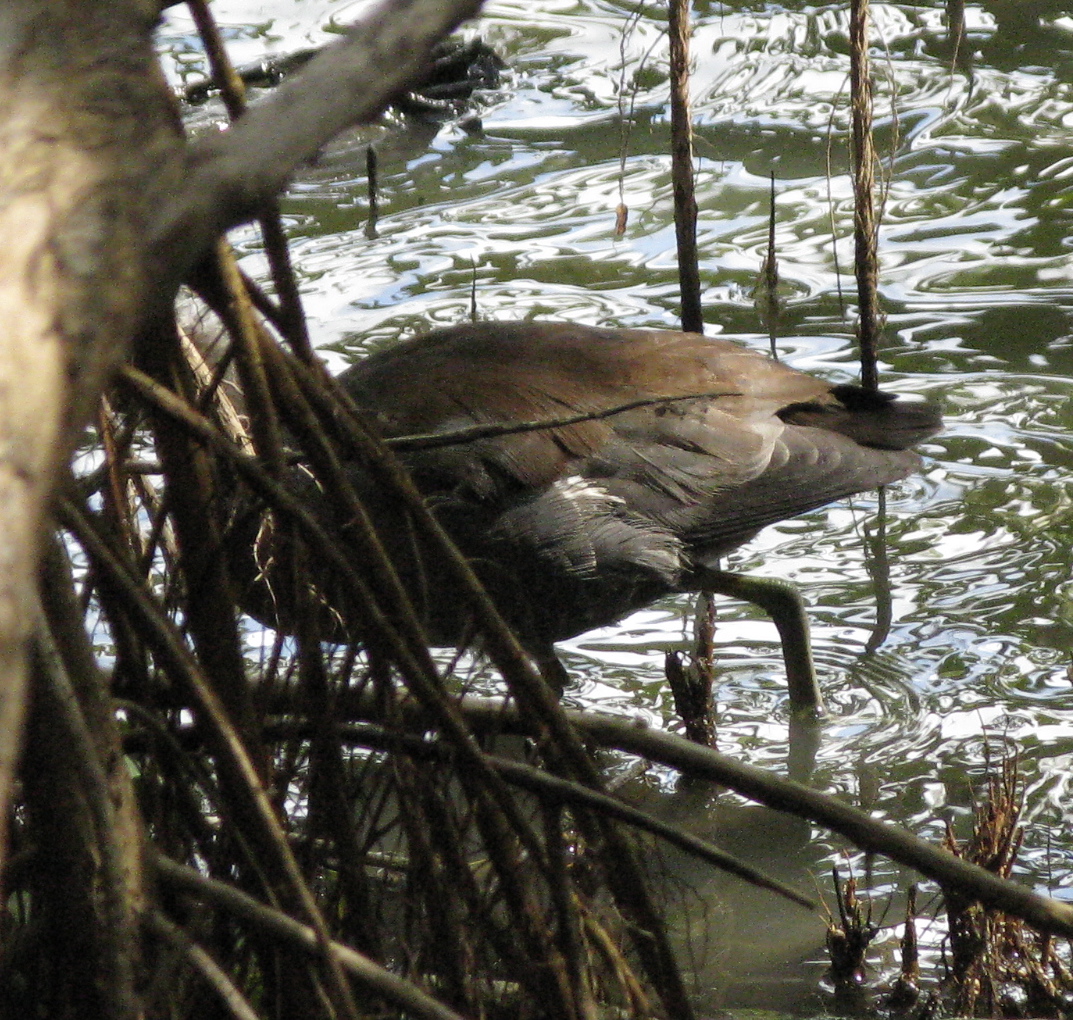 The richest bird habitat on the island are the salt ponds, which are often ringed by mangroves. I was halfway around the Francis Bay Trail at Mary Point despairing of seeing anything but Pearly-eyed Thrashers and Zeneida Doves, when I noticed the gallinule above. Which gallinule was the question. A new bird can often be discombobulating. It looked like nothing in my Princeton Field Guide to the Birds of the West Indies. (James Bond, where art thou?) There was a touch of red on the forehead. While I was trying to follow this with my eyes through the reeds, something else swam back and forth furiously, but for only a moment. It was much smaller than the chicken-like thing I was looking at. Two mysteries at once. The smaller bird resolved into a Sora, which I didn’t realize could swim. (As it happens, I saw my first Sora in Prospect Park.) When I got to the observation platform, the mysterious red-forehead began to make sense when I saw an adult Common Gallinule (Gallinula galeata), which used to be called Common Moorhen (G. chloropus).
 From the observation platform, two more life birds: the White-cheeked Pintail
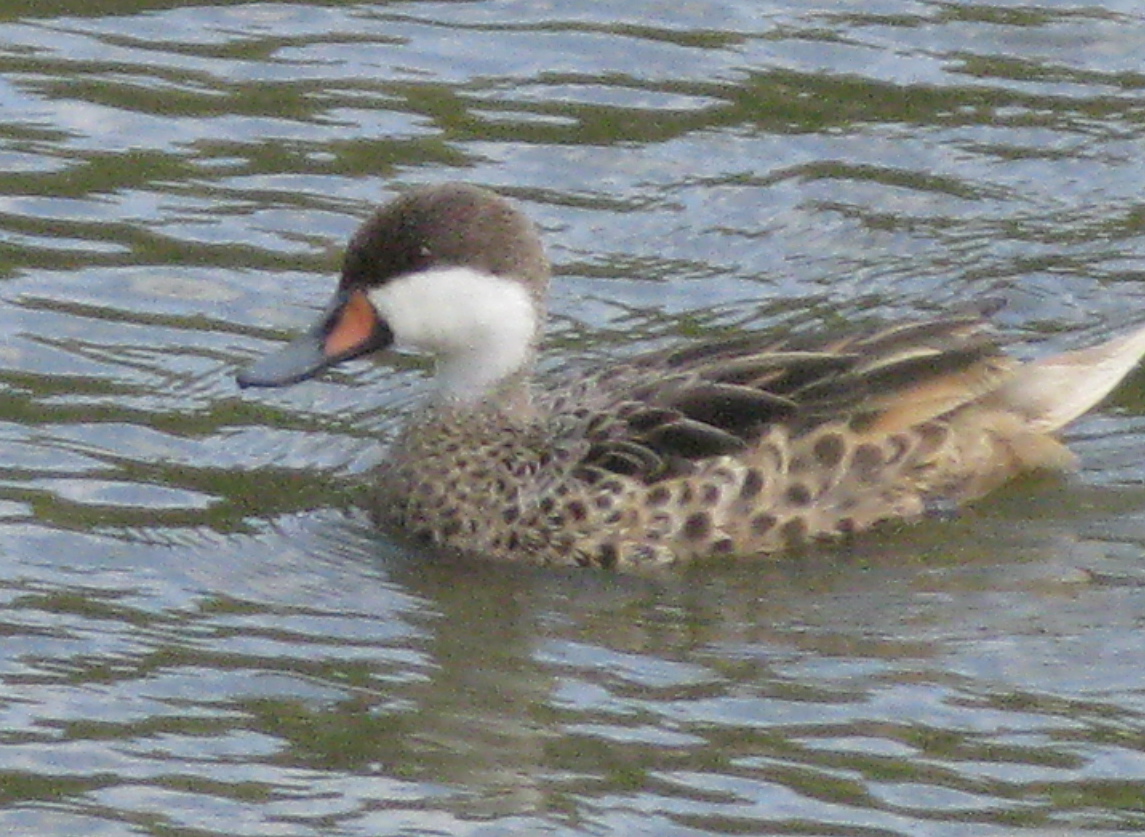 which I had hoped to see, and the Least Grebe, which was unexpected.
Here’s all the birds I saw, with life species in bold: Least Grebe, Brown Booby, Brown Pelican, Magnificent Frigatbird, Great Blue Heron (St. Thomas), Great Egret, Green Heron, Blue-winged Teal, White-cheeked Pintail, Osprey (resident birds have very white heads), American Kestrel, Common Gallinule, American Coot, Spotted Sandpiper, Rock Dove (St. Thomas), Zeneida Dove, Common Ground-Dove, Mangrove Cuckoo, Smooth-billed Ani, Green-throated Carib, Antillean Crested Hummingbird, Gray Kingbird, Pearly-eyed Thrasher, Yellow Warbler, Hooded Warbler, Bananaquit, Black-faced Grassquit, Lesser Antillean Bullfinch, House Sparrow (also seen inside the St. Thomas airport terminal). (This is the checklist I used.) The only “common” resident species that eluded me was the Scaly-naped Pigeon.
 Backyard and Beyond
Leave a reply to Rob Ripma Cancel reply