We don’t have many trees or bushes that have differently shaped leaves on the same plant. Sassafras (S. albidum), with its three different leaf-shapes, is one. (The roots of these used to be made into sassafras tea and sodas; a crushed leaf smells like a soda fountain root beer and is immensely refreshing.) The mulberries are another.  Red mulberry, Morus rubra, is a native species, with delicious berries. The similar white mulberry, M. alba, comes originally from China and is the food of the silk worm ~ they were much imported to the U.S. in various attempts to start silk worm production here. These berries are also delish. (Eat the ripe dark purple ones.) There’s also the paper mulberry, Broussonettia papyrifera, native to Japan and Taiwan, whose fruits are very different; in some places it’s a serious invasive.
So which is this, growing out my the neighbor’s knotweed jungle and starting to overhang the Back 40? It’s got immature mulberries, so it’s either the red or white.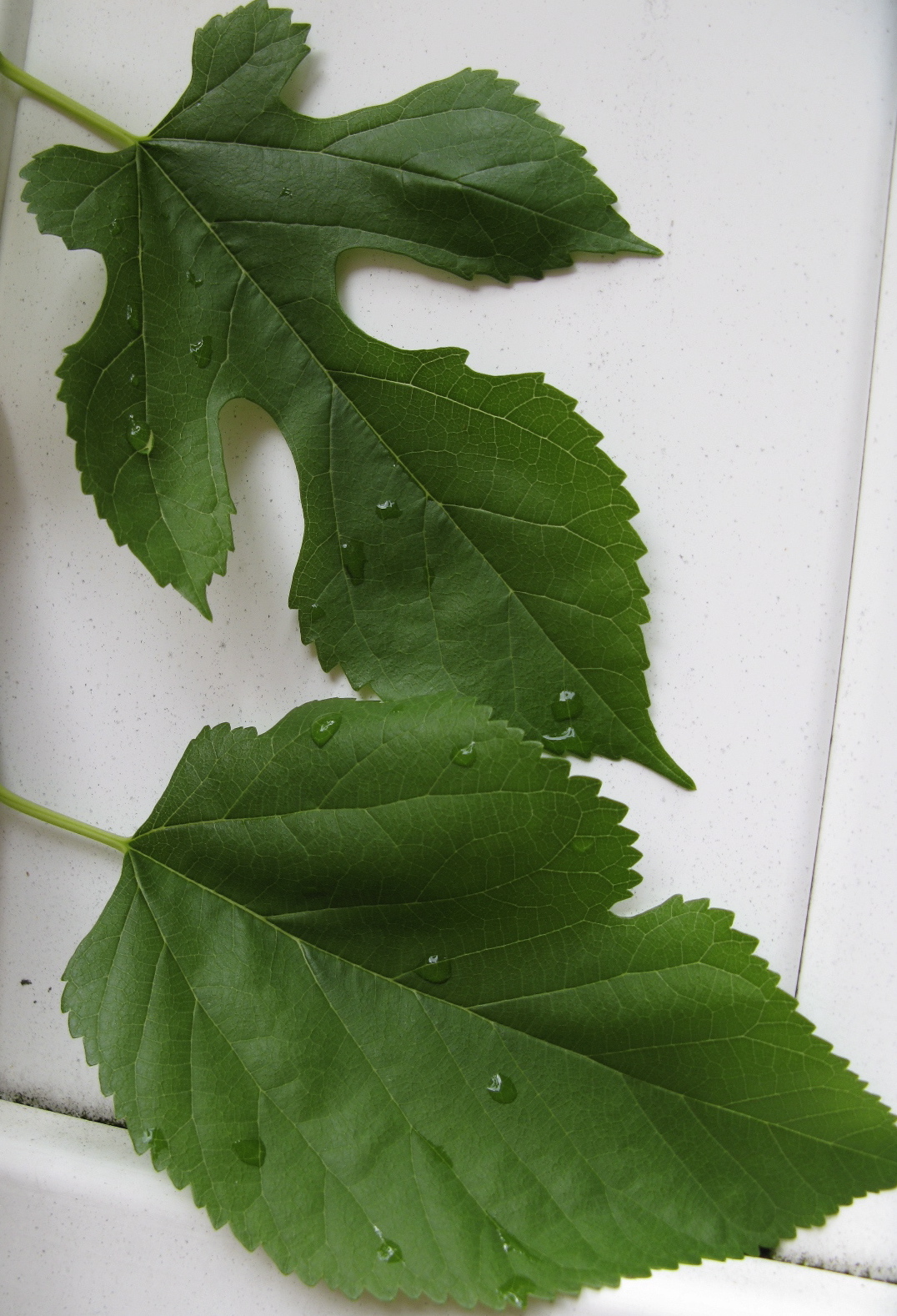 Complicating matters is that there are many cultivars and hybrids of both red and white mulberries. But, since the leaves are rough on top, like sandpaper, I’ll put my tentative bet on red mulberry. White mulberry leaves are shiny and smooth.
A juvenile northern mocking bird was in the tree a few days ago. There will be no fruit left for us bipeds!
For the complete arbornerd: the common fig, Ficus cacia, grown in backyards (and roofs) here in Brooklyn: and the Osage orange, Maclura pomifera, found in Prospect Park, are also in the mulberry family (Moraceae). So is breadfruit, Artocarpus altilis….
 Backyard and Beyond
Leave a reply to View from the Back 40 « Backyard and Beyond Cancel reply