Reviews
-
Ocean Double Feature
This is a great book combo: Helen Czerski’s The Blue Machine explains why planet Earth should really be called planet Ocean. Susan Casey’s The Underworld takes us on journeys to the deepest parts of this Ocean world, the places until very recently we knew almost nothing about. A physicist and oceanographer, Czerski explains how the ocean works and how…
-
Behold The Book
Larval development in odonates can last from a few months to as many as five years. They’re aquatic at this stage, so very different from their adult airborne forms. Mostly aquatic, that is—there are always exceptions in the insect world: family Petaluridae, the petaltails, have larvae that are semi-terrestrial. These nymph/naiads capture prey with their…
-
O, Wasp, Where Is Your Sting?
I spend a fair amount of time around wasps and bees. Sometimes they get in my face, but in all these years I’ve only been stung three times: 1) on the hand by a Honey Bee in a Lower East Side community garden because we were coming for her honey; 2) on the ear lobe…
-
Cicadas
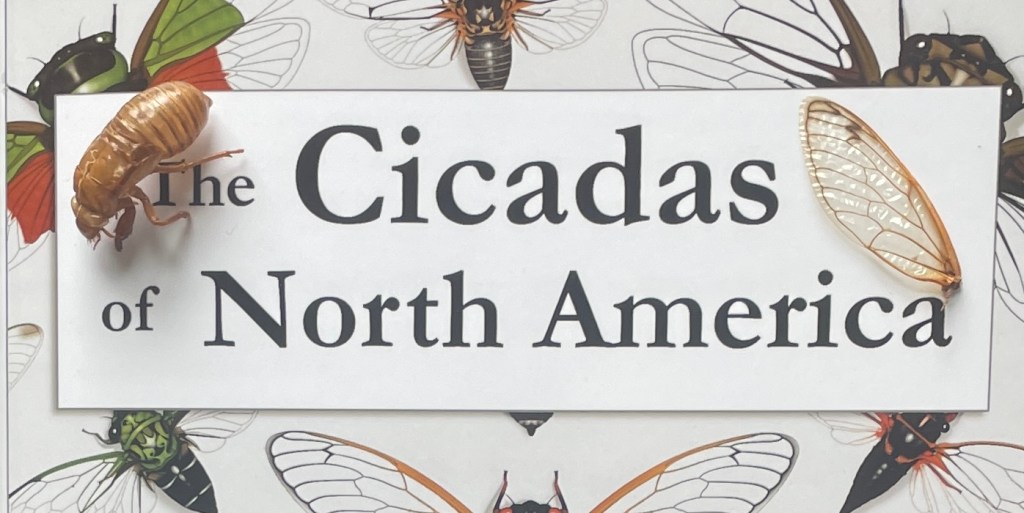
The clade Pancrustacea includes both crustaceans and hexapods. So it makes sense that cicadas taste, writes Chris Alice Kratzer, a little like shrimp, albeit “somewhat nuttier and earthier.” This also means you should stay away from them if you’re allergic to shellfish. Evolution is nutty that way. In her new guidebook The Cicadas of North America,…
-
An Impossible Task
Heavy with illustrations, this cultural history of birds will enliven any naturalist’s bookshelf. Of course, anything approaching a complete cultural history of birds would fill many volumes and be an on-going project. It would be in as many languages as there are—and ever have been. The human/bird connection goes back a very long way. Was…
-
The Book of Beaver
I’ve seen a lot more beaver sign than actual beavers. Flooded areas, dams, lodges, and especially gnawed-off tree trunks: beavers leave a lot of signs. Castor canadensis wrote themselves across most of the continent before the fashion for beaver felt swept over from Europe. There, the native beaver, Castor fiber, had been mostly trapped out.…
-
An Ology of Ornos
When I was a boy, I lived near the entrance to Hades. Lago d’Averno north of Naples near Cumae was where Virgil located an entrance to the kingdom of the dead. I listened hard for the baying of the three-headed dog Cerberus, but never heard him. The round lake—it’s a flooded crater—turned dark red in…
-
Wallace 200
I’m a big fan of the cover of James T. Costa’s new biography of Alfred Russel Wallace, who was born two hundred years ago in Wales. Most biography covers would of course go with a picture of the subject. In this case: yet another bearded Victorian. Wallace certainly sported the ample facial hair of his…
-
Summer of Wasps
I don’t think it’s a coincidence that these three recent books about wasps were all written by entomologists. The business of science journalism, non-scientists interpreting the often obtuse communiques in scientific journals, is roaring, but wasps really need some loving professional attention by people who’ve spent their lives among them. Wasps, after all, are the…
-
Wild Sounds
While reading this, I heard it was nominated for a Pulitzer. Great news, because this book about the evolution of sound needs its profile raised. It’s an utterly fascinating and necessary read. Life and sound are intimately wrapped together over millions of years. This is a book covering the soundscape from syrinx to larynx, from…
 Backyard and Beyond