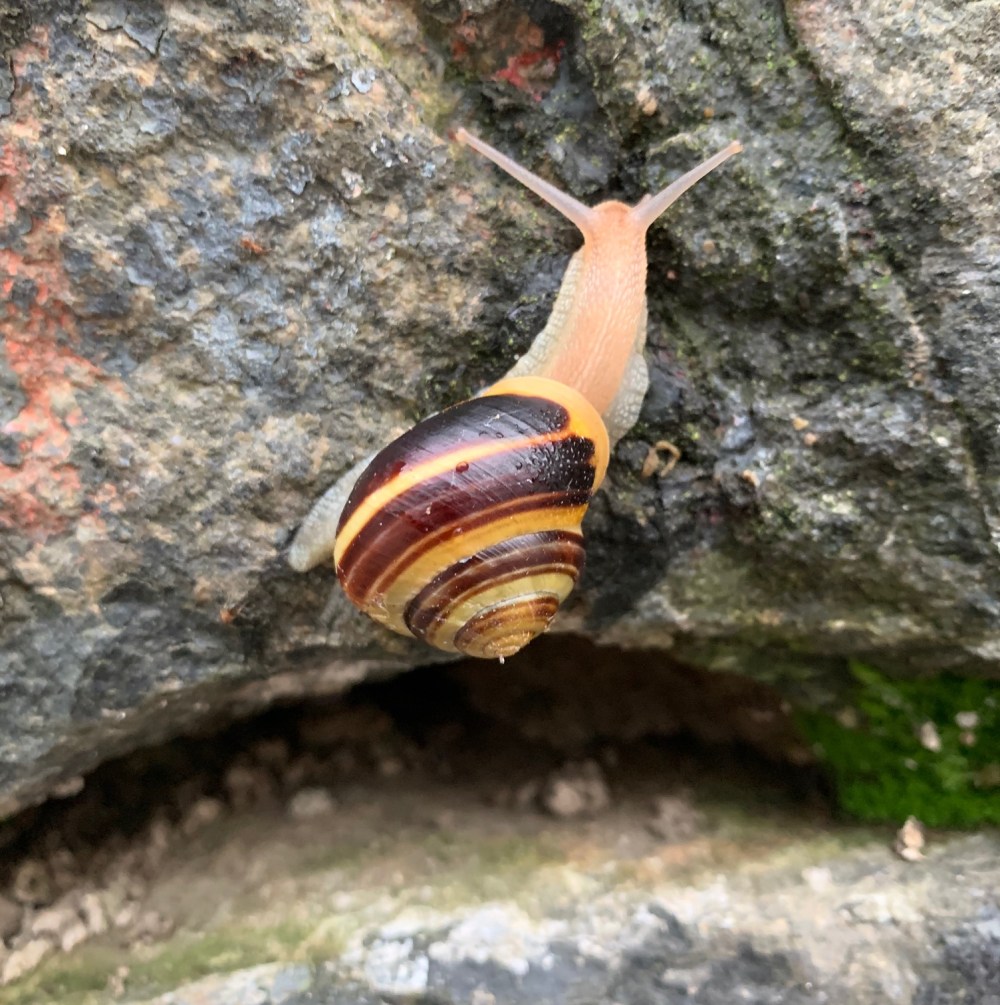
Snails are hermaphroditic so perhaps it is not surprising that the German word for snail, Schnecke, was masculine in Middle High German but became feminine in Modern High German. Snail in German, French, and Latin can be slang for vulva. Hegel thought snails upset taxonomic order; he presumed they reproduced body parts like plants.
There’s a famous snail in an Annunciation, but the iconography of Mary as ever-virgin snail was not at all a common one. This snail is, in fact, outside the space of the painting looking in, like me, like you.
Old English snaegl, from snag-/sneg- meaning to crawl. The twisty road to Weimar was called the Schnecke.
“Goethe’s own disquiet about snails arises first and foremost from the realm of the erotic. His fantasies of snail seclusion mirror the contradiction inherent in libertinage: the libertine pursues, but the relationship is asymmetrical because he will have perceived any counter-pursuit as curtailing his freedom—which means he can at the same time be on the hunt for the snail and feel persecuted by the snail.” Barbara N. Nagel, “Goethe’s Stalker Snails” (Feminist German Studies Fall-Winter 2020, Vol 36 No 2.)
From the end of the 13th century into the first half to the 14th century, man versus snail combat becomes a theme of marginal illustrations in illuminated manuscripts. First in North French, then Flemish, then English, this marginal motif depicted a man (usually, but in at least one instance a woman) fighting a snail.
The cowering snail, hiding in their shell (house, castle?), some even with a door (operculum), was a long time metaphor for cowardice. “Once established as a symbol of illusory courage, the snail became a creature to be hunted down and destroyed,” wrote Lillian M.C. Randall (Speculum Vol 37 No 3, July 1962), “Confrontation by a snail therefore, represented a test of moral fortitude.” (Sir Gawin and the Snail: how did Monty Python miss this comedy gold? “It’s just a snail!” “Just a snail, man? Have you nae seen its radula scrape the flesh off a man in no time at all?”) The Roman de Renard lists the weapons used to combat snails: sticks, maces, flails, axes, swords, and forks—the last especially, one presumes, favored by the French.
“Holy the whorl and the breath that wells there,/The shell’s shape fixed in unfurling, and the slow/ Worm within.” W. S. Merwin, “Snail.”

 Backyard and Beyond

Leave a reply to gleaming6a974aa938 Cancel reply