I spend a fair amount of time around wasps and bees. Sometimes they get in my face, but in all these years I’ve only been stung three times: 1) on the hand by a Honey Bee in a Lower East Side community garden because we were coming for her honey; 2) on the ear lobe by what I think was a wee Scots Honey Bee in Edinburgh, for reasons unknown but probably just a fateful crashing together on the south side of Arthur’s Seat, near where a pint and sticky toffee pud at the Sheep Heid soothed the outrage; 3) in the middle of the back by a Vespula yellowjacket that had gotten trapped in a car in a Brooklyn parking lot one Labor Day. Zhazam! that was an electrical bolt, and though it left a silver-dollar-sized hotted-up red-zone for days, the pain was short-lived.
I see no reason to intentionally repeat these performances. For that we have Justin O. Schmidt. Something of a stuntman as the “man who got stung for science,” he’s the creator of a scale of pain from stinging insects. (Michael Smith went even further, with three Honey Bee stings on 25 locations on his body [yup, including that] over six weeks.)
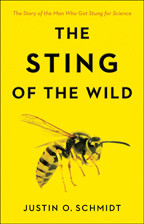
Schmidt’s The Sting of the Wild is anything but a stunt, however. It’s a fascinating exploration of stings in the insect world and how we jumped-up apes react to them physiologically and emotionally. And, ultimately, evolutionarily.
“Stinging insects win the emotional fear game. We are afraid, if not outright petrified, of stinging insects, yet we fear not smoking, diabetes, and other many-times-more-dangerous and preventable aspects of life.”
Velvet ants, which are actually wasps, have some of the most painful stings, but their venom is some of the least toxic. This means they hurt, but “Cow-Killer,” one of their common names, is quite an overstatement. As it happens, there’s a lot of overstatement in sting wortld. But it is true that some stinger mechanisms are autonomous: they keep pumping venom when separated from the body of the insect. Honey Bees are the best known of these; the act of stinging is suicidal, because the barbs on the stinger lock it in the victim and the retreating bee rips apart when she moves away. All for the collective.
The Schmidt Scale runs from 1 to 4. Apis melifera, the Western Honey Bees, has a good solid punch, scaled at 2, which is a lot worse than a 1. (These are average because stings can feel differently depending on where you’re stung, how well the insect aimed, and how long the stinger got to pump in the chemical cocktails they use to defend themselves). Tarantula Hawks and Bullet Ants are some of thethe most power stingers at 4s. Quite a few of the big, bad wasps that fill this blog are 1s or 1.5s, meaning they are essentially bluffing.Since stingers are modified ovipositors, only females sting; so males are always bluffing, though some have psuedeostingers that can jab if not much else. You get a good sense of this in Prospect Park in July when one side of the path is a lawn filled with zooming Cicada-killer Wasps and the other side is a lawn packed with day-campers.
It’s generally the case that social insects are stingier than solitary ones—they have more to defend. Think yellowjackets, harvester ants, Honey Bees. Tarantula Hawk wasps are an exception.
Schmidt notes that “wasp” comes from the Anglo-Saxon root “webh,” meaning to weave, no doubt from the weaving of wood fibers into nests. Oddly, though, he isn’t sure why Bald-faced Hornets are “bald” and insists the light markings on them aren’t white. I’ll give him ivory, but from a distance most read as white markings on a black body.
Distressingly, in his preface, he “begs that these numbers not be too much of a nuisance” about his footnotes. WTF kind of scientist tries to soft-pedal the notes? Which, by the way, got me back on George D. Shafer’s The Ways of a Mud Dauber, a small classic of nature writing from 1949.
 Backyard and Beyond
Leave a reply to elwnyc Cancel reply