
Grooming wasp on a leaf. Such yellow and black wasps get called yellowjackets, but that’s not a species-specific term. This one looks like it could be a ground yellowjacket of the genus Vespula. We have at least five Vespula species in NYC, the most common being Eastern/V. maculifrons and the introduced German/V. germanica, which has been in the U.S. since the 1890s.
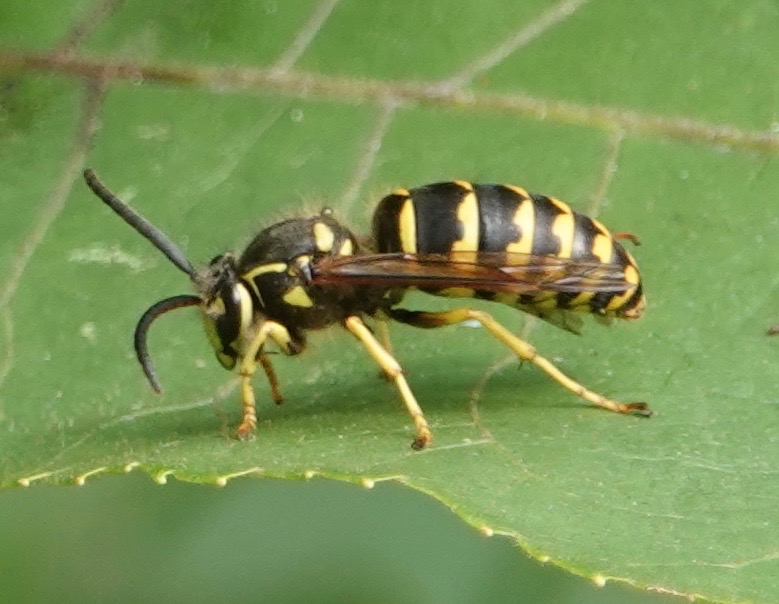
But this is actually an aerial yellowjacket of the Dolichovespula genus. (The ground/aerial distinction relating to where they usually build their nests.) The typical Dolichovespula seen here is the Bald-faced Hornet/D. maculata, which, being black and white, is unlike any other wasp seen around here. (We don’t seem to have records of either the mimicking Bald-faced Hornet Fly/Spilomyia fusca or the Blackjacket/V. consobrina.)
More rarely seen is the Common Aerial Yellowjacket/D. arenaria, pictured here. The abdominal patterning is distinctive, but subtle, and I still reach for my copy of Kratzer’s Social Wasps of North America all the time to distinguish the yellow and black species.
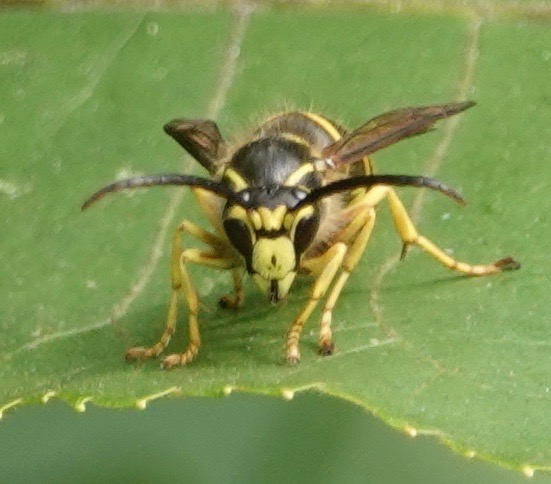
What also separates the Vespula and Dolichovespula are the faces. Dolichovespula literally means “long vespula” (vespula means “little wasp”–these are all smaller creatures than the Vespa species). The “long” part is the face, because of the ocular-malar space, that section between the eyes and the jaws.
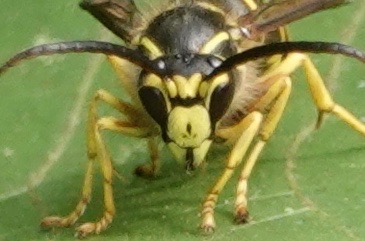
It’s very much relative, of course, but compare to the face of an Eastern Yellowjacket:
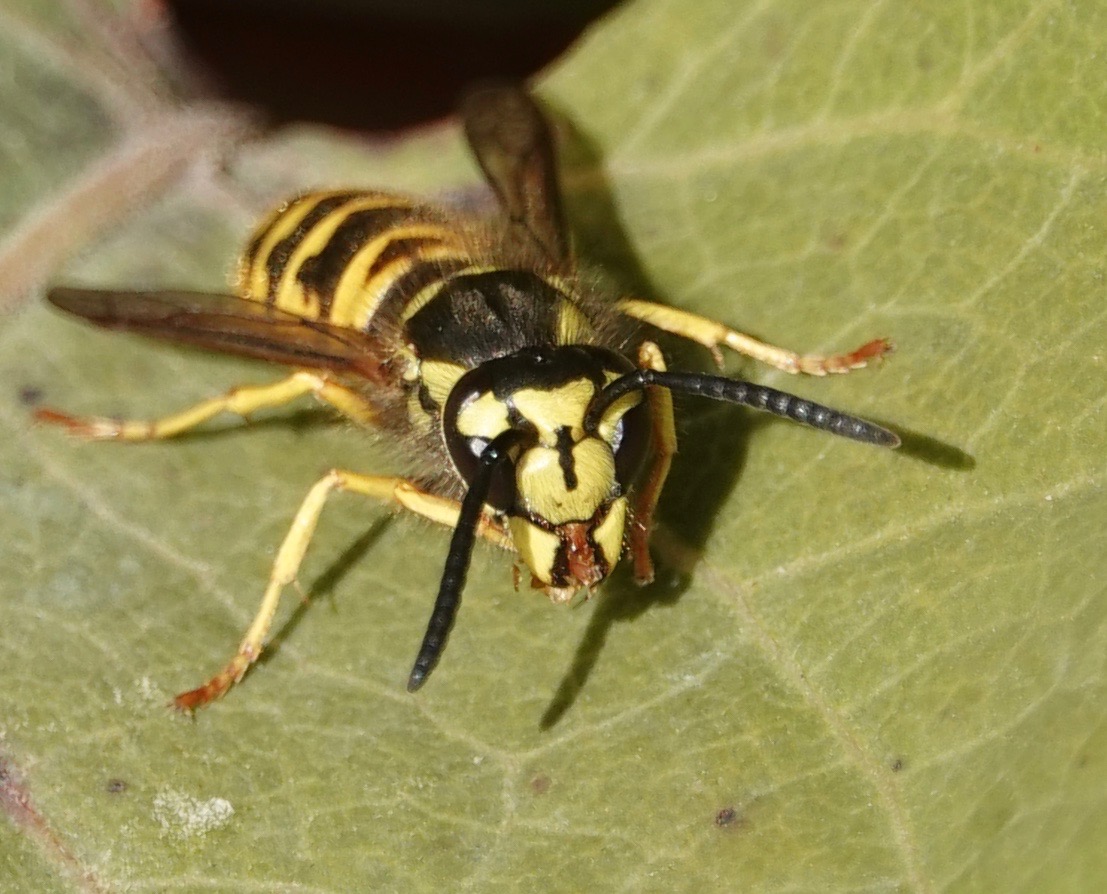
(It’s hard to get a head-on view of living wasps. The image directly above is from November 2021; of the 104 observations of Vespula wasps I have on iNaturalist, this was one of the very few I could use for a comparison.)
How rare are Common Aerials in NYC? I’ve seen one this year and didn’t see any last year. There are 39 observations of them in the city on iNaturalist, compared with 1,061 for Bald-faced. Only two nests have been observed: one in Green-Wood and one in Central Park.
*
An entomological joke I came up with:
Dolichovespula wasp walks into a bar. Bartender says, “Hey, why the long ocular-malar space?”
*
Dolicho is ye ancient Greek for long. The word is also used in botany, and anatomy. Students of perversity may recognize it in dolichocephalic, the supposedly superior skull shape supposedly found among so-called “Nordics” by race scientists and eugenicists at such fine institutions as the American Museum of Natural History in its hellday-heyday. For a great example of the horse-faced Anglo Saxon, look up a picture of H.P. Lovecraft, a man absolutely obsessed with miscegenation and “inbreeding.”
 Backyard and Beyond
Leave a reply to slonismo Cancel reply