 Bald Eagles (Haliaeetus leucocephalus) over Croton Point Park. Hugely perched in trees, wheeling in the air on their seven-feet wingspans, primary feathers sticking out like fingers, or powerfully, but not super-speedily, rowing through the air. I was reminded of the giant eagles in Tolkien, deus-ex-machina-ing over and over again to pull Hobbits and wizards out of the fire.
  In John Bull’s Birds of the New York Area, of 1964, Croton Point was “by far the best place in winter to observe Bald Eagles.” In 1951, 18 were seen there on a single day. But the numbers were plummeting. Shooting, hunting, and egg collecting, once a popular hobby, had taken their toll (for instance, Bull cites an 1844 report of 60-70 eagles shot on Long Island); removal of the large trees used as nests; and pesticides running up the food-chain to the top predator; all these were cited by Bull as reasons for the decline. (Rachel Carson’s Silent Spring was published in 1962.) The Second Atlas of Breeding Birds in New York State (2008) notes that by 1974, the species was functionally extirpated in the state, with but one known pair, which was not successfully reproducing (DDT thinned eggshells so much birds were crushing their own young). Beginning in 1976, a reintroduction program brought the birds back; this hacking lasted until 1989. And it has had some success. According to the NYSDEC, there were 173 breeding pairs confirmed in 2010.
  Good news is rare in the Anthropocene. Croton Point is once again the place to see them, right off the Metro North. Ice-bound rivers further north drive the birds southward along the Hudson (but sometimes you don’t have to go that far up-river: a friend in Riverdale photographed a dozen on the ice during the big freeze two weeks ago) searching for open water; Bald Eagles are piscivores, fish-eaters.
I was up there this past weekend, from before noon to sunset. I gave up counting at nine birds, plus one seen from the train at Ardsley-on-Hudson, since I couldn’t tell how many were duplicates, moving hither and yon on their powerful wings or soaring overhead during the day. One person I spoke to, though, counted thirteen individuals roosting by the RR bridge (where, several people told me, they watched half a dozen coyotes emerge from the phragmites when an eagle brought a fish to the nearby ice: what a sight to miss, pirates stalking a pirate!).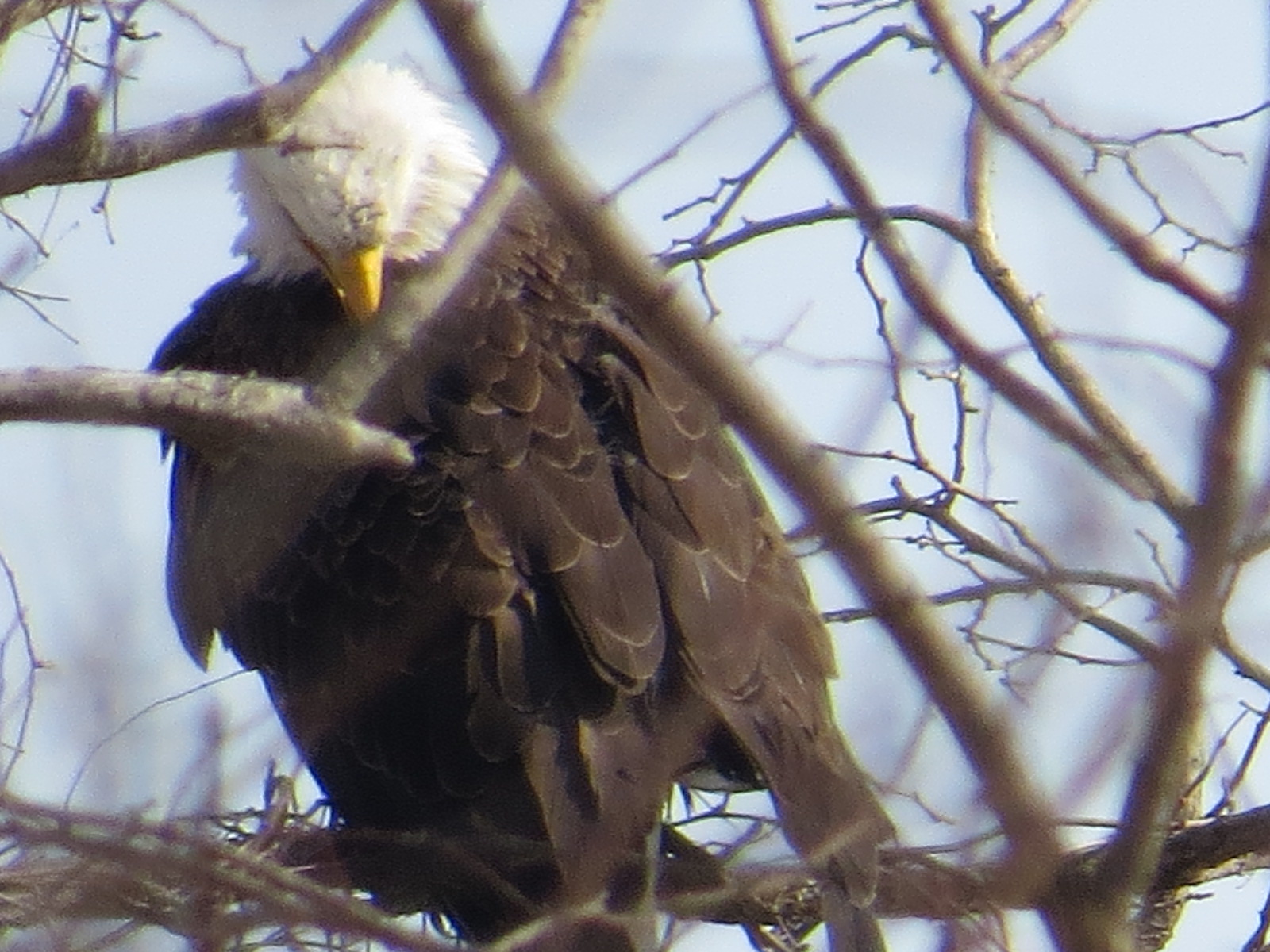 It is the fully mature bird of four or more years that has the distinctive white head and tail with dark — black from a distance — body. Note how, in the first picture above, the bird perching on the left sticks out even from a good distance.
 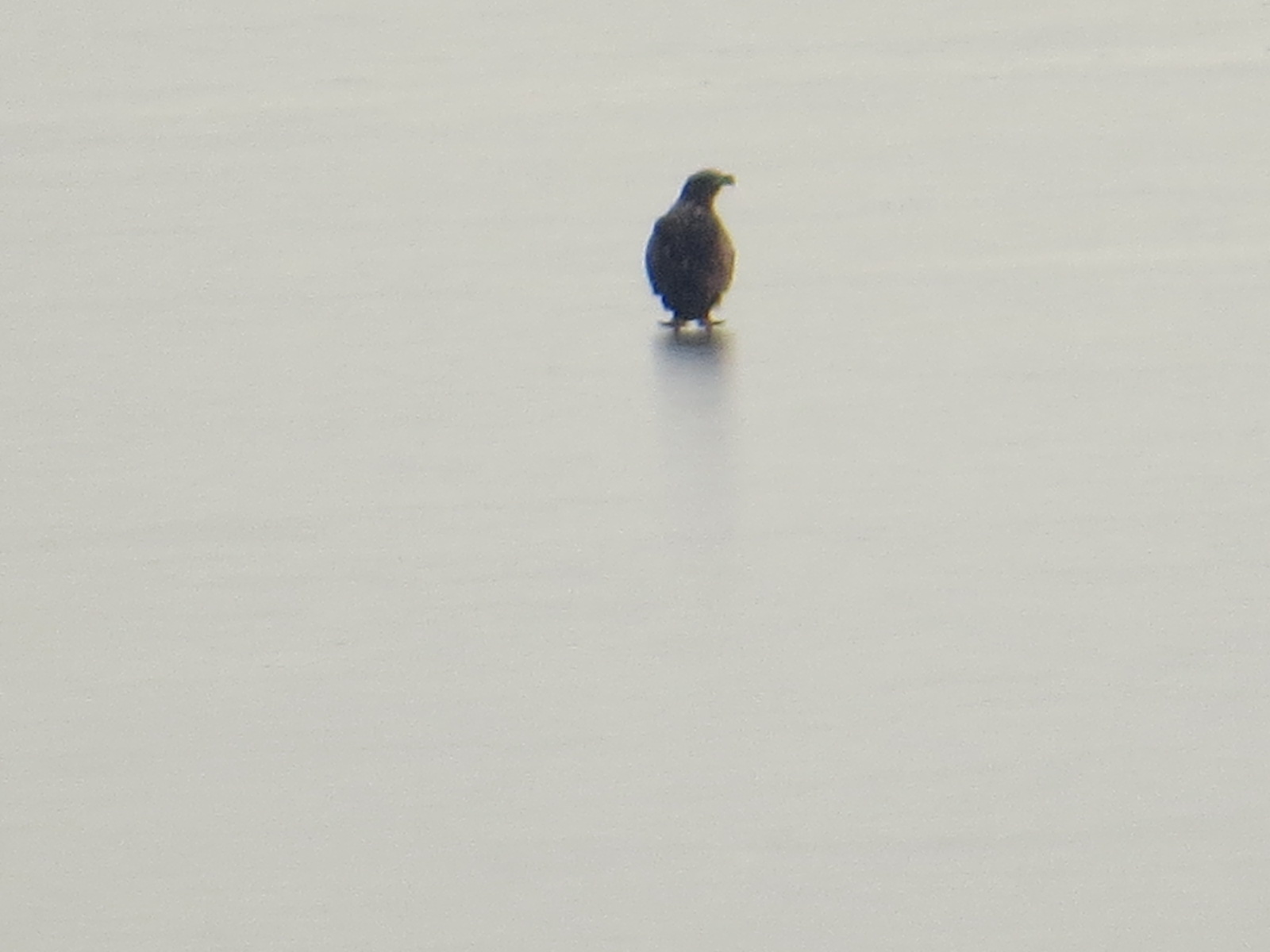 Way out on the ice, a juvenile looks dark all over. But, as in the third picture, it has some mottled lightness under the wings. Subadults will show some whitening of the head and tail. It was an all ages show while I was there.
 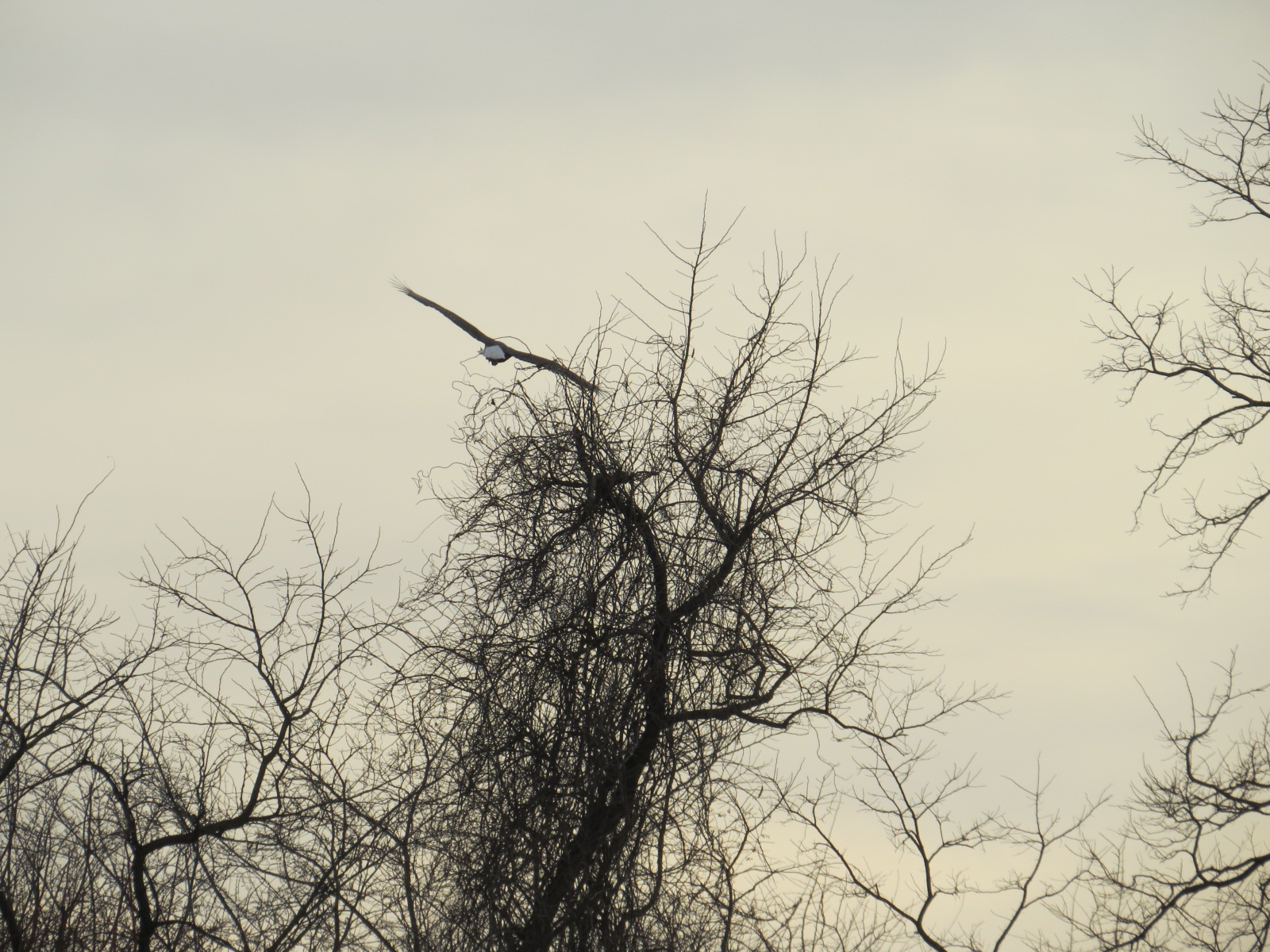 Three separate birds flew from the Point as twilight came on, one northwards along the river, the other two bayside, towards their night roosts.
As the sun disappeared, I stood up on the hill — the capped mound of a former landfill now preserved as grassland — getting colder and colder, hoping for either an aural or visual sign of owls. I heard instead the barking, howling, and yipping of coyotes, sounding as if they were just on the underside of the hill. Whoa doggies! Indeed, two little dogs being walked by a father and daughter were stilled by the sound, too. It was a magnificent and hair-raising way to end the day. [Update: check out the comments, where Elizabeth reminds me that some of our “coyotes” are actually mixes between coyotes and wolves.]
 Looking up the Hudson.
 Backyard and Beyond
Leave a comment