“And all the leaves on the trees are falling,” this time of year, some of them enormous. My friend and fellow nature blogger Melissa of Out Walking the Dog sent me a photo the other day of a very large face-covering leaf I thought might be American Sycamore (Platanus occidentalis). The very next day I was walking (mile 30 of 1000) near the corner of 6th and 6th and found some similar giants underfoot my size 9s. 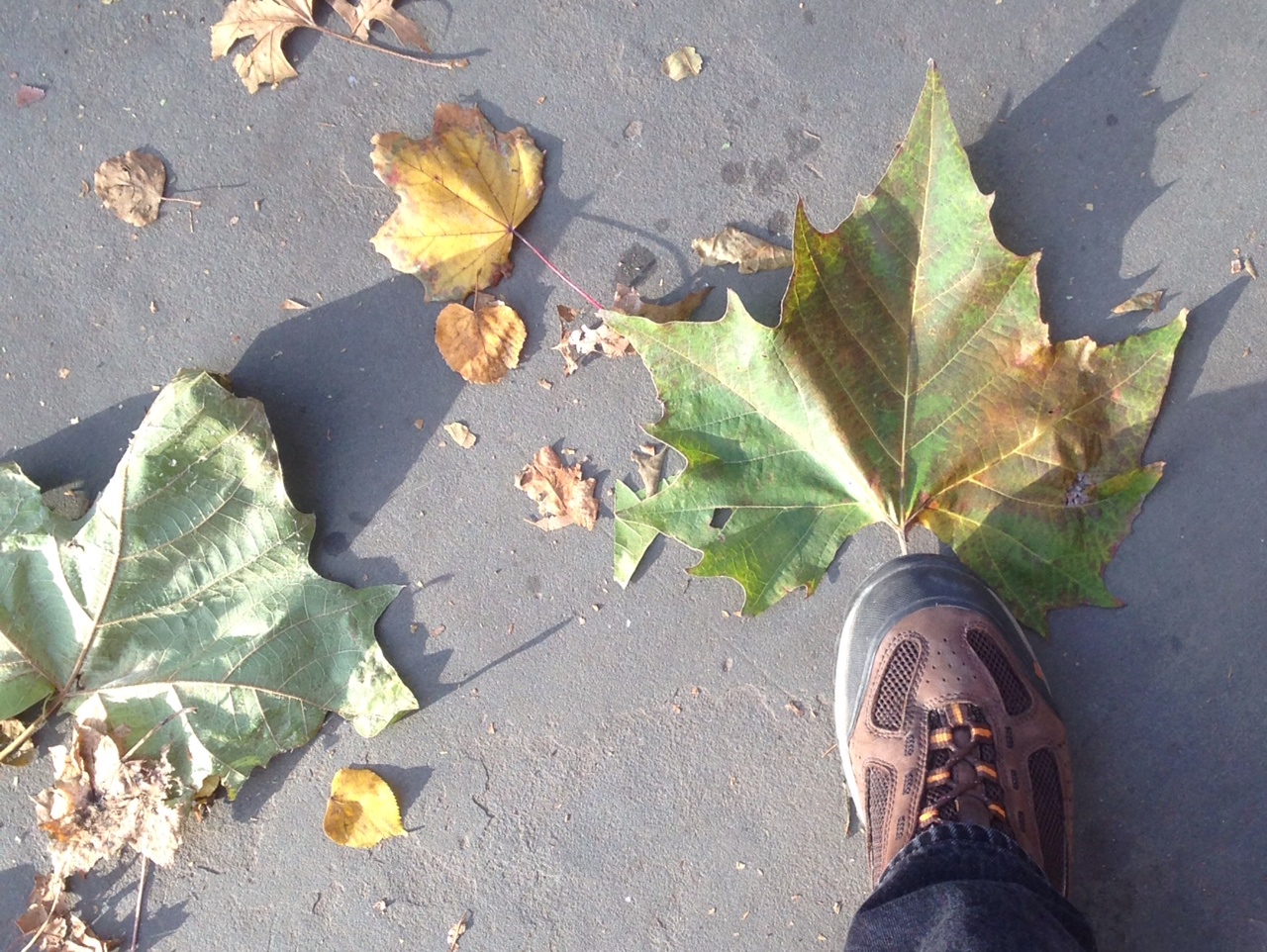
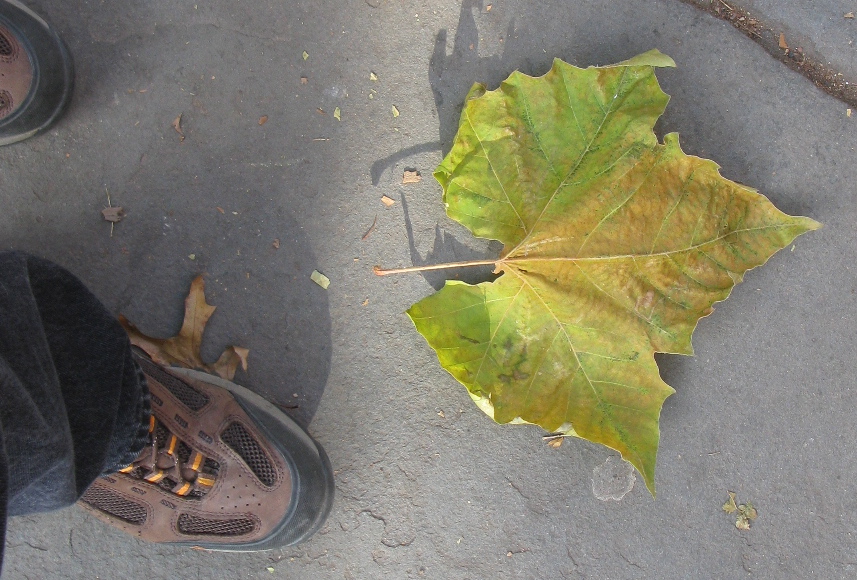
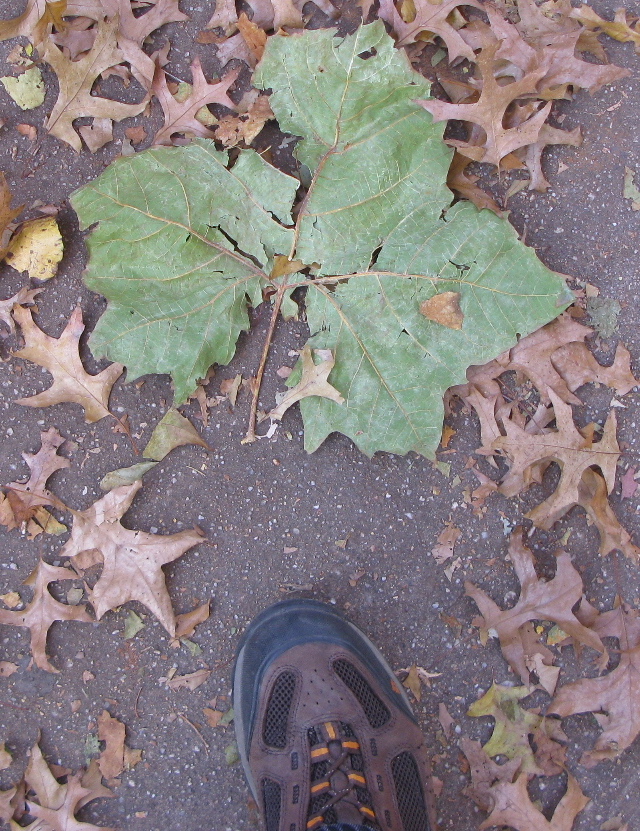 Nice coincidence. For American Sycamores, though native to the region, are rare indeed on the sidewalks here in NYC, and aren’t even all that common in the parks (extraordinary tree-mapper Ken Chaya found 22 in Central Park, compared to 1,138 London Planes there). They are not on the current list of approved, or even quarantined, city species).
This is a shame, since the Buttonwood, as it’s also known, is quite intimately tied to city history: the stock exchange was founded by 24 brokers meeting under a Buttonwood on Wall St. in 1792, their founding document known to plutocrats and their toadies ever since as the Buttonwood Agreement. In the confusing non-binomial world, this species is also just known as the Sycamore, as well as American Planetree and Buttonball. It’s one of the largest Eastern hardwood species (the range sweeps from the coast to across the Mississippi, with the rich bottomlands of that river and the Ohio being their great fastnesses) and has the largest trunk diameter (there was a record 15 footer). They have a lifespan of 500-600 years, if they’re lucky; but the wood has long been used for purposes from dugouts canoes (Petrides mentions a reputed 65′ long one supposedly weighing 9000 lbs.), barrels, butcher blocks, furniture, etc. Like all our trees, it is host and habitat to many creatures who use it for food and shelter: deer, muskrat, raccoon, wood duck, opossum, swifts, to name just some of the vertebrates who hang with the Sycamores. 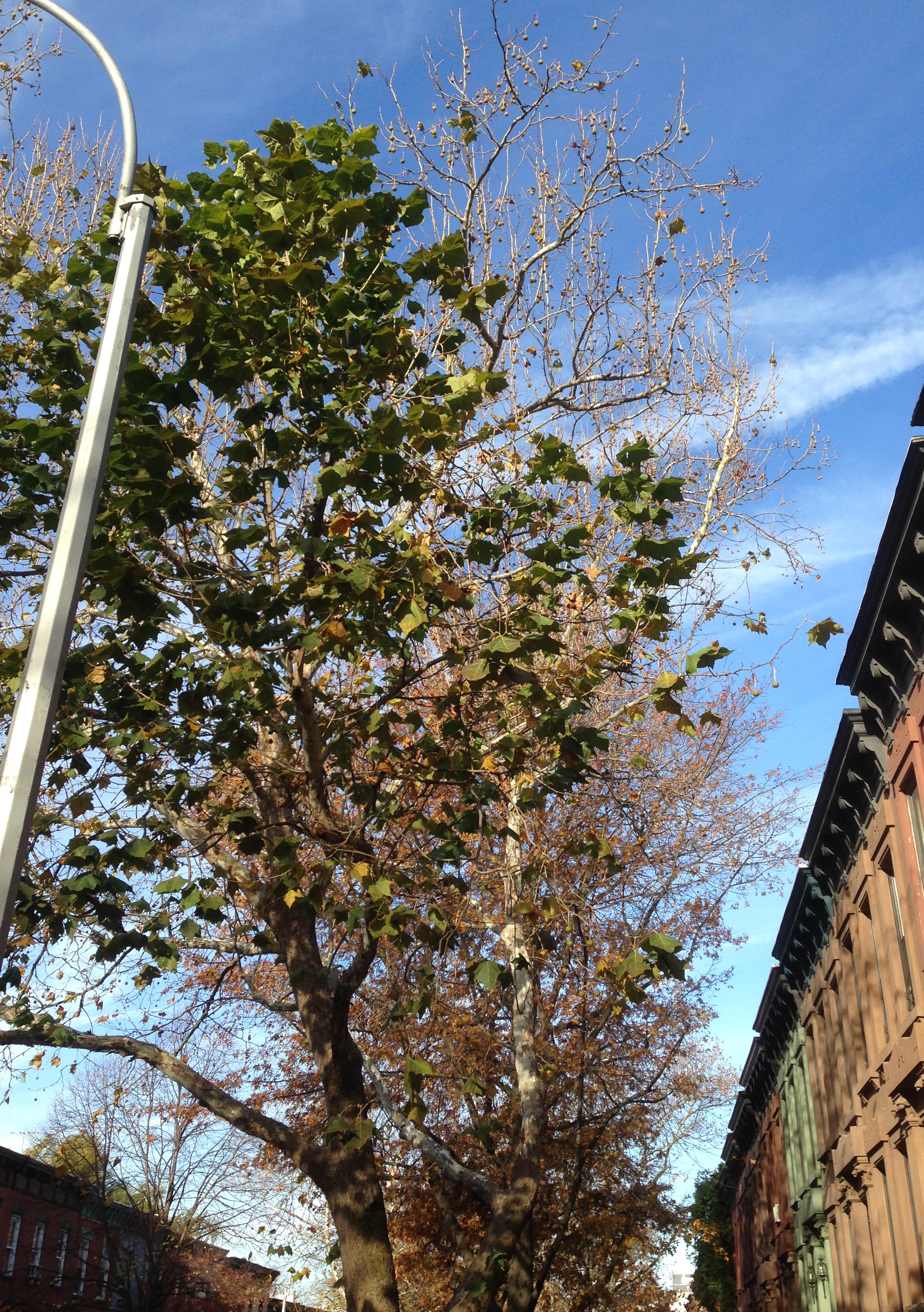 But was this 6th/6th tree a Sycamore? It had ample seed balls, one to a stalk (check), and the characteristic dark, scaly lower trunk of a mature specimen (check).
 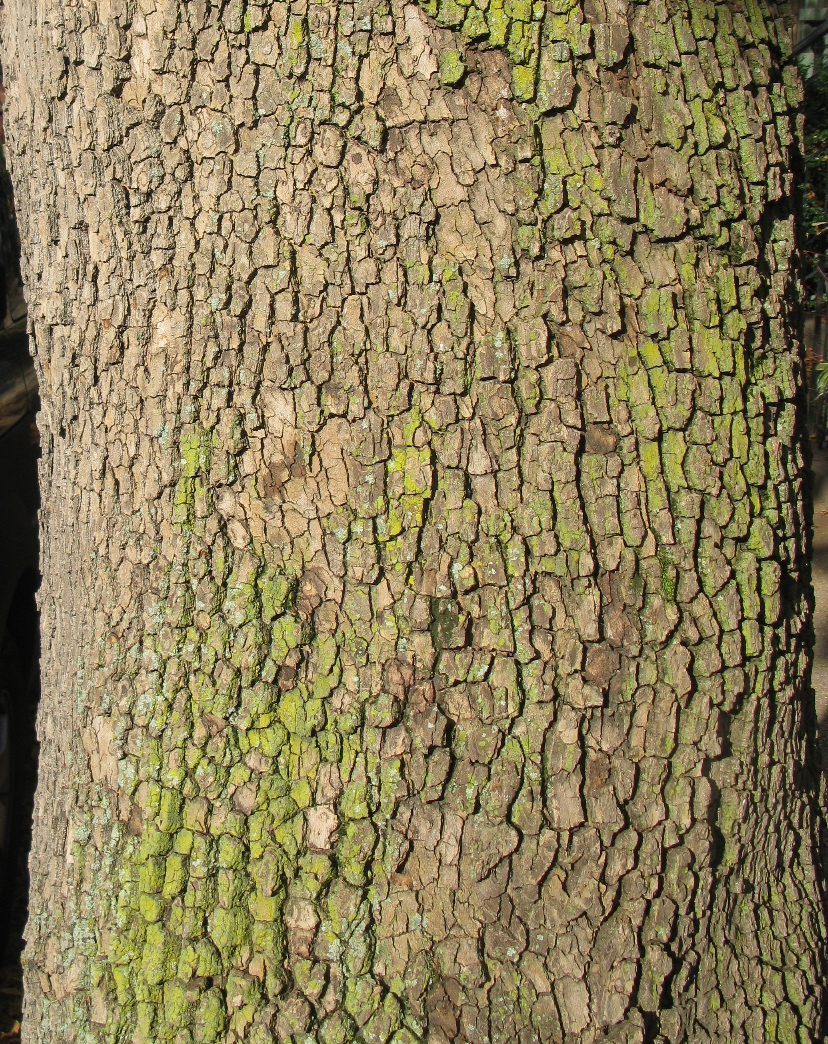 The v. similar London Planetree (Platanus ‘x acerfiolia’) keeps its smooth, pale, peeling mottled trunk from top to bottom as it ages. The London Plane, usually with two (or more) seed balls on the same stalk, is of course a common street tree, both here and Europe, although it is now no longer recommended for NYC because of the threat of the Asian Longhorn Beetle. (Though I have seen some recent street plantings of the “Bloodgood” variety.)
I have a surplus of field guides to trees: Barnard; Little; National Audubon; Petrides; Plotnik; Sibley. (Could be a law firm.) Not one has an example of leaves as above, with the deep lobe at the leaf base. Indeed, according to those books, these leaves look more London Plane-ish, again except for that deep lobe, and the size. Leaves are a bit like snowflakes, no two exactly alike; each individual tree, with thousands upon thousand of leaves, showing variation within the patterns. The leaves at the bottom of a tree can be bigger than those at the top, since they have more shade to work with while trying to capture the sun. A healthy, vigorously-growing twig can have larger leaves than a weak or sickly one. And so on. Every tree is unique. And everyone has its own story. (We hardly live long enough to tell these stories; Tolkien’s very slow-to-roil Ents were on to something.) Still, I’m fairly confident as an amateur tree hugger that I solved Melissa’s leaf mystery (her tree is also scaly barked at the base and the seed balls hang like Goring’s in the patriotic ditty), but shout out if you disagree.
 Backyard and Beyond
Leave a comment