 The famous “blackbird singing in the dead of night” is the (Common) Blackbird of Europe, Turdus merula. Ditto the “four and twenty” baked in a pie. The Blackbird is a thrush, part of the family Turdidae, like the American Robin, which also shares the same genus. The “thrush” appellation tells you to expect some lovely singing. Our American “blackbirds” are like our “seagulls,” just a general term, really, not speaking directly to a single species. We have Red-winged, Yellow-headed, Rusty, and Brewer’s Blackbirds (with the Tricolored Blackbird out west); these birds are all in the Icteridae family and can be very noisy, but are generally not lauded as charming singers. The magnificent — to me, anyway — croaking of crows and ravens come from birds in the Corvidae family; they are also famously black-feathered birds.
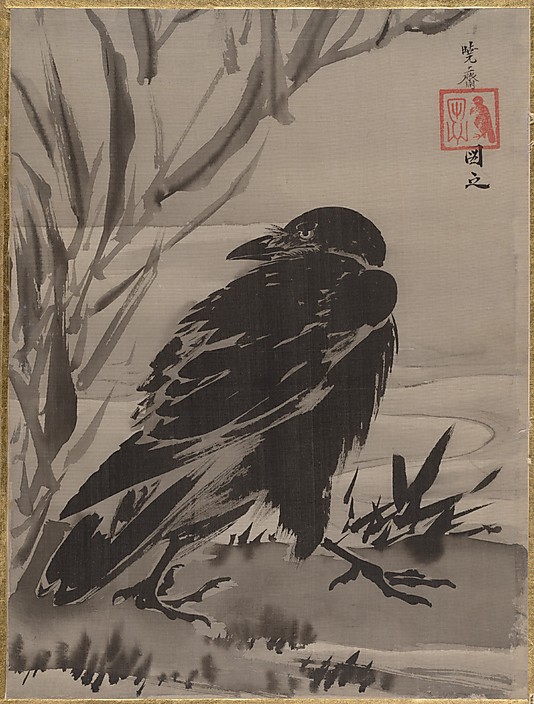
 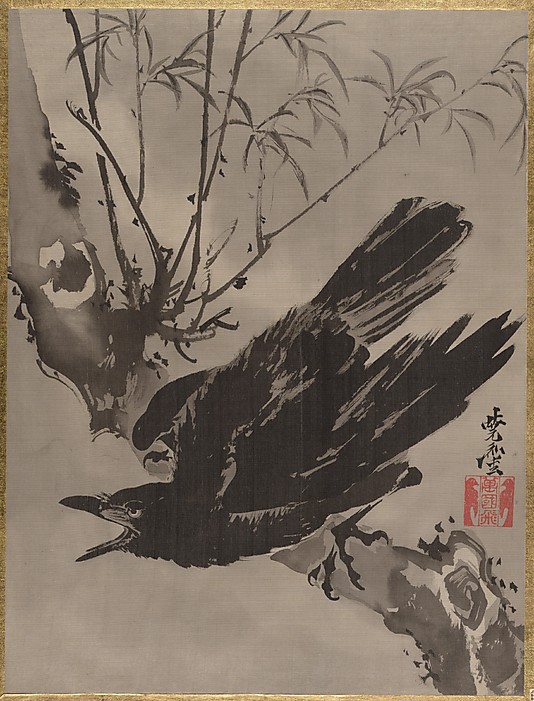 Wallace Stevens doesn’t seem to have been a birder, so the blackbirds in “Thirteen Ways of Looking at a Blackbird” may be taken as poetic license, not a particular species to be found in the poet’s Connecticut. The poem is prominently posted next to thirteen paintings by Kawanabe Kyosai in the Asian Art wing of the Metropolitan Museum until July 28, part of in an exhibit called “Birds in the Art of Japan.”
 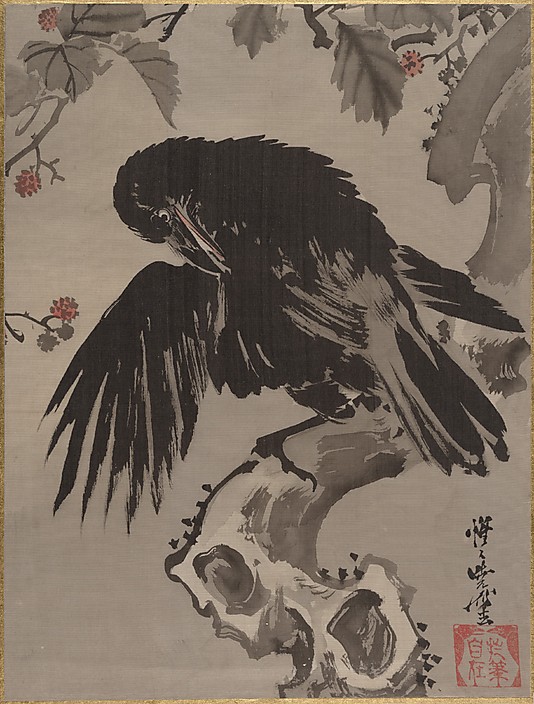 Kyosai’s black birds are crows — Carrion crows (Corvus corone, a species also found in Western Europe) by the look of them, and not Japan’s other crow species, the Jungle crow Corvus macrorhynchos — and are a revelation.
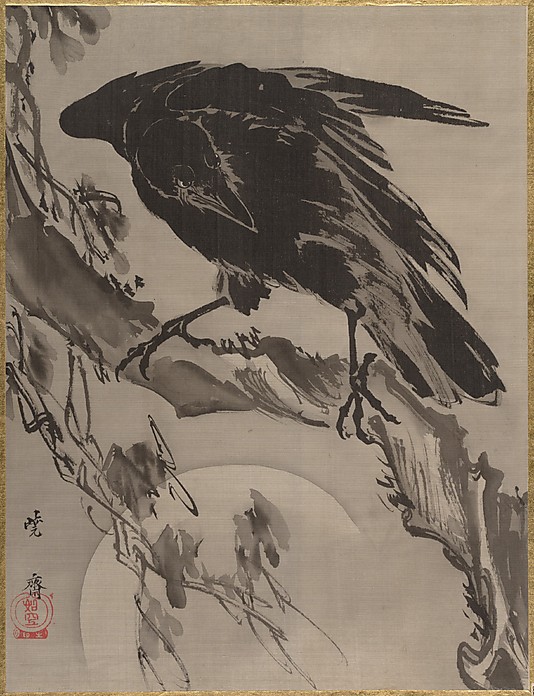 Kyosai’s sublime brushwork belies the fact that close observation of crows reveals the blue and purple iridescence of their feathers, making the whole notion of a “blackbird” even more complicated.
In 1870, our man Kyosai was arrested for satire (my kind of artist) and sentenced to jail and fifty lashes (not my kind of state). Not in the Met exhibit is his witty “Crow in Snow”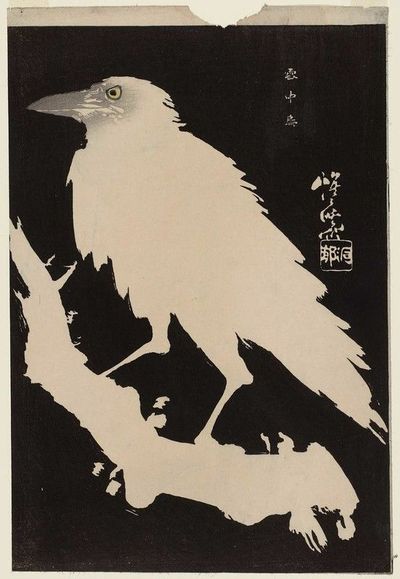
Three years ago today, Backyard and Beyond began as a blog. Thank you for coming along for the ride. New to the pool? Consider a free subscription for email delivery.
 Backyard and Beyond
Leave a reply to Elizabeth Cancel reply