We approach the first anniversary of my now constant companion, the distinguishing identifiable feature of my corpus, my horseshoe crab tattoo. So I was most pleased to notice this detail in the book, Natural Histories, I reviewed in my last post. 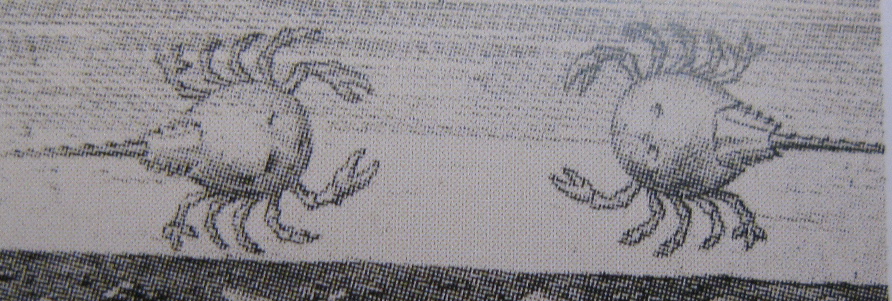 In 1590, Theodor de Bry’s opus America presented some of the first images of the New World to the Old. Bry (1528-1598) and his sons made engravings from the paintings of John White (c. 1540-1593), who was appointed Governor of Roanoke Colony in 1587. One of these shows some of the original (native) Americans in a canoe, and in the lower right corner, a couple of the underwater creatures encountered along the Virginia shore.
Is this the first published European representation of the Atlantic Horseshoe Crab (Limulus polyphemus)? It’s almost right. The tripartite body is well-rendered, but the legs are wrong, since they don’t actually extend from underneath the animal. It’s as if White and company crossed a Horseshoe with an actual crab. Though called “crabs,” Horseshoes are not members of the Crustacea.
One of the recorded Native American names for the Horseshoe is Se-ekanau or Seekanau. In English, it has been called the horsefoot crab, saucepan crab, soldier crab, king crab, and helmet crab. “Horsefoot crab” was coined by the British naturalist Thomas Harriot (c.1560-1621), who puttered around the New World (specifically that region that we’d now call the Carolinas and Virginia) in 1585 with Sir Walter Raleigh (c. 1554-1618) and thought the supposed crabs looked like horses’ feet. This is the source, via language’s slippery slope, of our name “horseshoe.” Meanwhile, the words in the binomial name actually do mean something. Limulus means a little askew, referring to the placement of the animal’s compound eyes. Polyphemus is the name of the one-eyed Cyclopes gorily blinded by Odysseus. (The much-studied and many-martyred Horseshoes have an impressive array of eyes and and other light-sensing organs and were instrumental in discoveries about vision, including human vision.)
Francis Parkman (1823-1893) wrote of Samuel de Champlain (1574-1635), who explored as far south as Cape Cod in 1604-1605: “The ‘horse-foot crab’ seems to have awakened his special curiosity, and he describes it with amusing exactness.”
A delightful show on wunderkammer at the Grolier Club revealed another of our old friends in the frontispiece illustration of Ole Worm’s Museum Wormianum, 1655, a catalogue of “one of the great attractions of 17th century Copenhagen.” 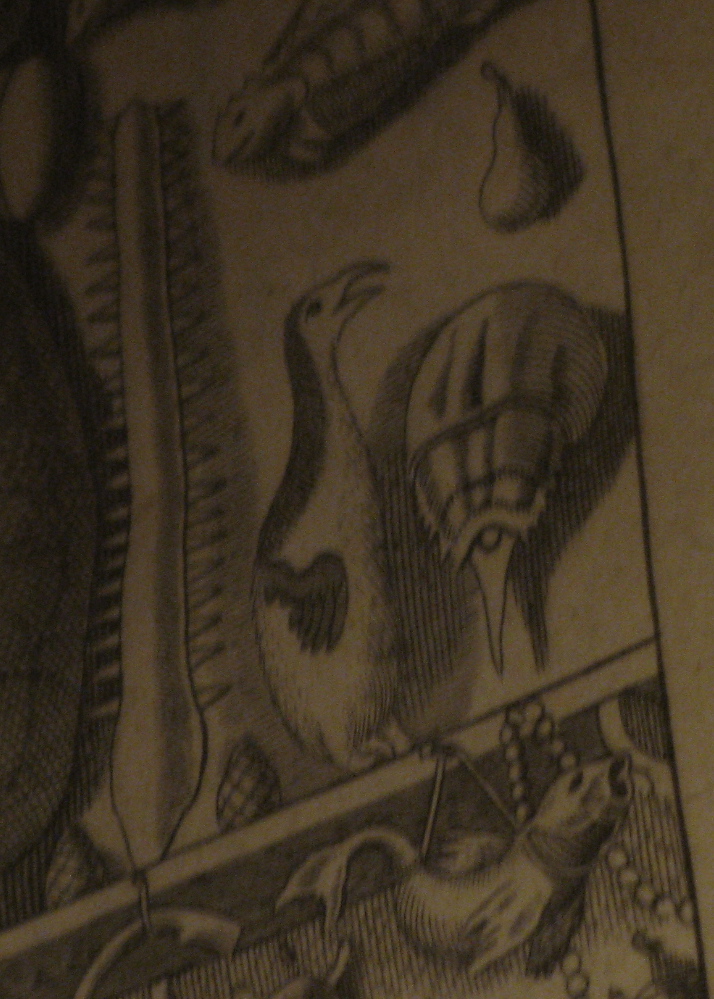
 Backyard and Beyond
Leave a reply to Rosamond Purcell | Backyard and Beyond Cancel reply