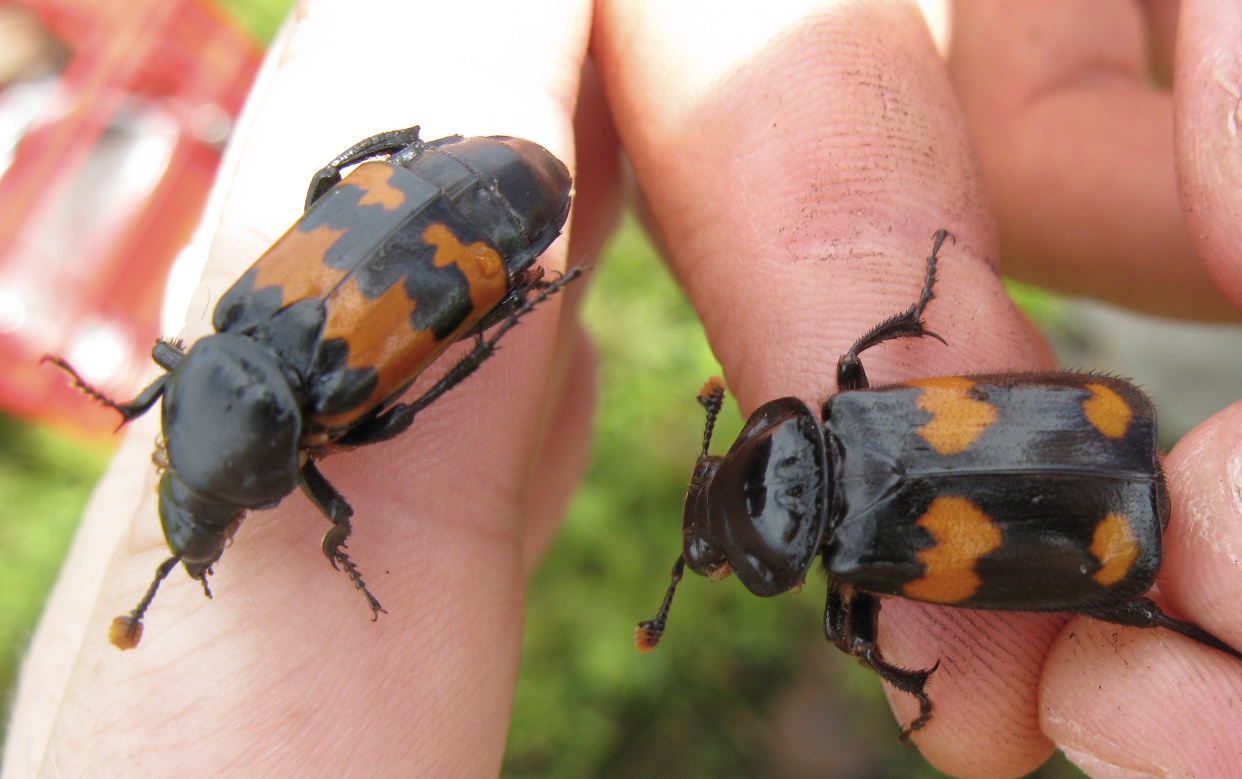
 Burying beetles, also called sexton beetles, after the church employee traditionally in charge of the congregation’s corpses, need carrion. They eat dead mammals and birds, as well as the fly larvae that feed off carrion, but most importantly they bury it with their own eggs, giving their young something to eat. Pictured above are two species of burying beetles: Nicophorus marginatus (left) and Nicophorus orbicollis (right), found in traps baited with rotting chicken on Nantucket last week.
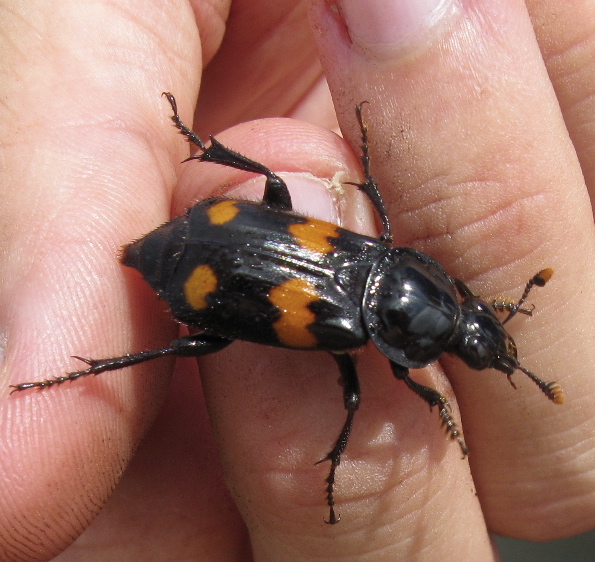 I accompanied Josh Morse of the Maria Mitchell Association to check out these profoundly stinky traps. (This is biology for the retch-proof.) The MMA is partnering with the Roger Williams Zoo to reintroduce and foster the American Burying Beetle (N. americanus), known as “ABB” to its fans.
The ABB was the first insect placed on the Endangered Species list. It is the largest of our carrion beetles (up to 1.5″, nearly twice as big as these) and was once found throughout the northeastern corner of the U.S. and Canada. But the species is now largely confined to a few Midwestern states. The only place on the East Coast ABBs can now be found is Block Island and Nantucket.
Josh didn’t find any ABBs on this trip, hence no pictures of them here, but then these beetle do most of their work in June. And that work is the recycling of carcasses as a food source for their young. They build their brood chambers around these carcasses, and then they stick around, feeding their young. For the ABB is one of the few non-social insect species that provides care for their young once the egg laying stage is done.
The ABB’s range has been severely limited because of habitat destruction, pesticides, and bug zappers, as well as the elimination or severe reduction of large predators like bears, wolves, and bobcats. That has meant a surge in smaller mammal predators, like foxes, raccoons, and skunks, who take carrion before these nocturnal beetles can get on the job. The increase in vultures and corvids, who have benefited from road kill, has probably impacted this as well. Notably, the bird thought most prized by the ABB for its broods was the Passenger Pigeon (Ectopistes migratorius, extinct), reaped from the skies during the 19th century in the hundreds of millions until there were simply no more of them left. A fine example of how species are interconnected, and how the elimination of one can affect a whole ecosystem, the thread that unwinds the rug. Today, ABB restoration projects use quail carcasses for the beetles. This exploitation of carrion by burying beetles is an important part of the recycling of nutrients back into soil (and also helps keep the fly population down). Josh is of the opinion this is the reason blackberries and low bush blueberries do so well in the trapping area, which was in the Miacomet area.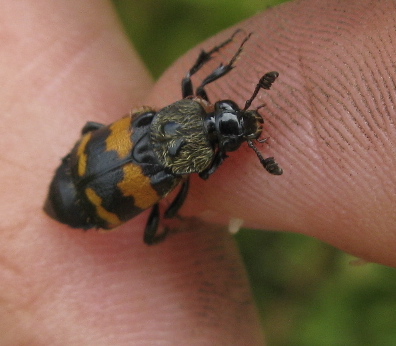 Meanwhile, there are several species of carrion beetles who like smaller carcasses of birds and mammals, and these species seem to be maintaining their populations. Pictured in this post are three of them, all, like the ABB, species in genus Nicophorus, and all showing orange-to-reddish spots on their elatra. Another carrion beetle, the American Carrion Beetle (Necrophilia americana: gotta love that binomial!) tumbled away before I could get a picture of it. All these beetles were released, by the way.
One of the things that most stuck with me from Josh’s explanation is that the size of all these beetles is largely determined by the size of the animal carcass they were raised on (and the number of young). Makes complete sense, of course, but something I’ve never considered before. The picture above, of Nicorphorus tomentosus, which seems to be a bit of a bumblebee mimic with its golden hairs and flying pattern, was of a particularly small specimen.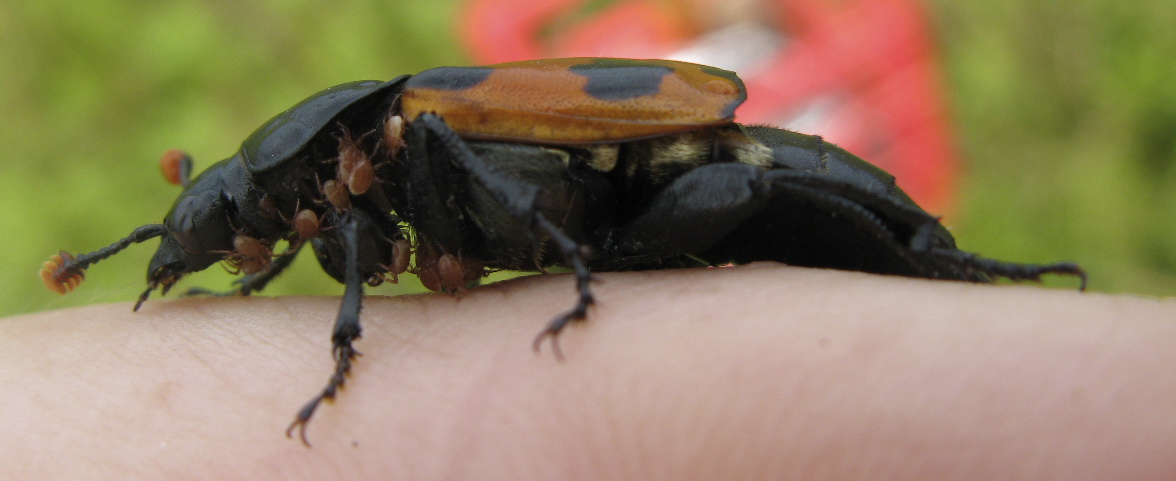 And speaking of small specimens: note how the marginatus above is absolutely crawling with mites. Click on image to get a bigger version, if you dare. These beetles turn out to be total mite-buses.
 Backyard and Beyond
Leave a comment