Two summers ago, a Black and Yellow Mud Dauber wasp built her nest in the Back 40 (inches). A new generation of these large, black-bodied wasps with yellow legs emerged in June of last year. This year I had one inside the house. Not here in Brooklyn, but at the family house in Massachusetts. This wasp was building her nest in the front door frame, between the screen and house doors. The screen door of the old manse is sagging, so there’s a gap at the top, which allowed her access. As the name mud-dauber suggests, these wasps build their nests out of mud, individual cells first, then a surrounding stucco of mud around the cluster of cells. Here she was just starting out. One of the inch-long cells had been sealed, the other was still open and unfilled.
 Inside each cell, the wasp lays an egg atop the provisions she has brought for the larva-to-come. The young eat paralyzed spiders.
 I shooed the wasp out of the house half a dozen times before I found the location of the developing nest. Regretfully, I broke it up and found these four spiders in the sealed cell. But then a couple of days later, in the same door frame, clearly an excellent location — water is dried mud’s worst enemy — another cell appeared. It’s darker on the left hand side of the cell because the mud there is still wet.
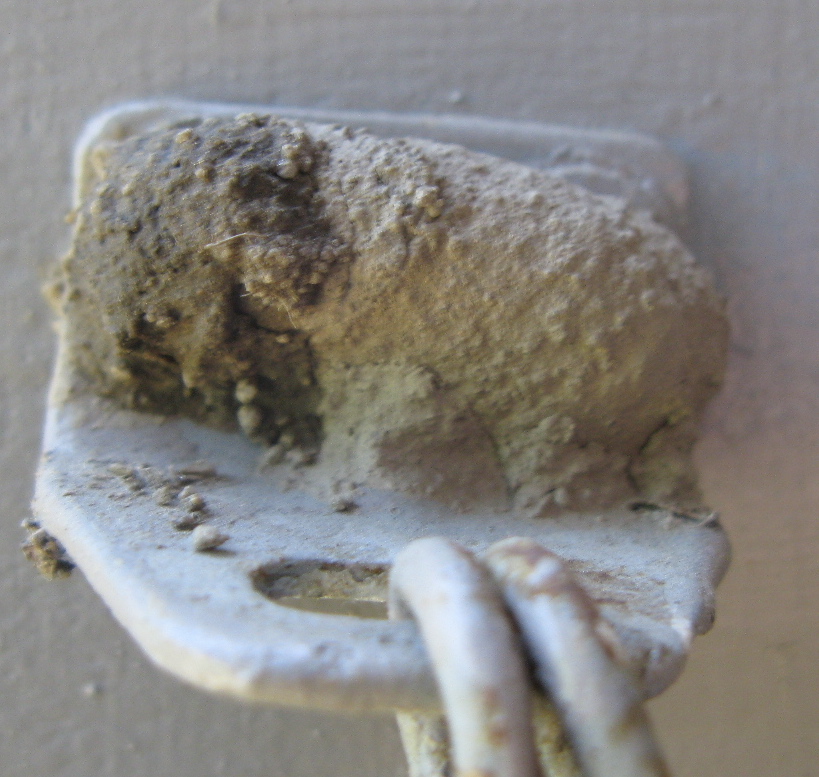 This one had thirteen spiders crammed into it.
 There are several different species of orb-weavers here. The abdomen certainly do look meaty.
 Really sorry I had to break up the housekeeping here, considering the huge amount of work this one wasp had to do. She carried bit after bit of mud — it’s been dry on the island too, but I’m guessing the construction site next door might have been a source — and hunted down the spiders on her own. Like a lot of adult predatory wasps, she herself is a vegetarian, supping on nectar. Meanwhile, there are cleptoparasitic wasps who like to avail themselves of the provisioning the Black and Yellow wasp does. Endlessly fascinating is the natural world.
Mud Cells
12 responses to “Mud Cells”
-
Hello. I’m curious to know why you broke up the nest. I’m guessing the wasps would get in the way? Great blog – found you via twitter
-
Yes, unfortunately, the nest would be in the way. If I lived there myself, I might have left her to her business. The nest would have gotten to be as big as a fist eventually. But the location between the front door and the screen door gets a lot of traffic, and the screen must be replaced with glass for winter, and then the thought of a dozen or more wasps emerging inside the house next summer, it all got complicated. Hated doing it.
-
-
I find these mud cells on the porch of my little cabin regularly.
-
Sounds like a perfect location.
-
-
[…] Great Black Wasp (Sphex pensylvanicus) is a katydid and grasshopper hunter. As with the spider hunters and others I’ve been detailing this summer, the prey provisions the nests of their young. In […]
-
[…] nests, provisioned with spiders and other delicacies for larvae to eat. Vintage ’17, awaiting the warmth of ’18. I had […]
-
[…] It’s the time of year to spot the paper nests of Bald-faced Hornets. They usually build their nests in trees. Winter weather often destroys them and/or brings them down to the ground, like this one. But this one looks to be in excellent shape. However, it won’t be reused; the colony is gone, having only lived over the course of summer. Only the queen survives. She over-winters somewhere, perhaps behind the bark of a tree.But wait. Did you notice that hole in the glass behind the bars, visible in the first picture above? Mud-daubbing wasps have gotten in to build their nests of mud. These round holes are where the adult wasps dug their way out of their mud-encased cocoons, probably last August. This one, however, looks like it was never sealed off. Nor filled with spiders. […]
-
[…] I don’t seem to have a photograph of one of these wasps. I’ve sure seen a similar species, the Black and Yellow Mud-daubers (Sceliphron caementarium). They’re particularly photogenic, or just hang around long enough for photographs. They also feed their young spiders. […]
-
[…] for their tomb-like nest. She will fill this with paralyzed spiders and an egg before sealing it off. (A cluster of these may then be clumped over in mud. The blue […]
-
[…] July 18, I found it sealed off. It is presumably stuffed with paralyzed spiders and a wasp egg. Or two: a kleptoparasite may have gotten in […]
-
How did you get rid of them?? As we have the same problem
-
Making sure the house is sealed off to prevent them from getting in. In this case, it was an ill-fitting screen door warped by the weather. She was making the nest on the inside of the screen door, which is why she just kept coming in. I made sure the door was shut and scraped the mud off. Would have left anything on the outside alone.
-
 Backyard and Beyond
Leave a comment