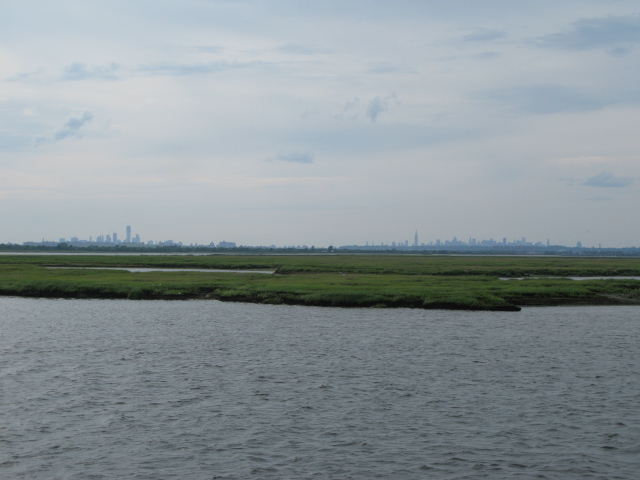
 Aboard the Golden Sunset out of Sheepshead Bay with the American Littoral Society’s Jamaica Bay Ecology Cruise. Looking across Jo Co’s Marsh towards You Know Where, which is about nine miles away as the crow flies. Speaking of flying, JFK is immediately to the right, launching planes one after the other, including the somewhat terrifying A380, which can hold 500 passengers. Jo Co’s Marsh is the largest island of salt marsh extant in Jamaica Bay. The tide is low. You can get some sense of the dense soil anchoring this marsh here:
 Actually, the marshes of Jamaica Bay have been disappearing for a while now, through in-fill, rising water, and far too much nitrogen,* most of it from the four wastewater treatment plants that ring the bay. In-fill is no longer possible, since we finally recognize the vital importance of salt marshes to life, and the city is committed to reducing nitrogen, but there’s no stopping that rising water-level… even if some benighted theocracies like North Carolina are attempting to ban the science of climate change and make illegal planning for its effects.
  A nice illustration of the way a salt marsh borders uplands. This is a portion of the northern edge of that long barrier beach we call the Rockaways, somewhere between Queens and Nassau Counties. Next to the water is Spartina alterniflora, the cordgrass that can take saturation with salt water twice a day at high tide. Right above it, looker paler in this washed out low-res image, is Spartina patens, which can handle flood a couple of times a month at very high full and new moon (spring) tides. Right above that, some shrubbery and pioneering trees like black locust and cottonwood. Beyond, further in, oaks and maples of a climax forest.
OK, some more good news. Half a century ago, you would have been hard pressed to see egrets, osprey, peregrines, and even herring gulls in Jamaica Bay. Herring gulls, and Great Black-backed gulls, the largest in the world, and Ring-billed gulls, and Laughing gulls, are now commonplace. Great egrets are now almost common, and a good early spring day in Jamaica Bay Wildlife Refuge will reveal the Greats as well as Snowy egrets, along with Great Blue and Little Blue Herons, Tri-colored herons, and Black Crowned and Yellow-crowned Night-herons. Ospreys, with their five-foot wingspan, now nest in several Bay locations, including on a boat hull in the middle of Jo Co’s Marsh. We saw three peregrines on the Gil Hodges Memorial Bridge, then another, or perhaps the same, three falcons on Cross Bay Veterans Memorial Bridge, the odd number suggesting a family. There are many more species of fish now found in the Bay then there were in, say 1975.
Oops, but don’t forget that some idiots built JFK in a marsh. Managing bird populations to avoid strikes with the endless jets is now a full-time occupation for the Port Authority. They’ve shot tens of thousands over the years, but sometimes something as easy as letting the grass grows has better results. Roosting gulls on the ground want to be able see all around, so tall grass will send them elsewhere.
*As a supercharging nutrient, excess nitrogen causes algal blooms, which suck much of the oxygen out of the water, leaving little for other plants. It’s all downhill from there for everything else in the water. Lawn-slaves in America who have nitrogen fertilizer spread on their precious, but ecologically criminal, green lawns also contribute to these dead-zones.
 Backyard and Beyond
Leave a reply to mthew Cancel reply