 I heard a few of the BBC’s History of the World in 100 Objects series on WNYC and later I gobbled up the book. One of the episodes concerned Albrecht Dürer’s famous 1515 print of an Indian rhinoceros. In the episode, I learned that the rhino, Rhinoceros unicornis, a gift to Portugal’s king, had stopped at St. Helena on the way to Europe. This island in the South Atlantic (16°S/5°45W) is a long way from anywhere, and was at the time known only to the Portuguese (it was uninhabited when they found it).
The island is famous for being Napoleon’s place of exile from 1815 until his death in 1821 (the body was returned to France in 1840). It has a few other highlights. A twenty-year-old Edmund Halley was on-island in 1677 to observe a transit of Mercury. In 1761, Nevil Maskelyne was sent there to observed a transit of Venus — a key component in the strategy of calculating the distance from Earth to the Sun, but it was, alas, cloudy.
Paternal ancestors of mine lived on St. Helena while Napoleon and Darwin were there, three centuries after the rhino stopped by. The island, at 47 square miles in size, is just a tad smaller than Nantucket. Islands run in the blood. The first Wills to arrive was Richard (1762-1833), a British East India Company mercenary who retired there. He had been baptized in Tavistock, England. Three on-island generations followed him. The last, my great grandfather Robert, was born there in 1866, and bought to the U.S. with his family in 1872.
Meanwhile, back in Nuremberg, Dürer never saw the great rhino, which helps to explain the superfluous horn on the neck and the plate-like armor hide. Most Europeans didn’t see it in the flesh, but it caused a sensation, not least because it confirmed Pliny’s description of the animal, the first seen in Europe in a thousand years. Dürer’s print was part of that sensation: it sold thousands of copies in his lifetime and is still an icon found on t-shirts, etc. Unfortunately for the great beast, it drowned off the Italian coast, like Percy Shelley, as it was being re-gifted to the Pope. Walton Ford‘s monumental triptych of the real and legendary animal just before it drowns captures a creature far way from home, entering myth: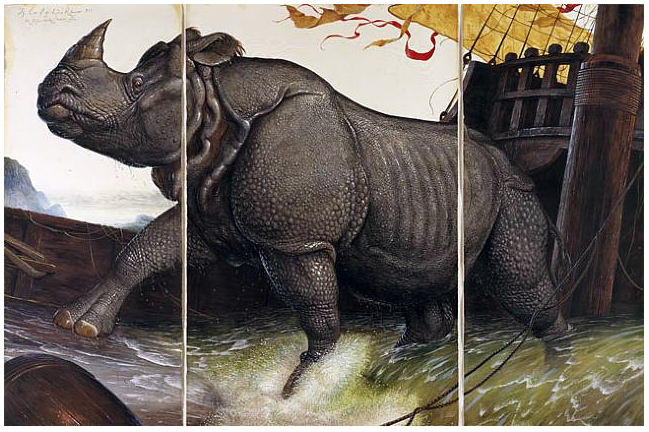 An estimated 3000 of the animals live in the wild today.
 Backyard and Beyond
Leave a reply to Regina Cancel reply