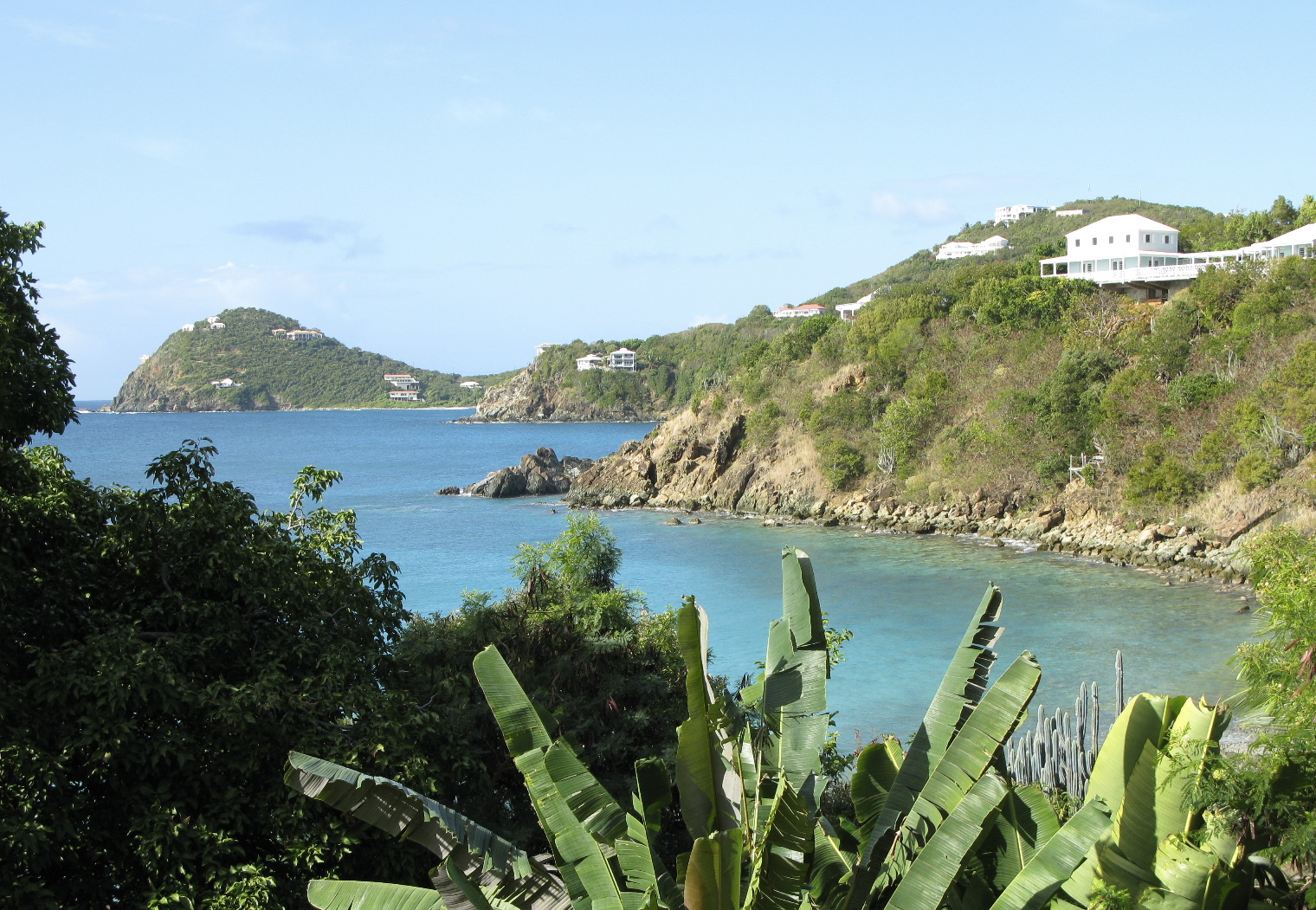
 The western edge of Klein Bay is rocky, but I scrambled about three-quarters of the way along its edge the first morning of our trip. I wanted to see the sun come up over Dittlif Point peninsula (unseen to the left in the above image). I found a nice flat rock to stand on – it was too wet from the night’s surf to sit on -and while waiting heard a noise behind me.
St. John, like Virgin Gorda, is hopping with lizards, anoles, and geckos, most of them just a few inches long. And I do mean hopping: they will often jump to get ahead of you. 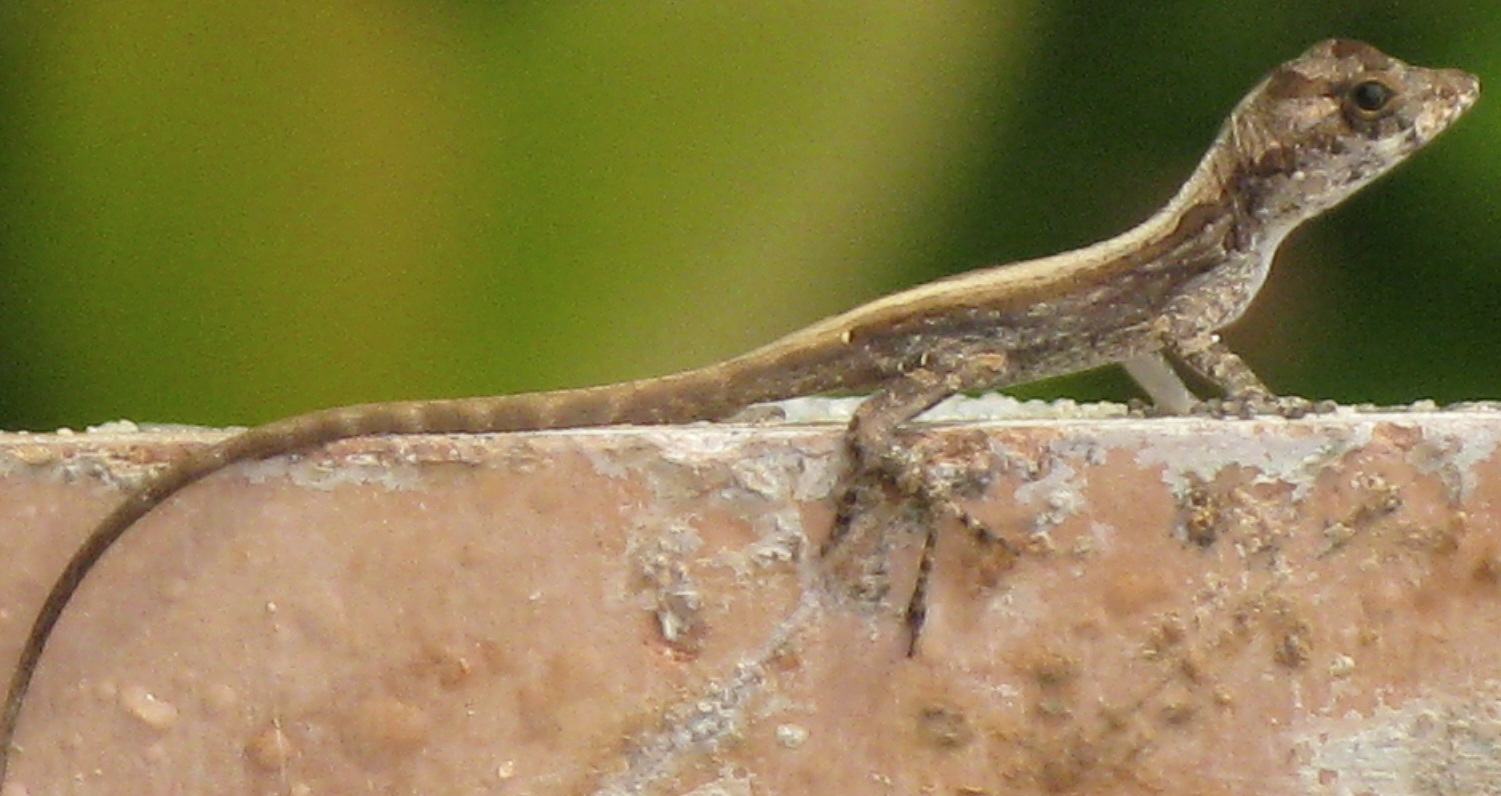 This one, for instance, was barely 1.5 inches long.
But this morning’s noise-maker was a three-foot long iguana. It was obviously waiting for the sun, too, on an outcropping a couple of yards above me.
I don’t think Virgin Gorda, which is smaller, has a drier and more cactus-dominated habitat, has any of these long-tailed reptiles, so this was my first opportunity to see one. So we spent some time waiting for the sun to crest the land, iguana and I. But just as the sun was cresting, it was suddenly obscured in clouds. I scrambled back in time to take shelter under a maho tree before it started to pour. Luckily, these tropical downpours are brief this time of year. I then found this on the way to our villa: I think it’s a piece of shed iguana skin. It looks like it came from the chin, where those large eye-like spots are. It seemed a red-letter day, and was eager to tell my crew about my finds, all before they even awoke.
 It turned out, however, that this was just the beginning of the iguana watching. We had them as neighbors, just a few feet way. Seven was the high count one day. They loved to hang out atop the trees and bushes and palms right next to the house. I saw one crossing the road slowly, dinosaur-ishly; another time I saw one scramble up a tree rather quickly, monkey-ishly. They were by the side of the roads, in trees, all over, even downtown in Cruz Bay.
 Unlike a lot of things on the island, iguanas are native to the region. The very name seems be a Spanish version of the Taino name. Though plenty fierce-looking, they are herbivores. Their common name is Green Iguana, Iguana iguana, and are most immediately differentiated from the endangered Lesser Antillean iguana by the bold stripes on their tails.
 Backyard and Beyond
Leave a reply to xrisfg Cancel reply