I live on an island. It’s a rather lengthy island, and so, unimaginatively, it’s been called “Long Island” for several centuries now. I’m on its far western end, in the once-upon-a-time city and now borough of Brooklyn, which, uh, doesn’t really think of itself as being a part of “Lon Guyland.” The reasons for this are complicated — historical, political, social, satirical — but not very geographical. For, if you head eastward from here, following either of the two terminal moraines created during the last ice age, you eventually hit the water. But the moraines continue, emerging in Block Island, the Elizabeth Islands, Cape Cod, Martha’s Vineyard, and finally, Nantucket (where, once upon a time, I graduated from high school). It was originally all one stretch of land, now divided up by the invading ocean. So there are quite a lot of similarities still.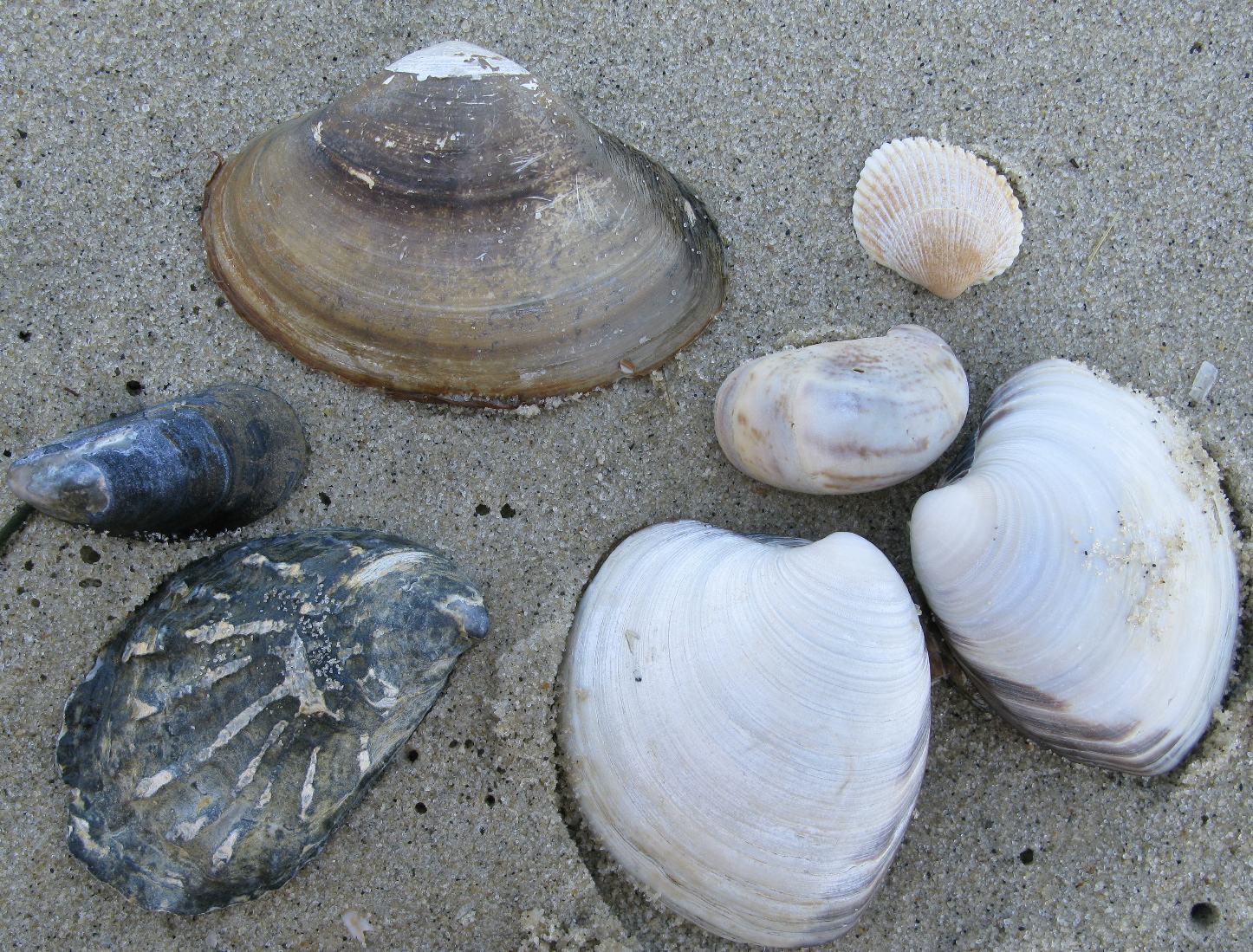 Take these typical bivalves, for instance. This picture was taken on the north shore of Nantucket, but if you comb any beaches around here (Brooklyn), you shouldn’t find these unfamiliar.
Clock-wise from the top: soft-shell clam, Mya arenaria, the “steamer clam” or, for the less polite, the “piss clam”; blood ark, or blood clam, Anadara ovalis, so called because the mollusk has red blood, which is most unusual for a mollusk; common slipper shell, Crepidula fornicata; both halves, or valves, of the quahog, or hard-shell clam, Mercenaria mercenaria; Atlantic oyster, Crassostrea virginica (the ridges on this specimen are unusual); common or blue mussel, Mytellus edulis. I found a nice example of an Atlantic jackknife clam (which we always called “razor clams,” but there’s another species that shares this common name),Ensis directus, a few minutes after I’d passed the composition above: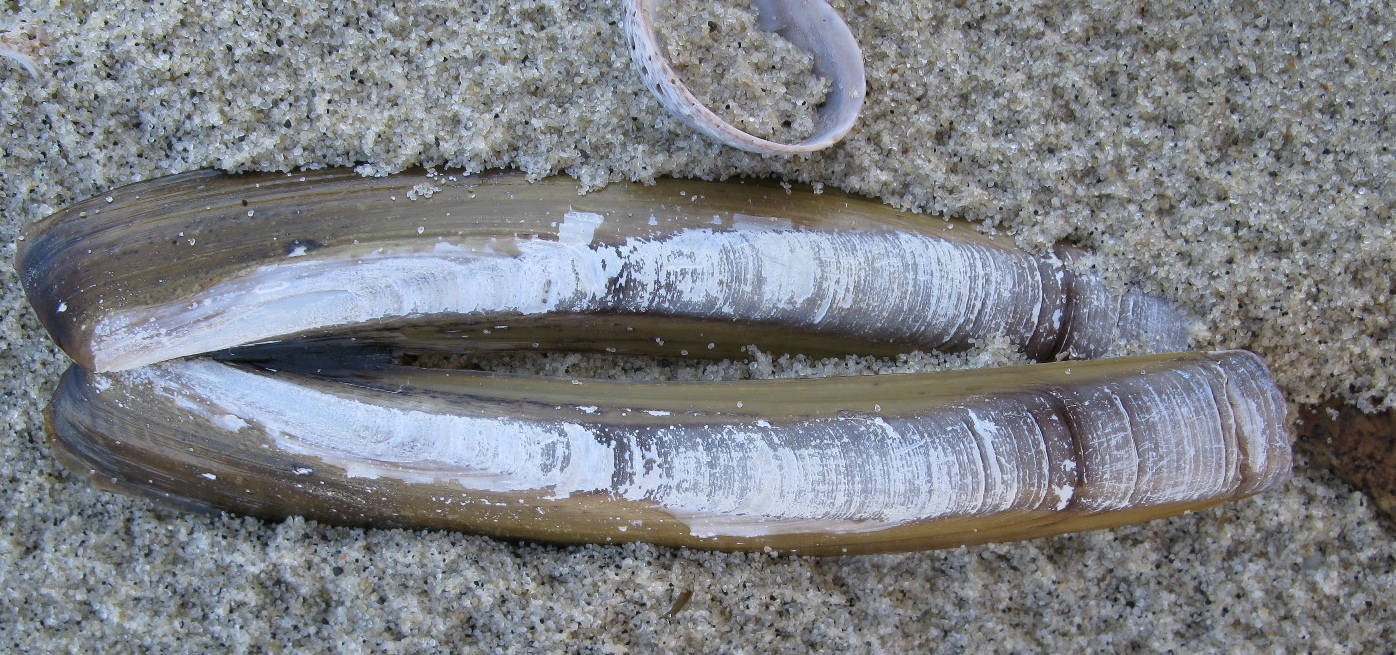 Note the tan coloring here, also seen in the soft-shell clam in the first image: when alive, these shellfish have a skin-like covering to their shells, called the periostracum. In the case of blood arks, it can be hairy looking. The material wears off as it meets the merciless exposure of the beach.
 Backyard and Beyond
Leave a comment