The “Departures and Arrivals” mosaic at the Jay St./ Borough Hall subway station (A, C, F trains) here in Brooklyn.
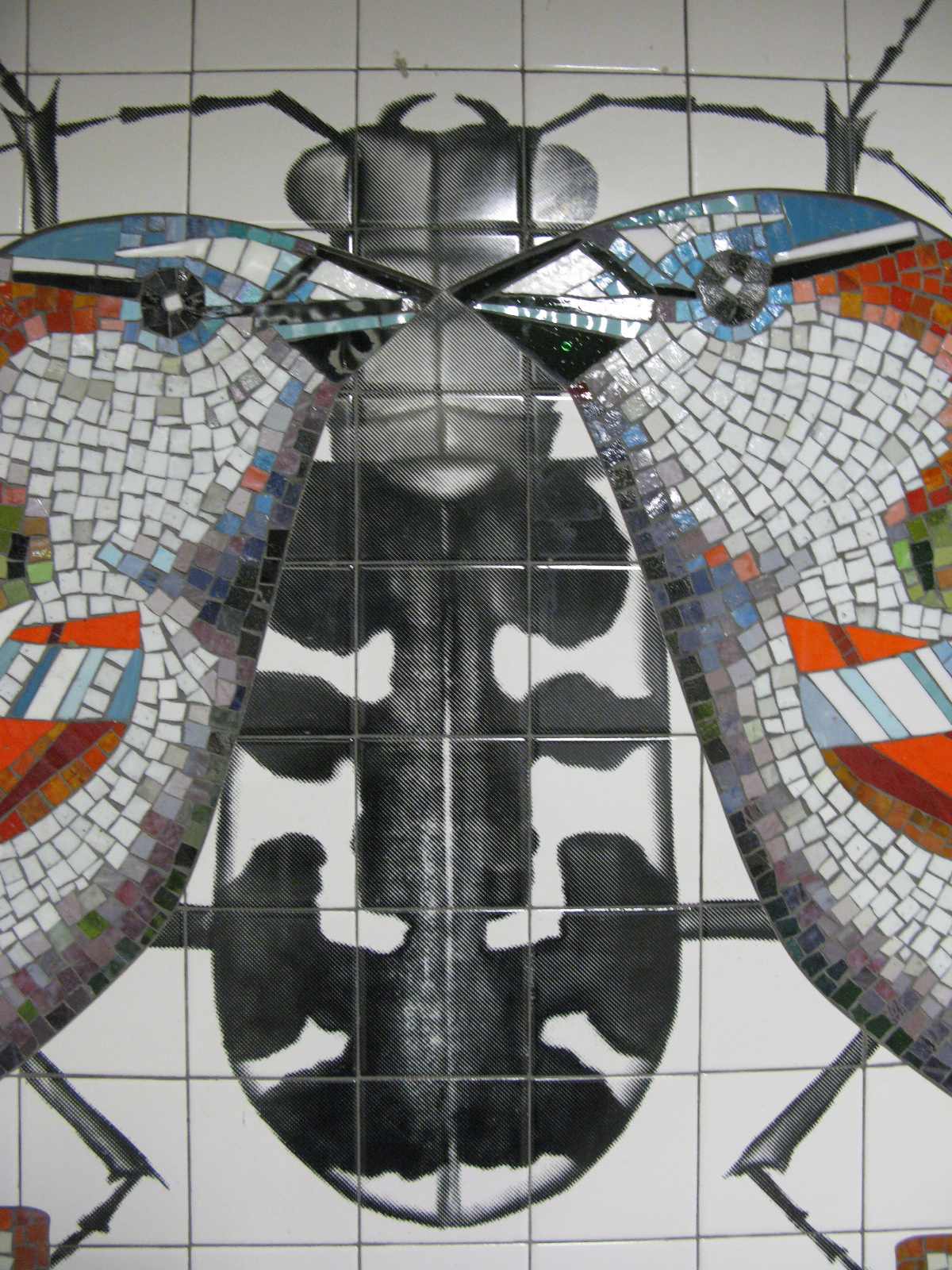 Artist Ben Snead’s notion here, as explained on the plaque, is that species come and go, just like peoples. “The artist is interested in how the natural world mirrors our local population; in both great diversity and movement to and from other places.”
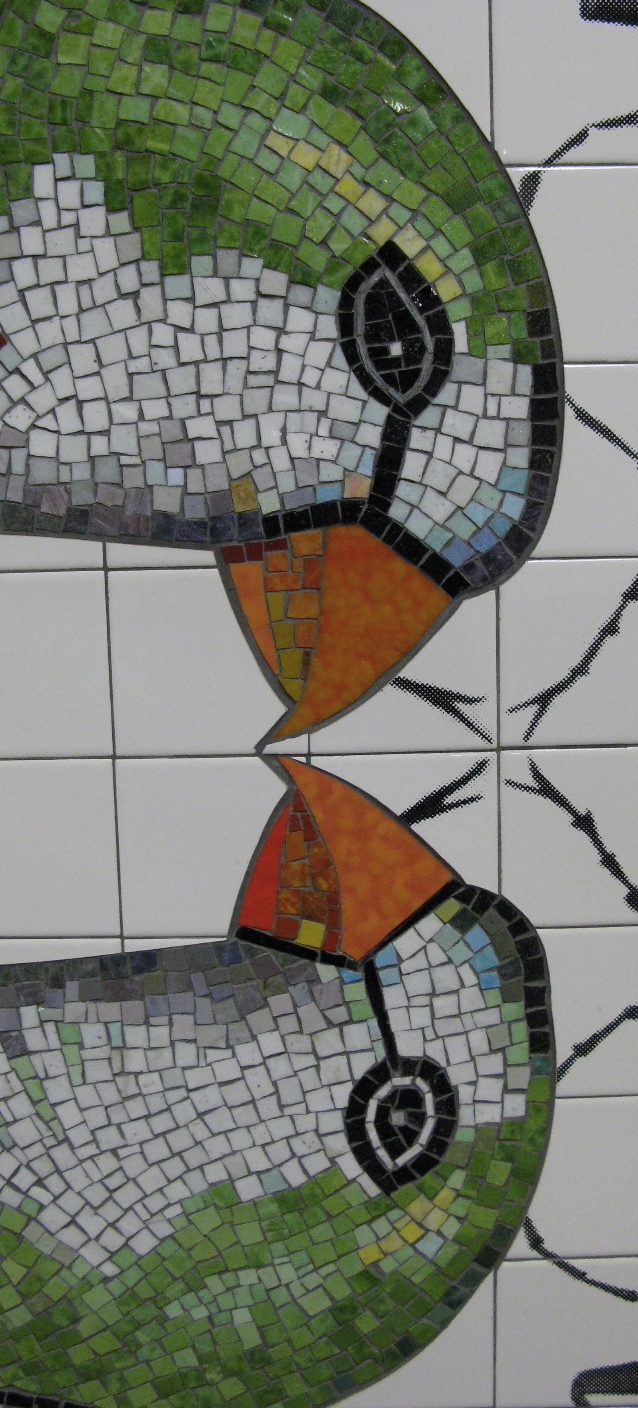
He has pictured the European starling and English House sparrow, both released in NYC in the late 19th century; the South American monk parrot, a more recent arrival; the red lion fish (from the Indian Ocean) and the Japanese koi. These are all invasive species to the region. And there is the native tiger beetle in the background — I’m not sure what species is being referred to, actually — which is on its way out (? NY state has two beetles on its endangered list as far as I could tell, and this isn’t one of them). The beetle looks like a beetle, at least, but I’m afraid the glasswork here doesn’t flow as beautifully as Deborah Brown’s sublime “Platform Diving” at Houston St. (1 train). The house sparrows are unrecognizable; the starlings are better, and the monks are at least parroty. Pity, since we city slickers need all the natural history we can get.
There’s some thin ice here, since invasive species have often been metaphorically merged with human immigrants, on the invasive = invaders theory. Snead’s celebrating, but such anthropomorphism is slippery. Brooklyn’s self-demise as a city and consolidation into Greater New York City (1898) was opposed by some ruling “native” WASPs who did not want Lower East Side Jewish and Catholic Eastern and Southern Europeans moving over the East River. Arizona’s apartheid scheme is only the most obvious of the contemporary aspects of this hateful thinking, which can also be seen/heard in the neo-nativist ravings of the “Tea Party” (the name stains American history) cohorts who want their cracker-Klanish America back.
 Metaphors, and analogies, aside, though, some invasive species do do tremendous damage to biodiversity. Starlings (l) and house sparrows (r), for instance, do not contribute to diversity; they’ve helped reduce native populations of blue birds, red-bellied woodpeckers, and other cavity nesters.
Some things have already done irreparable damage. The American Chestnut Foundation estimates that 4 billion American chestnut trees (C. dentata) were destroyed by the chestnut blight fungus (first publicized on Long Island, which suggest NYC was the port of entry) during the first half of the 20th century. There are now a few leafing stumps left, and generations who have never seen this storied tree. It’s really amazing how we have so bollixed up the world, isn’t it? This site lists the 100 worst invasive species in the world.
 Backyard and Beyond
Leave a comment