If you would like to contact me, leave a comment below. As all comments are approved, I will not publish your query if you don’t want me to.
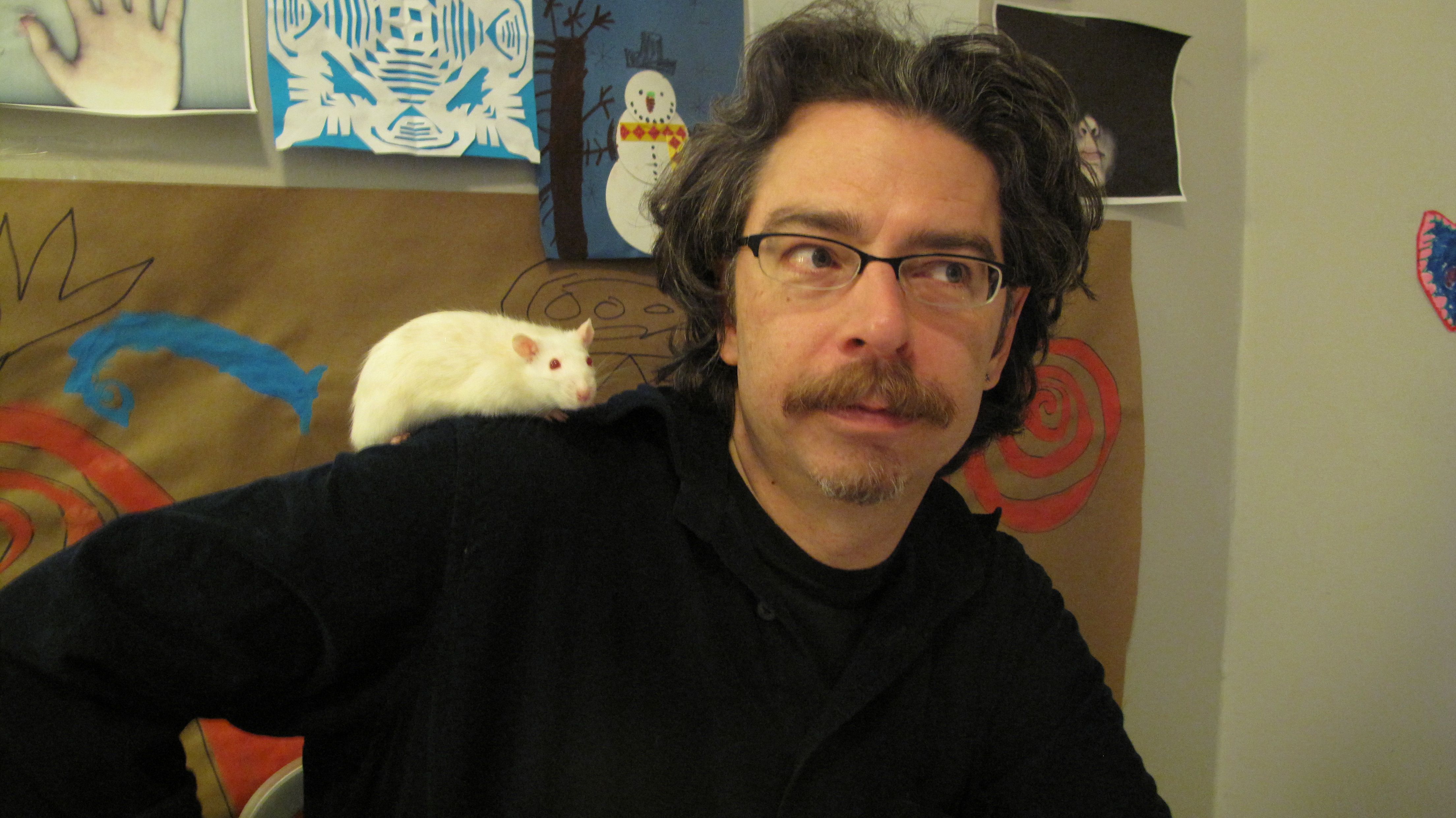
My name is Matthew Wills. I’m a Brooklyn resident who, in growing older, has returned to nature. In Brooklyn? Yes, as a matter of fact, in Brooklyn, NY, where, you may be surprised to learn, a host of life-forms are to be found. In these pages (of blog), I will be exploring the life I discover in what I call the Back 40, a small patch of concrete out back, as well as the wider range of Brooklyn and the rest of NYC, and places beyond. I am an amateur naturalist, with a stress on the amateur, so please feel free to challenge and/or correct my bogus/bunk science. I started bird watching in Prospect Park about a decade ago, a story I write about here and was interviewed about here by artist extraordinaire Zina Saunders, whose portrait of me is below. From there I branched out into trees, mushrooms, arthropods, etc., whatever catches my eye and awakens my curiosity.
Ivana Kottasová and Audrey Yoo of the The Brooklyn Ink produced this profile of me:
Nature Blogger from Brooklyn Ink on Vimeo.


Wow – Zina Saunders did a portrait of you?! Very, very cool! It’s a great painting also.
Zina is wonderful. Her Overlooked site, including her book, is here http://www.overlookednewyork.com/.
Hello Matthew, and thank you for your article in TNC’s magazine about what I call the wonders hidden in plain view. Although I’m “retired” now, for about ten years I worked as a teacher/naturalist for the Massachusetts Audubon Society, and plants are my favorite thing, especially the very most ordinary plants (so-called ordinary). I wrote a little book called Never Say It’s Just a Dandelion: 125 Wonderful Common Plants for Walkers and Walk Leaders, and I am sending you a copy right now. when I used to lead natural history walks for the Appalachian Mountain Club, people would always ask, Will we see any wildlife? by which they meant big sexy mammals. I would always point out that the plant world is the “other” wildlife.
Anyhow, I am putting my book in the mail for you this afternoon. Let’s hear it for “vacant” lots, schoolyards, parking lots and edges of sidewalks.
Best wishes for this day,
Hilary Hopkins
Cambridge MA
I am so happy to have come across your site! I am a super-amateur naturalist (perhaps enthusiast is a more appropriate term), also living in Brooklyn. Thank you—your blog is an inspiration!
Bonnie
Thank you, and welcome aboard.
Who’s the rat in your pic?
I trust you’re referring to the four-legged critter? Friends have two of these cute lab rats as pets, and, over for brunch, they — the friends and the rats — were very friendly.
I love your site, Matthew. What a great journey you have begun in your backyard. A kind of Brooklyn Walden. Thanks for listing my site on your blog.
Your fellow urban trekker,
Betsy McCully
Thank you, Betsy! Thoreau is definitely my model.
I love your site. I’m sure readers know your book, but if not they should, and can find out about it here.
Hey, accidently came across your site while googling the Four Sparrow Marsh meeting tonight. Thanks for linking to WildMetro (no space between the words but what the hey, I tried the link and it worked).
FYI, WildMetro has been battling sprawl shopping centers for many years but we are not winning many of these battles. It is especially bad on Staten Island, where rare habitat is being destroyed. We are unequivacally opposed to anymore auto dependent sprawl-style retail development in the city. It is part of the continuing (since Robt Moses) effort to kill what makes NYC green (density and public transportation, see the recent book by David Owen) and make it safe for automobiles. Ironic for this “Green” mayor to be selling off natural areas for big box retail.
Keep up the good work! Staten Island does have it bad. For those who don’t know, it’s the city’s least developed borough, with the most open space, but it has seen some of the ugliest sprawl development known to humankind, suburbanization in action.
I don’t know David Owen’s Green Metropolis, but I will look it up. Thanks for the reference.
(P.S. WildMetro is now typographically corrected.)
Matthew, I just read your essay in Nature Conservancy – it’s very beautiful.
Thank you, Melissa.
Hey Mr. Wills,
I work for Public Advocate Bill de Blasio and we’re compiling a list of blogs to send tips/press releases to. Bill cares about nature just as much as you do, so I can wondering if you could do me a favor and send me your email address? It would make it easier to contact you and send you updates.
Thank you,
Rico
Thanks for thinking of me, but I’m afraid I would rather not receive the Public Advocate’s press releases.
A really interesting blog. The interest you have in the ordinary plants is worth appreciating. And the pictures are great.
I just linked to your entry of July 5th, 2011, on Diamondback Terrapins from Turtle Wife’s Newsletter. I enjoyed it very much, especially the pics. Very sad to hear of the predation rate. Do you think those covers really keep the raccoons out? I know they are very ingenious.
Thanks, Sue. I don’t know how effective the covers are. I hope to volunteer for the nest research session and find out more.
Hi Matthew
I can’t find a contact email for you, so: Any chance of interesting birders and naturalists in our Prospect Park clean up every other Tuesday? The next one, our 10th, is tomorrow.
http://66squarefeet.blogspot.com/2011/09/litter-mobsters-sought.html
We believe that if a more diverse group of people were actually in these woods, they would stay cleaner, and safer.
- Your Neighbour
…the woods, not the people…though, one wonders
Hi Matthew,
Just came upon your blog. I did the signage for Four Sparrow Marsh and helped a (tiny) bit with the restoration about ten years ago. Just went there today to see what’s what. REALLY overgrown. In an awesome way. Definitely a dude or two living in there AND I saw a red fox. It is the place that awoke me to the nature of NYC, and I will be heartbroken if they sell it off for some crap-ass box retailer. Really heartbroken. It’s such a special place.
I’m doing a project sort of about the city and have a blog that sort of looks like yours: http://www.nypelagic.com
Thought you might be interested. Here’s what else I do: http://www.georgeboorujy.com
I’m happy I found your blog. Cheers,
George
Hi, George, thanks. I really like your drawings. I’ve actually been on the lookout for one of your bottles as I patrol the city’s watery edges. News of the red fox is excellent; joins the ever-growing list of Brooklyn mammals. See you on the shoreline!
Matthew, I was so delighted by your Thoreau post recently, and kept meaning to send you a little slice of a biography I wrote of HDT (still awaiting publication). This excerpt seems like something you already know and express in your own work. Peace, Kevin Dann
“The woodcraft of the cunningest hunter”
Sometime just before July 1855, Ralph Emerson made a brief entry in his journal:
The new professions-
The phrenologist
The railroad man
The landscape gardener
The lecturer
The sorcerer, rapper, mesmeriser, medium
The daguerrotypist
Emerson was himself acting as a kind of phrenologist in compiling this vocational roster, for it gave a characterological reading of American culture at mid-century. The “railroad man” was the easy choice, as by 1855 rail lines penetrated every corner of the country, and had transformed the social and economic lives of many Americans. Emerson’s other choices hardly composed a nested set, but they all were professions that burst quickly upon the scene and then, perhaps with the exception of the landscape gardener, went extinct. Phrenology was already by 1855 losing its former cachet, displaced by other “sciences of the mind”; the wet developing process, which dramatically reduced the exposure time for making photographic images, came into its own this year; the lyceum movement had peaked, and though Emerson went on lecturing until 1870, lecturing as a profession was certainly on the wane; the mesmerizer had been largely replaced by Spiritualist mediums, who saw their commercial opportunities contract as spirit rapping became a hobby for millions.
Phrenology, landscape architecture, professional public speaking, Spiritualist and mesmeric performance, and daguerrotype portraiture were united by something other than their meteoric rise to obsolescence; they were all “physiognomic” pursuits, seeking to reveal or enhance hidden inner qualities. The phrenologist was the direct descendant of Gall and Spurzheim, who in the late eighteenth century developed a science of physiognomy. Landscape architects and the gardeners who executed their plans sought to discover the inner quality of a place and then to sculpt the soil and plants to best express that quality. Lecturers like Emerson and Thoreau read the physiognomy of their fellow citizens and then suggested through their rhetoric how their audiences might better shape their ideas and actions to the pursuit of goodness, truth and beauty. Sorcerers of all stripes—from the stage magician to the professional or amateur mediums and mesmerizers—used theatrical technique and prescribed physical gestures to lead their subjects and audiences into another world. The daguerrotypist was antebellum America’s supreme recorder of gestures, to whom everyone rushed to immortalize their countenances before their facial physiognomy began to fail and fade away. Like other mid-century vocations, all aspired to scientific objectivity; in their pre-Enlightenment forms, all of these professions would have been “arts,” while in 1855 each one claimed for itself the mantle of science.
Thoreau’s profession in the 1850s was profoundly physiognomic as well, for in making his journal a “record of his love,” he was practicing the art of reading and responding to gestures. Science by 1855 was entirely analytic, always attempting to reduce complexity and ambiguity by taking living and non-living things apart. Art—and Thoreau’s natural history practice falls into this domain—enlarges understanding by seeking wholes and then rendering them synthetically. Along with artistically observing and recording a wide world of natural phenomena, Thoreau practiced a physiognomic natural history in his indefatigable attempt to place himself inside what he saw, heard, and felt. Trying to imitate the honking of geese, he instinctively flapped his arms and twisted his head as he uttered “mow-ack” in his best nasal twang. His large inventory of bird calls had been won by constantly mimicking the little songsters. Whenever possible, be felt the fox’s foxness, the turtle’s turtleness, the frog’s frogness, by leaping or crawling or croaking just like them. His physiognomic science allowed him to see and speak across structural and functional lines; he thought that the songs of frogs in late March were not only contemporary with, but analogous to, the blossoms of the skunk-cabbage and the silver maple. He belittled naturalists for not being more attentive to color, believing that in both animals and plants, “color expresses character.” Human gestures fascinated him as well—“Why do laborers,” Thoreau asked, “so commonly turn out their feet more than the class still called gentlemen, apparently pushing themselves along by the sides of their feet?”
Even his ecstasies by 1855 had taken on a profoundly physiognomic cast. On an “aggravated November” day (called such by Thoreau for the lack of snow on the ground) in December, Thoreau while threading the tangle of a spruce swamp thought about flocks of lesser redpolls and pine grosbeaks and other northern birds coming south in winter to add color and activity to Concord’s drab landscape. The thought “charmed and haunted” him:
My body is all sentient. As I go here or there, I am tickled by this or that I come in contact with, as if I touched the wires of a battery. I can generally recall—have fresh in my mind—several scratches last received. These I continually recall to mind, reimpress, and harp upon. The age of miracles is thus returned. . .
Beauty and music are not mere traits and exceptions. They are the rule and character. It is the exception that we see and hear. Then I try to discover what it was in the vision that charmed and translated me. What if we could daguerrotype our thoughts and feelings! for I am surprised and enchanted often by some quality which I cannot detect. I have seen an attribute of another world and condition of things.
In the ecstatic condition, with his etheric body slightly lifted out of its physical casing, he feels the electric “breeze” of the earth’s etheric body, and the effect is to heighten his sense of the fit physiognomy of Nature. Reaching for some device to inscribe and thus fix the sensation, he imagines himself a daguerrotypist. The analogy is particularly apt in that the daguerrotype subject had to sit for long periods of time in order for an image to develop; Thoreau had to remain attentive and still for long periods in order to receive the crystalline, finely etched impressions that were characteristic of his perception. “It is only necessary to behold the least fact or phenomenon,” he concluded, “however familiar, from a point a hair’s breadth aside from our habitual path or routine, to be overcome, enchanted by its beauty and significance.” This was the talent of the physiognomist, to heighten meaning by tilting the head slightly, thereby catching the accentuated relief of surfaces too long seen as flat and featureless.
Along with a wealth of drawing and describing of animal tracks, the winter and early spring of 1856 found Thoreau reflecting more often than usual on the tracks of his own past. Having the day after Christmas exclaimed: “In a true history or biography, of how little consequence those events of which so much is commonly made!” He found that most of the important events in his life, “if recorded at all,” were undated. He also was struck by how difficult it was for most people even to recall in which towns or houses they had lived, and when, so the next day he made an inventory of these facts, with the help of his mother. The three-page entry in his journal is actually the most concentrated autobiographical offering since he composed his class autobiography at Harvard eighteen years before. A few months later, he reminisced on Fast Day (April 10) of baseball games played on the snow-free fields near Sleepy Hollow. Years of intense of reading of the gestures of his environment had obscured for Thoreau the contours of his own physiognomy. “I am sometimes affected,” he mused, “by the consideration that a man may spend the whole of his life after boyhood in accomplishing a particular design; as it he were put to a special and petty use, without taking time to look and appreciate the phenomenon of his existence.” He found it impossible to believe that the “innate” passions of a person—“interest in our country, in the spread of liberty, etc.”—could end with death; “It cannot be that all those patriots who die in the midst of their career have no further connection with the career of their country.” The very next morning after making this heartfelt speculation about the endurance of individual destiny across the threshold of the grave, his Uncle Charles died. His mother’s brother had forever been the family member whose eccentric gestures—his clownish habit of swallowing his nose; his falling asleep mid-sentence; his trick of tossing his hat tumbling into the air and then catching it on his head–made the strongest impression on Thoreau.
Gestures are what we fall in love with, the expressions that catch our eye and delight us to the bone. The day of Uncle Charles’s burial, Thoreau memorialized him with but one thought—that he had been born in February 1780, the winter of the Great Snow, and that by dying in another winter of much snow, Uncle Charles had a life “bounded by great snows.” While his love for his uncle melted even the greatest snows and was only augmented by death, Thoreau’s feeling for another loved one was turning cold: “Farewell, my friend, my path inclines to this side the mountain, yours to that. For a long time you have appeared further and further off to me. I see that you will at length disappear altogether.” In recording the growing distance between himself and Emerson, Thoreau employed gestural language—“I come here to be reminded of the past, to read your inscriptions, the hieroglyphics, the sacred writings.” “Love is a thirst that is never slaked,” declared Thoreau. “Under the coarsest rind, the sweetest meat. If you would read a friend aright, you must be able to read through something thicker and opaquer than horn. If you can read a friend, all languages will be easy to you.” Thoreau’s facility for reading physiognomies actually freed him from the constraints and possible pitfalls of language. Ultimately, he relied on pure gesture to know the status of his friendships:
You know about a person who deeply interests you more than you can be told. A look, a gesture, an act, which to everybody else is insignificant tells you more about that one than words can. (How language is always found to serve best the highest moods, and expression of the highest truths!) If he wished to conceal something from you it would be apparent. It is as if a bird told you. Something of moment occurs. Your friend designs that it shall be a secret to you. Vain wish! You will know it, and his design. He says consciously nothing about it, yet as he is necessarily affected by it, its effect is visible to you. From this effect you infer the cause. Have you not already anticipated a thousand possible accidents? Can you be surprised? You unconsciously through sympathy make the right supposition. No other will account for precisely this behavior. You are disingenuous, and yet your knowledge exceeds the woodcraft of the cunningest hunter. It is as if you had a sort of trap, knowing the haunts of your game, what lures attract it, and its track, etc. You have foreseen how it will behave when it is caught, and now you only behold what you anticipated.
“A friend tells all with a look, a tone, a gesture, a presence, a friendliness,” thought Thoreau. “He is present when absent.”
The tracks that Thoreau made through his life were unmistakable to those who walked with him. Channing remarked that Thoreau’s “whole figure had an active earnestness, as if he had no moment to waste. The clenched hand betokened purpose.” Channing also knew well his friend’s other physical characteristics–his aquiline Roman nose, large overhanging brows, prominent lips, searching eyes, hearty laughter, his peculiar rolling pronunciation of the letter “r.” Emerson and others commented how like his writing Thoreau’s speech was, and that they often heard him say in conversation phrases that would later appear in his books. Thoreau was a stunning example of the very expressiveness he found in Nature. Once, commenting upon the striking relationship between animals and the plants they fed or lived on, he said that it was “as if every condition might have its expression in some form of animated being.” Thoreau was like the yellow spider on the goldenrod—not so much “adapted to” his place and time but called forth from it
Thanks, Kevin. This is really interesting, and very well written. Let me know when/where the larger work is published.
hi,
I work at the NAtural History Museum in London and I was wondering if we could use some of your pictures of horseshoe crabs for our Nature Live events?
http://www.nhm.ac.uk/visit-us/whats-on/daily-events/nature-live/index.html
looking forward to hear from you,
Hi Matthew – thanks for posting on Brooklyn Bridge Park’s Facebook page. We’d also like to use some of your park pictures if possible. Please let me know. Best, Ellen
Hello Matthew,
I’m a producer for Science Bulletins at the American Museum of Natural History and would like to use one of your images of Freshkills Park for this month’s Biodiversity News video on the recent discovery of a new species of frog in the Tri-state area. The video will play in the Hall of Biodiversity through mid-May, and the photo would be credited onscreen to your specifications.
I look forward to hearing from you!
Thanks and best regards,
Mindy Weisberger
Dear Matthew,
Through the wonders of technology, I have discovered your site, after our conversation on the bus to Boston last week.(Our communications office picked up on the reference to the Canada Council for the Arts in your tweet.)
My husband is a long time birder and naturalist, so I have shared your site with him.
Catherine
Hi Matthew,
I’m a freelance reporter for the New York Times, and I’m currently working on an article about wild groundhogs in the city (for Groundhog Day). I see you’ve written about this topic on your blog, so I was wondering if you were available for an interview sometime in the next week-and-a-half.
Looking forward to speaking with you!
Best,
Jesse Greenspan
I was happy to look through your nature blog. I actually was linked there because I was searching for information about the 10 hour musical (I heard something about it on the radio) and your tweet was the only reference I could find. Is it in Brooklyn?
My husband and I are planning a short Brooklyn vacation for March. What sort of nature should we look for then?
That would be the Kafkaesque Nature Theater of Oklahoma’s Life and Times at the Public Theater in Manhattan http://publictheater.org/component/option,com_shows/task,view/Itemid,141/id,1068
Definitely check out Prospect Park for the early blooms and early birds. More blooms, perhaps, at Brooklyn Botanic Garden; the Flatbush Avenue/Empire Blvd entrance to the Garden is right across the street from the Park.
Hi Matthew,
I am a student at the University of Mannheim working on a project on internet and politics. I am asking bloggers who have posted something about Occupy Wall Street about internet and politics. Would you consider helping me complete this study by filling an anonymous survey of 10 questions that takes less than 2 minutes?
You can find the survey on our University’s webpage here: http://www.mzes.uni-mannheim.de/survey/socmedia/index.php/survey/index/sid/924582/lang/en
You can find all the information you need about our project and the researchers in the project’s Facebook page here: https://www.facebook.com/groups/socialmediasurveyMZES/
If you have any questions about the project please feel free to ask me, I will be more than happy to answer them.
Alternatively you can email: socialmediaproject@uni-mannheim.de
Many thanks and your help will be much appreciated!
Eva
Dear Matthew,
I really enjoyed your wide-ranging nature blog. I am glad my friend Donna introduced us at the PSFC. I was reading your entry on the owl being owly and was reminded of an expression I have always loved in french. When you want to say something is really cool you can call it “vachement chouette!” which literally translated means “cowly owly.” I will send your blog around to delight others.
Best regards,
Deborah
Deborah,
That is is so cowly owly! Thanks for your kind words.