Larval development in odonates can last from a few months to as many as five years. They’re aquatic at this stage, so very different from their adult airborne forms. Mostly aquatic, that is—there are always exceptions in the insect world: family Petaluridae, the petaltails, have larvae that are semi-terrestrial.
These nymph/naiads capture prey with their fast-moving lower jaws, growing through several instars before crawling out of the water or murk for their final molt, emergence, and that first fluttering in the air.
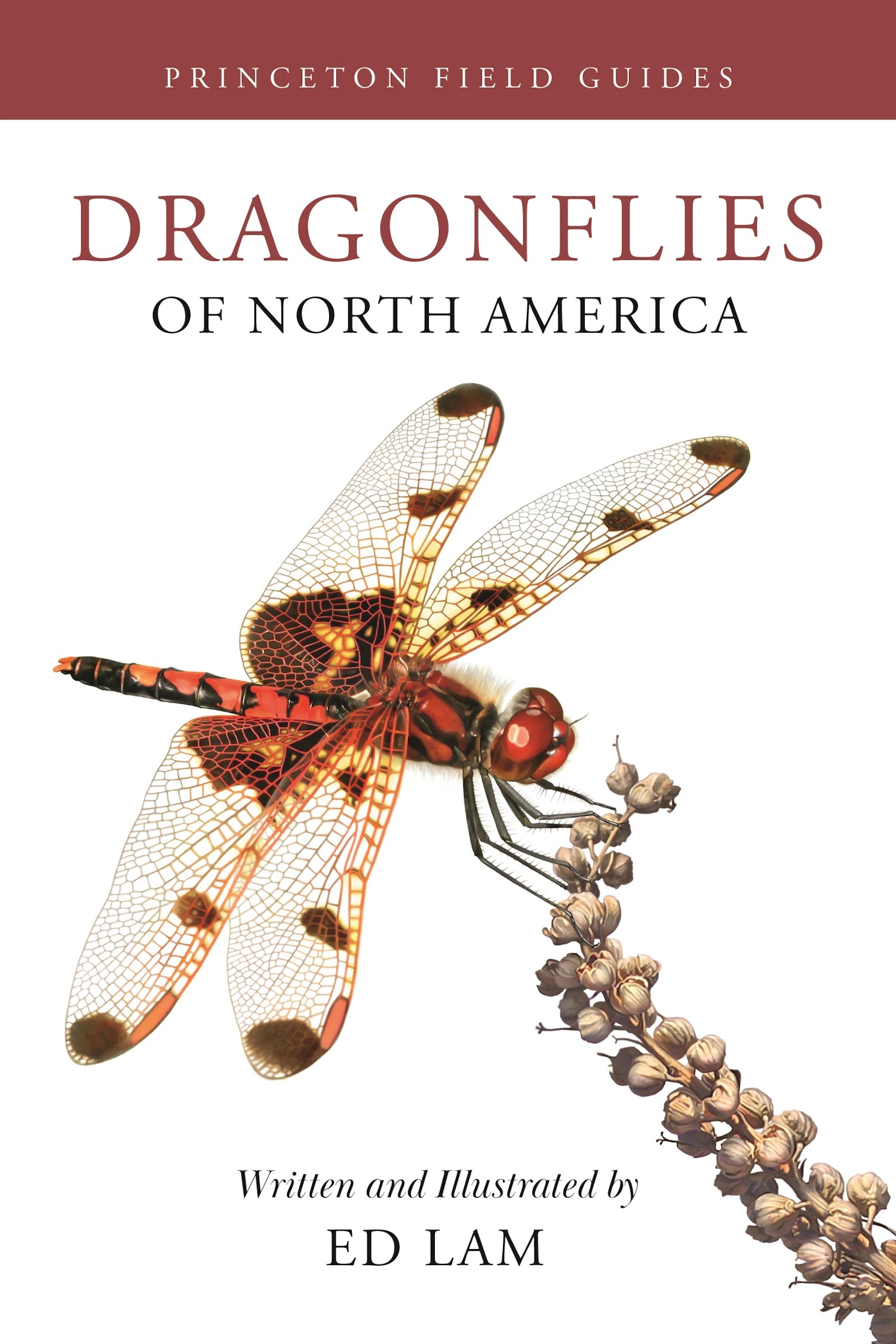
Ed Lam’s Damselflies of the Northeast came out in 2004. It is one of the great field guides. My copy is falling to pieces. Where other field guides are satisfied with a picture or two, Lam illustrated as many as six forms for some species. Having grown up with Roger Tory Peterson’s birds, I’ve always favored illustrations more than photos for field guide ID-purposes. The illustration is a platonic ideal; the photograph an individual in light that may not be very helpful.
DOTN was published by Biodiversity Books, a non-profit in Queens. I don’t know if they produced anything else. The slim book looks virtually impossible to get today. The bent-penis logo company is selling one for nearly $5,000. Whut? (Not sure, but it might be some kind of print-on-demand thing?)
Anyway, after DOTN word circulated that Lam was working on a large guide to dragonflies of the U.S. This would be a much larger project. DOTN covers 69 damselfly species and subspecies. (There are 329 dragonfly species/subspecies in the new book.) It was going to be published as a Peterson Field Guide, if I remember correctly. But illness intervened. We live in such a barbaric country that at one point Lam was selling off his original artwork for the damselfly book to sustain himself and his family. I bought his Familiar Bluet illustrations (the originals are 8” long; they were reduced by half for the book). The original book contract went unfulfilled. There didn’t seem to be much activity on his website.
Few of us see larval dragonflies or damselflies in action. But when they get into the air, look out!
This month, Princeton Field Guides came out with Lam’s Dragonflies of North America. Hallelujah!
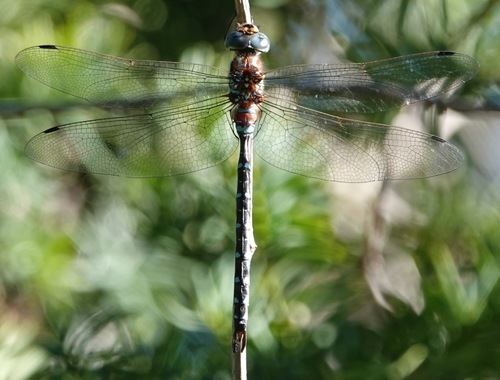
Let’s take a closer look, a case study. On September 7th, 2019, I was leading a group of startlingly frightened-by-the-outdoors undergraduates around Green-Wood on a bird walk for that year’s Bioblitz. I managed to get a couple photos of an unusual dragonfly I saw descend to a vertical perch.
An Aeshna mosaic darner, but which one? There are a baker’s dozen of the species found in the U.S., eight of them within range. I’ve seen few of them myself. I thought maybe Shadow Darner/A. umbrosa, based on photos on Odonata Central. There was disagreement with that on iNaturalist. And there it stood, mysterious, for, well, five years.
Lam stresses that pattern is more consistent than color. Eye, thorax and abdomen color can be age-dependent. Tenerals, the technical name for the nearly-emerged adults, start out plain and dull, their wings cellophane-like. As examples, Lam details four male Lancet Clubtail color stages; three for a male Widow Skimmer, one of the species that develop pruinosity, a whitesh/bluish/grayish waxy bloom on the body and wings.
For the mosaic darners, the markings on sides of the thorax are key identifying features. Ah, but it’s hard to see the sides of the thorax, what with the wings above them and all. My photos were from the top or dorsal side. But in these, the unmarked segment ten (S10) of the abdomen really narrowed it down. Combined with the single pair marks on S9, S8, S7, & S6 (S5-S1 have two pairs of blue markings) seemed to confirm it. Black-tipped darner/A. tuberculifera. As yet, nobody’s seconded that on iNat, though. There are only a few consistent Odonata identifiers. Hopefully, Lam’s book will increase that number.
Now, I need to see some more dragonflies. I’ve a seen a mere 10% of the species in this invaluable new book.
*
Caveat: “North America” in the title is debatable, since this books only covers Canada and the U.S. So it’s not the continental definition, which extends through Central America and includes the Caribbean, but this doubtless would have meant many more species, a number that continues to grow as new tropical species are described.
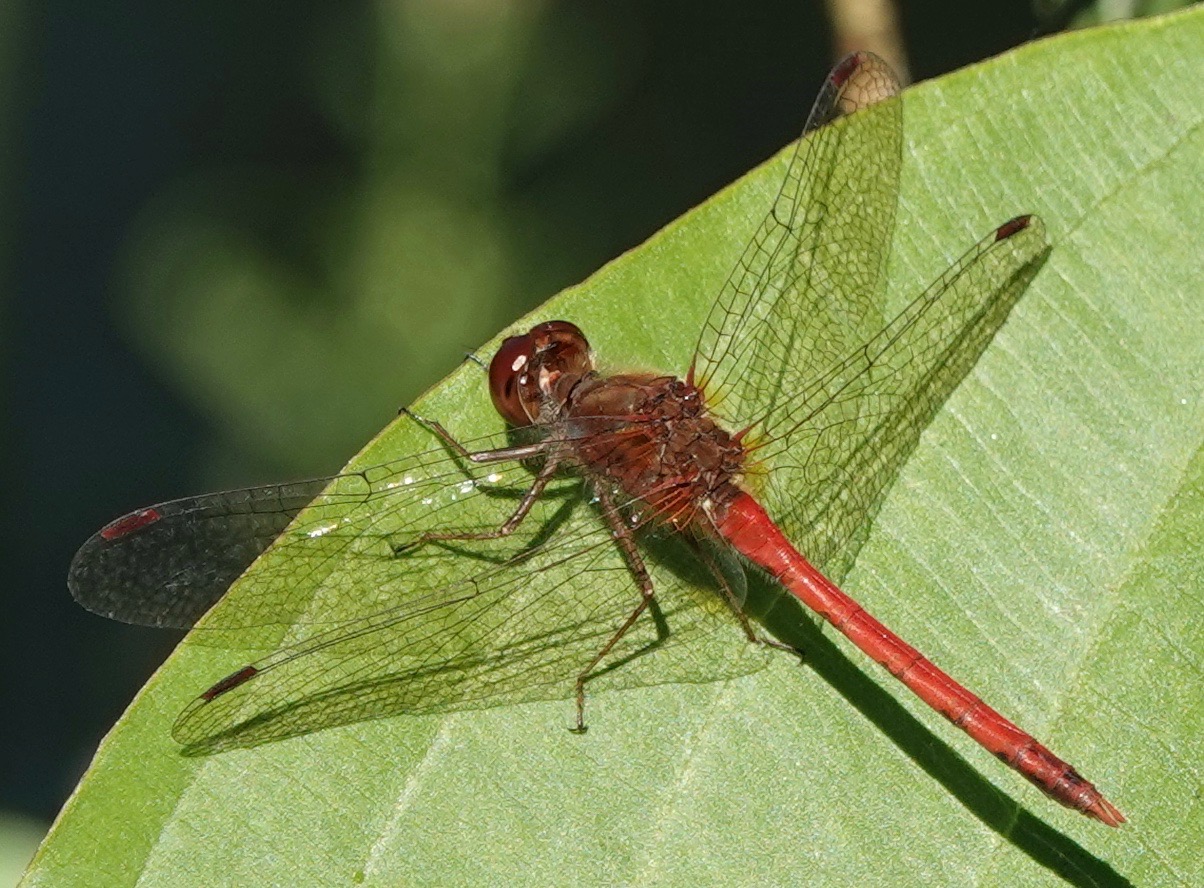
Autumn Meadowhawk, a late season local.
 Backyard and Beyond
Leave a comment