I used to follow the rules forbidding anthropomorphism. But this old thought, allegedly “scientific,” has fallen to the wayside the more I observe animals, and the more I learn about them. This, then, jumped out at me in Lynda Lynn Haupt’s Pilgrim on the Great Bird Continent:
“In his observations of seals and caracaras and ovenbirds and earthworms, in his records of their behaviors and his sensing of their thoughts, [Darwin] utterly, and even joyfully, abandoned his privileged human status. He threw his own thoughts and behaviors right into the animal mix, putting all creatures, including humans, on the same continuum of consciousness. Rather than imposing human concepts upon animal behaviors, he animalized consciousness in general. The human “privileges” imparted by advances such as language grew out of this continuum ran than being plopped down on top of it.”
Long-time readers will know I get itchy and scratchy over the inane human names imposed on charismatic fauna. Eagles named George and Martha, that kind of thing. (Nobody seems to name bees, on the other hand, except for Monty Python’s “Eric the Half a Bee”). And don’t get me started on the animal metaphors we use on ourselves.
For we humans are fairly distinct in our monstrousness. There’s no reason to insult, say, pigs, rats, snakes, et al. by comparing us to them. It’s more accurate to describe those creatures who do, on occasion, waste food or befoul their nests, as so human.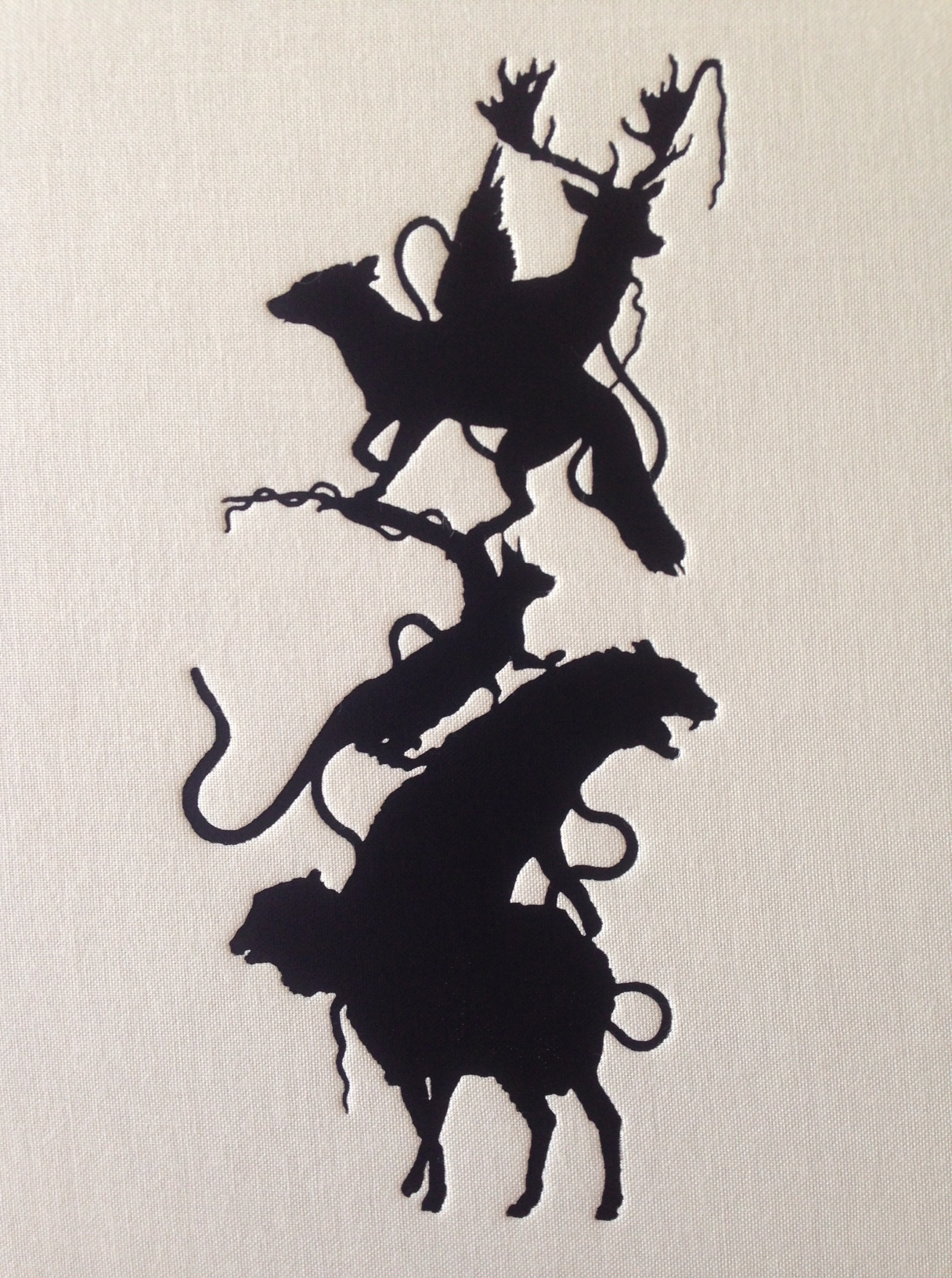 Yet we’re always — for as long as there are records, including cave paintings — drawing, singing, and emulating animals. We must be jealous. Of course, now that so many people are urbanized and digitized, animals are receding from our consciousness…
Image: Darren Waterston, embossed cover to A Swarm, A Flock, A Host: A Compendium of Creatures by Mark Doty & Darren Waterston (Prestel, 2013)
 Backyard and Beyond
Leave a comment