I’ve been reading Neil MacGregor’s Germany: Memories of a Nation, a deeply thought-provocking work even with its sprawling and superficial, in the best sense, scope. I wanted to make a note of Dürer’s famous rhinoceros, highlighted in a chapter on the master, in these pages of blog, but a pebble dropped into the mines of memory made me wonder if I’d done so before. I had, on the occasion of reading MacGregor’s earlier History of the World in 100 Objects.
In this new book, MacGregor writes that so powerful was Dürer’s image that 215 years later, the makers of Dresden’s porcelain menagerie modeled their rhinoceros on it, even though Europeans had a pretty good idea what rhinos actually looked like by then.
So instead of Dürer’s rhino again, I present his Das große Rasenstück, the Large Piece of Turf, a 1503 watercolor. Although he never saw a rhino, you can imagine what a fine job he would have done with a representation of the actual animal, instead of just a written description. He was a very close observer of nature. At least nine plants have been identified here.
Of course, one can easily go on and on with AD. I also favor his Klein Eule, Little Owl, another watercolor (for someone so well known for his copper plate work) of 1508.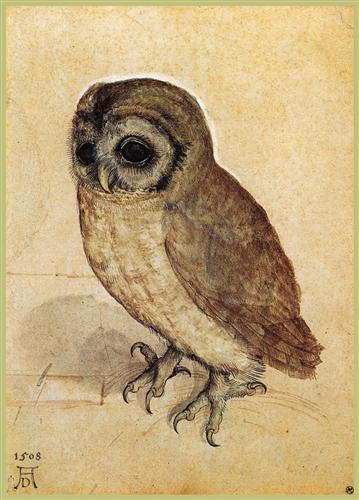
UPDATE: It turns out that the authorship of the owl painting is quite contested. It is certainly attributed to AD, but controversially so. Fritz Koreny’s Albrect Dürer and the Animal and Plant Studies of the Renaissance, the catalog of a 1985 exhibition, is quite sure it isn’t. The monogram and the date being added later, the brush strokes different, etc. Still, a lovely piece. Let me know if you have further information.
 Backyard and Beyond
Leave a comment