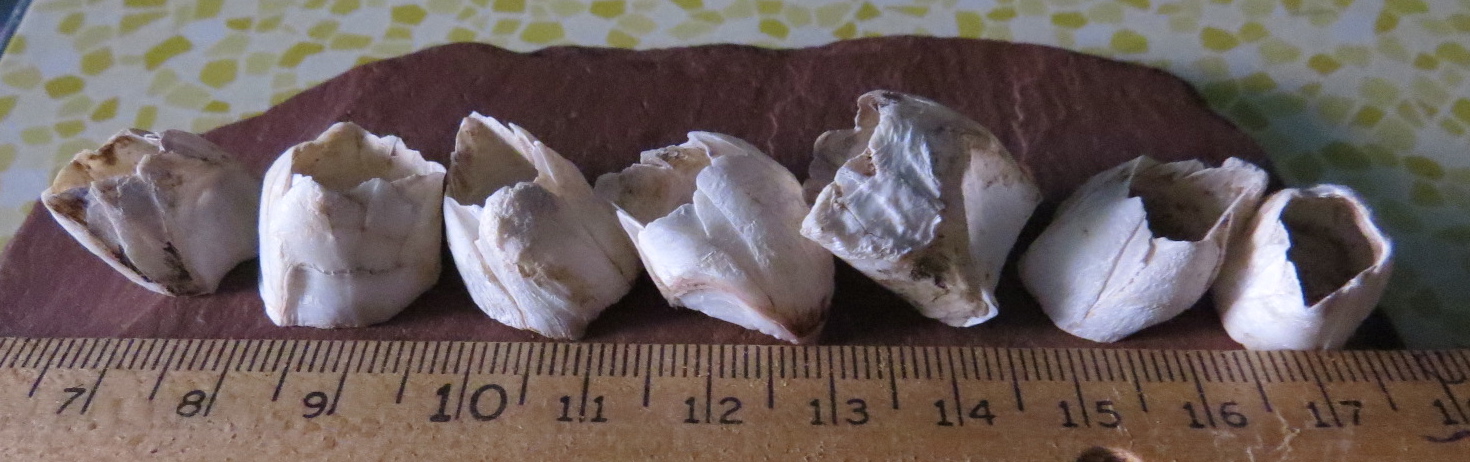
 I just pulled these acorn barnacle shells out of a side pocket of my backpack. I picked them up in Maine a couple of months ago and promptly forgot about them.
Crustaceans, acorn barnacles begin life as free-floating larvae. The tiny head and telson affair is called a nauplius. These grow into a second larval stage, the cyprid, whose job is to find a nice surface — rock, wooden piling, ship hull — to glue its head to. Once stuck, it stays that way. It’ll grow the six hard, overlapping calcareous plates that form these thoothy-looking thimbles. These are the now-sessile animal’s castle walls. But how then do they reproduce if they’re not going anywhere? Well, for starters most species are hermaphroditic, so it doesn’t matter who their neighbors are, and the penis is extraordinarily long — the longest in terms of body size ratio of any animal is a goose barnacle species’s — so it can go cruising, as it were, from home base. Some species also release sperm into the water, like trees release pollen into the air.
Our man Darwin was obsessed by them; before him, it wasn’t realized they were related to shrimp.
 Backyard and Beyond
Leave a comment