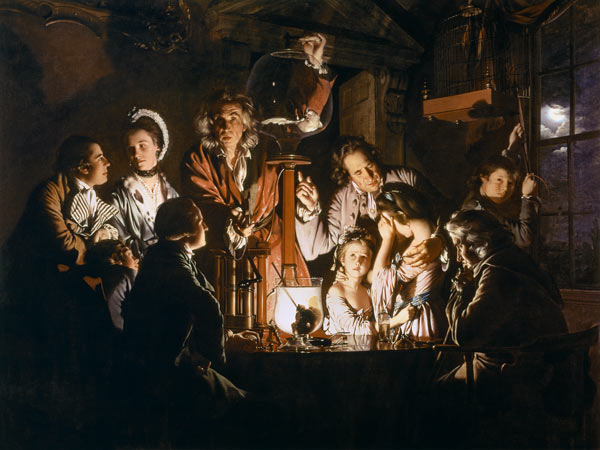
 An Experiment on a Bird in the Air Pump, by Joseph Wright “of Derby,” 1768. The painting is in the National Gallery, London, where I saw it in the oil this summer. Dramatically lit by a single candle, this tableau shows a scientist conducting the eponymous experiment and freaking out the children. Actually, in 1768, the word “scientist” was still some 65 years premature. This long-haired fellow, who reminds me of Newton in his later, alchemist, stage, is a natural philosopher (or, given that robe, possibly even a wizard…), even as he demonstrates actual principles and technology. One isn’t too sure how far he’s going with the experiment. Will the bird, a Cockatoo of all things, live or die? Probably live, since it’s so showy a creature he’ll want to reuse it over and over. (Very little concern for the lives of others as yet.) Not that the young couple on the left are paying any attention; their interest in each other is rather greater.
Richard Holmes actually uses another Wright painting as the frontispiece of his very enjoyable book The Age of Wonder: How the Romantic Generation Discovered the Beauty and Terror of Science. 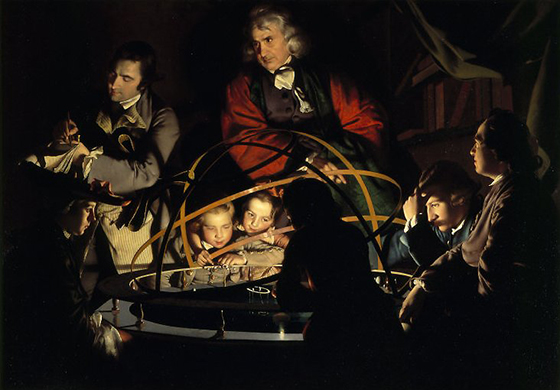 A Philosopher Lecturing on the Orrery, or three-dimensional model of the planets in orbit around a lamp-sun, is another of Wright’s dramatic case-studies in light (if not Enlightenment). Either painting would have worked for this book, which shows how the Romantics basically invented the idea of the lone scientist having his — usually, but Caroline Herschel gets much attention here — “Eureka!” moment, even though that’s hardly ever the case, even if some scientists eventually become convinced that that’s how it indeed happened. The Romantics also gave us, of course, Dr. Frankenstein.
Holmes ends his book criticizing the standard “two cultures” division that has arisen between science and the humanities: “We need a wider, more generous, more imaginative perspective. Above all, perhaps, we need the three things that a scientific culture can sustain: the sense of individual wonder, the power of hope, and the vivid but questing belief in a future for the globe.” [Italics in original] Three cheers for that! The Age of Wonder should be perpetual.
 Backyard and Beyond
Leave a comment