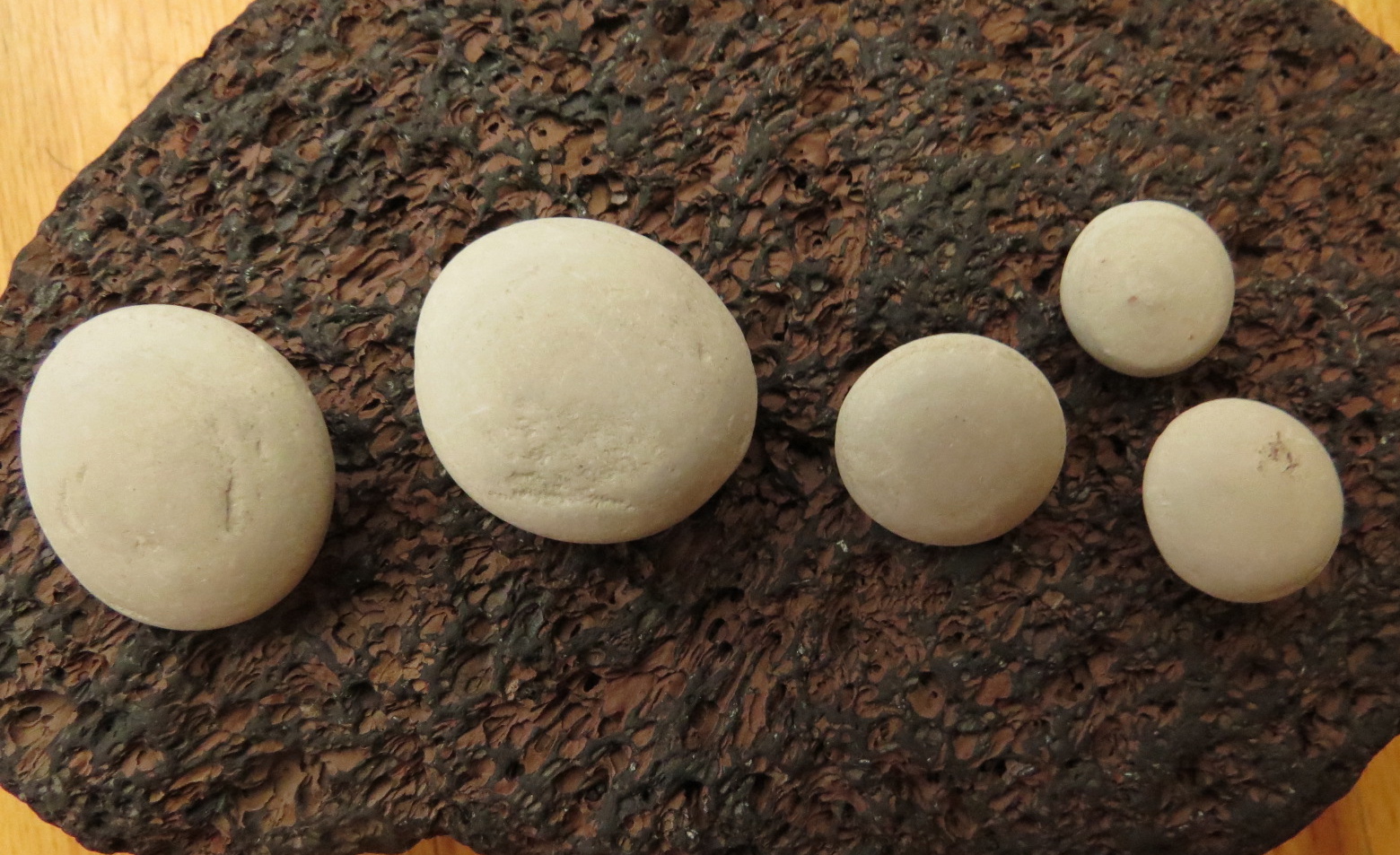
 These smooth, hard clay nodules are from Croton Point Park, formerly the location of a brick factory. They were sticking out of a large pile of less-clayey material, as if the surrounding had been eroded away by… river, rain, wind, all of the previous? The largest is the diameter of a quarter.
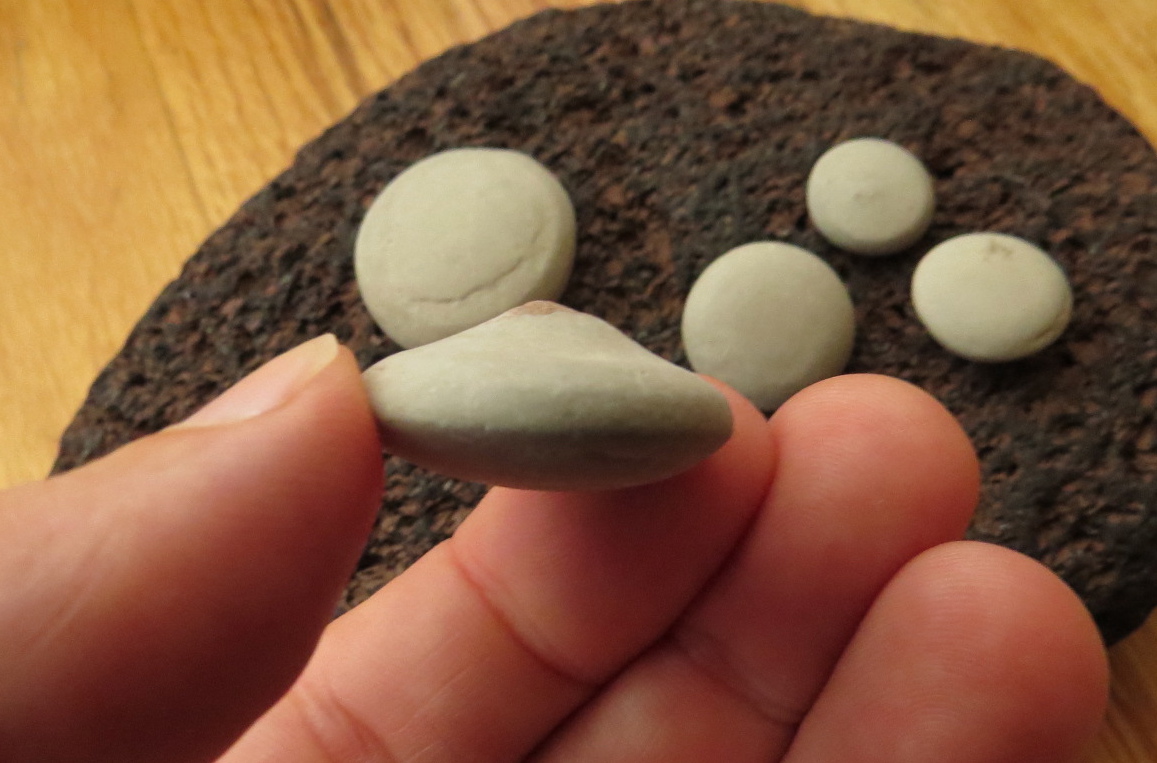 This is what the bottom of the nodules looks like, a little nubbin where they were attached to the larger mass — they came off with a twist — with a reddish stain suggestive of iron.
Any idea what these are called, if indeed they have a geological term?
Modeled on a volcanic piece — that’s redundant — of Iceland, the most textured rock in the house, to contrast with the ever-so-fine particles of clay.
Update: Thanks to Kevin (see comments) for the news: these are concretions. Vermont has a state park named after them, but I think these Croton Point examples are finer than the ones from that corner of Lake Champlain that I’ve seen pictures of, anyway. There are some wonderfully grotesque ones, too, known as “clay dogs.” The American Naturalist of September 1884 refers to “clay dogs, clay stones or clay concretions.” Wikipedia bemoans the loss of them at Croton Point after the place was turned into a park. But clearly not….
A further update: the Nature Center at Croton Point has an exhibit of “clay babies,” some of them aptly fetal.
Update: I got a postcard from my friend Sue: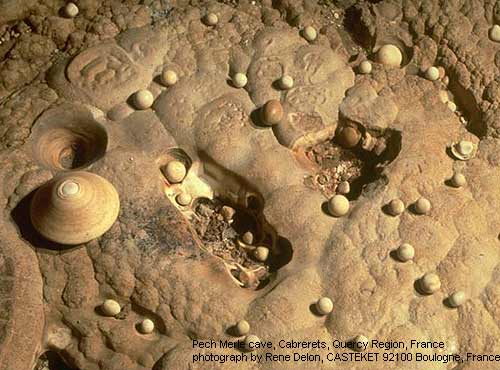 She was with us at Croton and was reminded of these buttons when she saw these “toupie et perles des cavernes” at the the Cro-Magon-era cave Pech Merle. These are made of calcite polished by water.
 Backyard and Beyond
Leave a comment