 I’ve mentioned the Maria Mitchell Association on Nantucket in my previous posts without explaining much anything about it. In four decades connection with the island, I’ve been to their observatory, science center, and library many times. A friend of the family wrote the most recent biography. So I naturally assume that everybody knows who Nantucket-born Maria Mitchell (1818-1889) was. Insular thinking, of course. Briefly, she was America’s first woman astronomer, the discover of a comet via telescope, and later the first ever professor of astronomy at Vassar College. Born a Quaker, she became a Unitarian, and combining these dissenting traditions, it shouldn’t be surprising that she was also an abolitionist — boycotting, for instance, (slave-made) cotton — and a suffragist. In the 19th century, Quakers were unusually egalitarian, and Nantucket’s isolation and male de-population (away for years in the whaling trade, abandoning the island for the Gold Rush, etc.) added to the impetus for the island being full of strong, independent women. No time for fashionably consumptive bed-sitters there. Of course, it helped that Mitchell’s father was a banker and could buy her a telescope.
Very important: her given name is pronounced like the wind, old English style, “Mah-RYE-uh,” not the new-fangled Latinate “Mah-REE-ah.” In 1902, some of Mitchell’s former students and surviving relatives got together to form the Association in her name to further her educational mission in the natural sciences and natural history. The place is still going strong, and growing even stronger with an new science center facility scheduled to open in 2013.
  Recently, I got to see some of the collections inside the Hinchman House property of the Association, where the Science Center is currently located. Collections Manager Julia Blyth, who is also the MMA’s bird bander, snake catcher, dragonfly surveyor, intern wrangler, and etc., led the tour.
 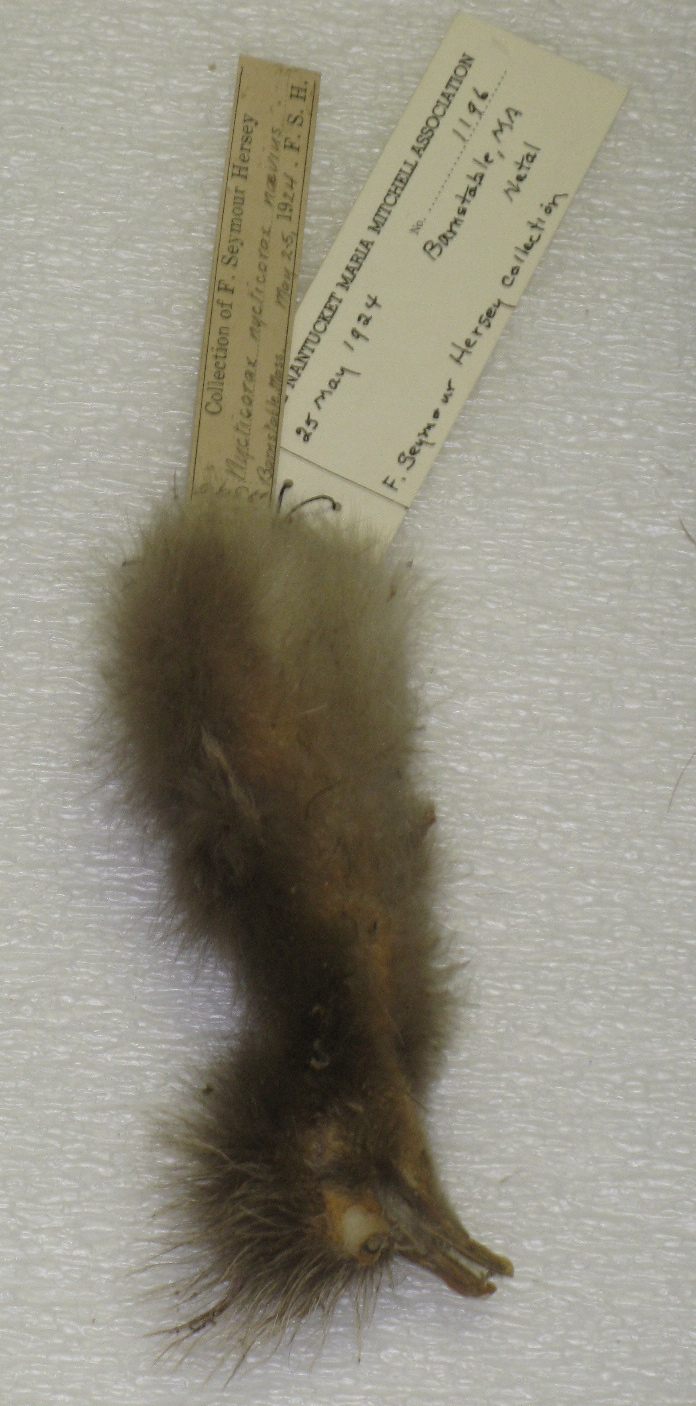 There are samples of the island’s spiders, moths, beetles, bees, mammals — including the Muskeget vole, Massachusett’s only endemic mammal, found only on the tiny satellite island west of Nantucket proper — but birds predominate. (And are also easier to photograph.)
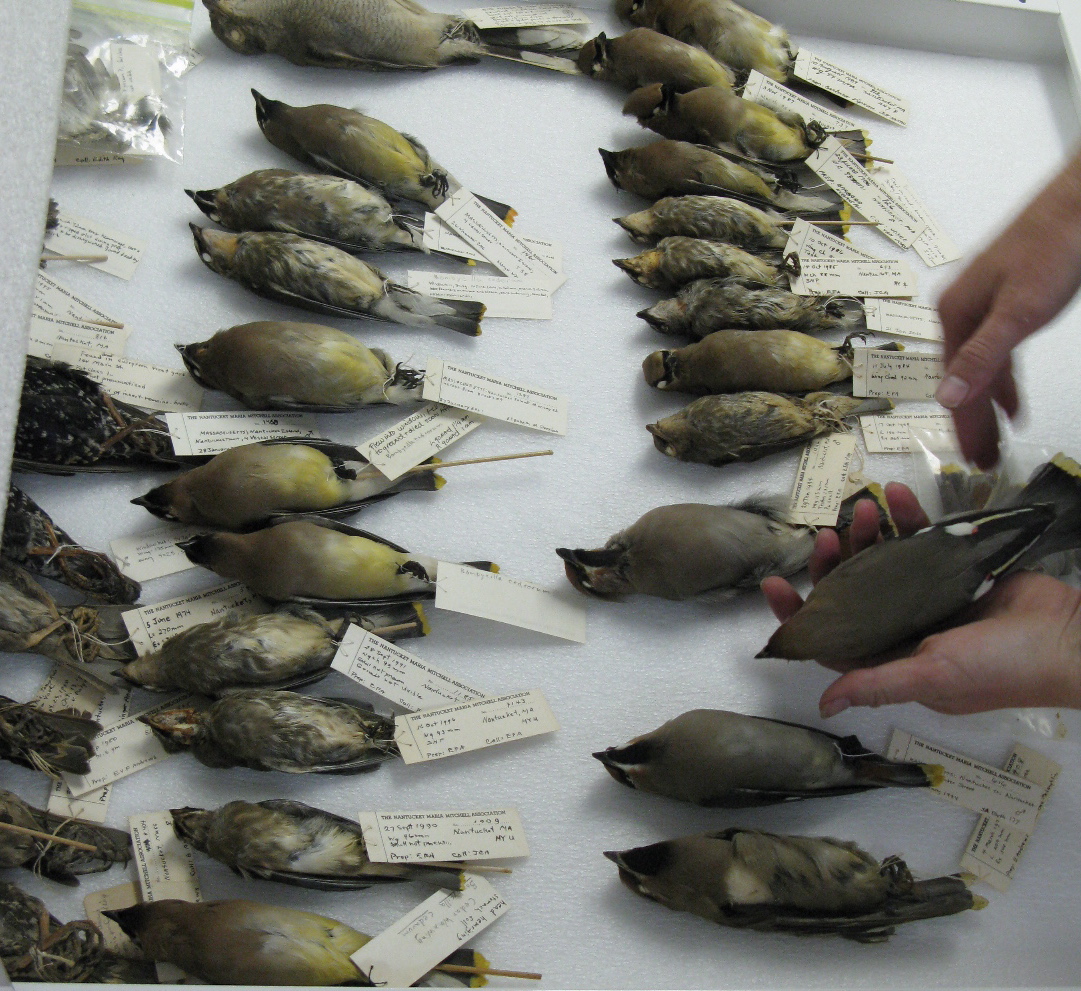 My mother used to bring home dead shorebirds and pop them in the freezer for Edith Folger Andrews, who wrote the book on Nantucket’s birds in 1948. People still bring in specimens. In fact, there’s a freezer full of specimens that Blyth, who prepares the specimens, or “skins,” now, just hasn’t gotten to yet.
  UPDATED: I got some excellent questions about this post from a friend on Facebook. Why are these things collected, anyway? What can we learn from them? Since each individual in a species is distinct, not least at the genetic level, a range of samples can be helpful to study populations in isolation and in comparison with others of the same species. Of course, it may be years before anybody wants to take a look at these things, but there have been cases where researchers have checked historic specimens to look at disease, DNA, speciation, etc.
For nearly a century now, it has been illegal to capture and/or kill migratory birds, collect their eggs and nests (once popular hobbies), and even to collect their feathers. This is because such birds used to be slaughtered in such numbers that people began to worry they would be made extinct, as some in fact were. Science is the exception when it comes to collecting bird specimens. Most of the specimens are from accidental deaths. The rare Golden Eagle (not photographed) in this collection hit a power line. The Bohemian waxwings (in the 5th photo), not normally found at our latitude, were the result of an irruption some years ago. Unfortunately, they died in droves on the island. A Peregrine falcon (not photographed) in the collection had been banded in Lawrence, MA, before wending its way south to the island, where it was struck by a car. All a bit of a bummer, to be sure, but hopefully, in being preserved and recorded, they can contribute something to our knowledge of the species. And hopefully that knowledge is something we can use to defend and foster the complex web of life that surrounds us, that we, in fact, are a part of.
 Backyard and Beyond
Leave a comment