Yesterday, we took a walk along Dead Horse Bay and the North 40 Trail at nearby Floyd Bennett Field. Before we knew it, we’d been outside for more than six glorious hours. This is a transitional time, with both winter and spring bird species finding themselves rubbing shoulders, so to speak. The large raft of Greater Scaup that winters here is still around, although they will be heading north to breeding grounds soon. The raft wasn’t so big when we first arrived in the mid-morning, but as we stood there wave after wave of birds flew in, their massed wingbeats making a most extraordinary liquid sound.
 Dead Horse Bay, the site of an old landfill, is a wonderfully bizarre place of glass bottles and rusting metal and shoe soles and marbles and bricks and pretty much everything else from the garbage pile of the 20th century. It used to be that very few people ever went there, but now it’s quite popular for beach-combers, collectors, artists, etc. Indeed, two pre-teen girls were having the time of their lives, although I’m afraid I had to narc on them to their mother, further along the beach, since they were barefoot, which is practically suicidal with all the sharp glass and metal to be found there.
 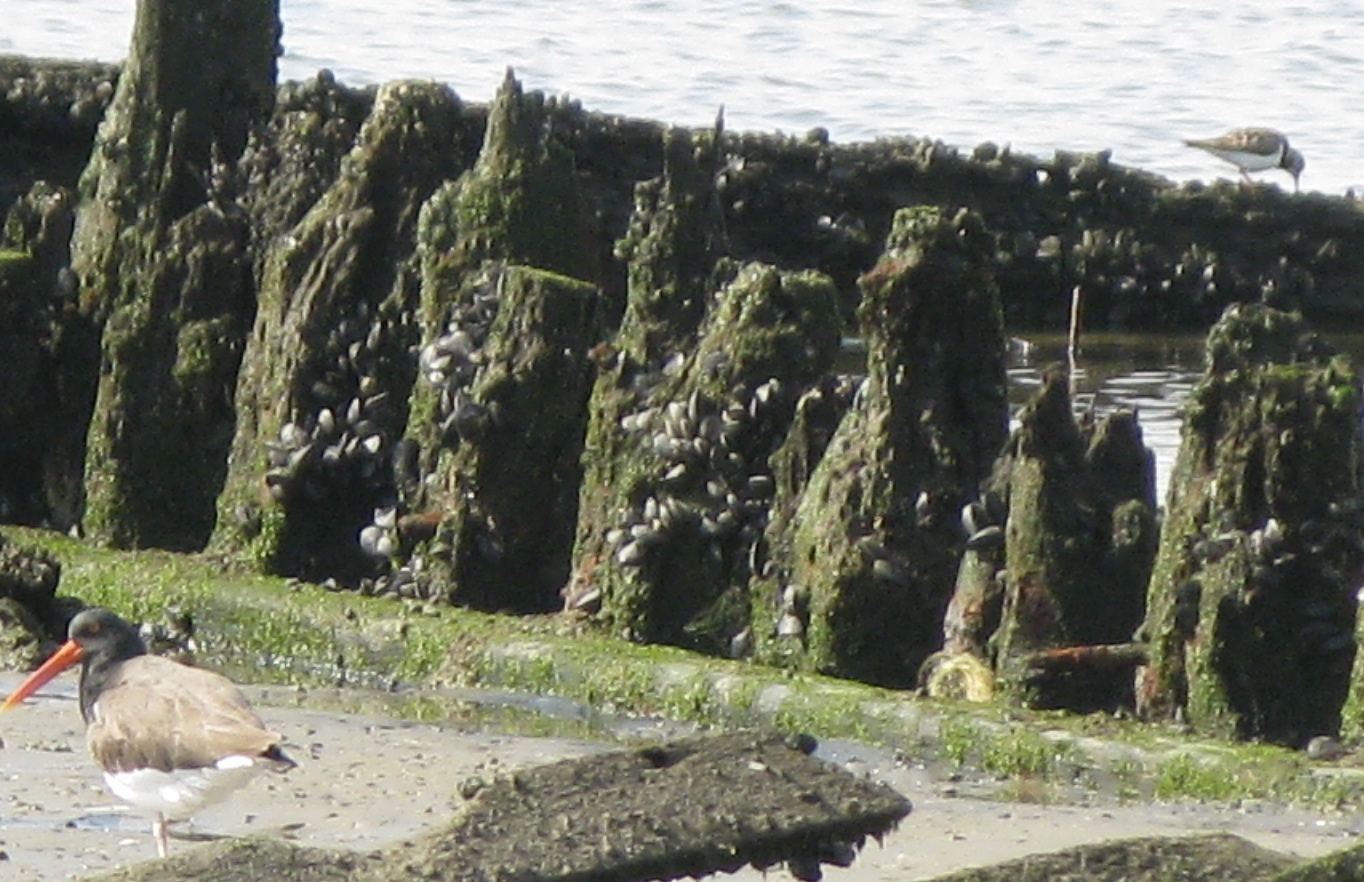 We saw our first American Oystercatchers, a species that breed in our region (and yet another reason to make sure your dogs are leashed on the beach), of the year, as well as a single Ruddy Turnstone, still in its non-breeding plummage. The old pier here supports plenty of blue mussels and other goodies.
 The very low tide may have caught these two.
 The rock-like black objects blurred by sand in both the above images are actually mud snails, Ilyanassa obsolete, which will eat these fish corpses if something else doesn’t.
 This is a Lady Crab, Ovalipes ocellatus; you usually only find their beautifully patterned carapaces on the beach, not the whole animal. The more usual crab whose remains are found is the Spider Crab, Libinia emarginata, evidently tasty eating for gulls.
 We went to Return-a-Gift Pond at Floyd Bennett Field to listen for frogs. This is one of the few fresh water ponds in Brooklyn where you can hear peepers. As it was only the middle of the afternoon and only just spring breaking, there were only a few sporadic amphibian calls, but the pond, seen here through one of the two bird blinds, had several Painted turtles, Green-winged Teal, Hooded Mergansers, Mallards, and a Northern Shoveler on it. On the North 40 trail, we saw our first butterfly of the year, a Cabbage White, and our first Eastern Phoebe, that early arriving harbinger of spring migration.
- Comment
- Reblog
-
Subscribe
Subscribed
Already have a WordPress.com account? Log in now.
 Backyard and Beyond
Leave a comment