We’re going nuts this week to celebrate summer’s ferocious growth spurt, which channels energy into storage systems we call seeds and/or nuts. Botanically, true nuts are produced by, among others, oak, beech, chestnut — but not horse-chestnut — alder, hazel, and hornbeam species, but we’ll be a little looser here, since any one of the big seeds coming up on this blog would feel like a nut if it hit you on the head. And this time of year, the things are cascading from the sky.
First, a couple of acorns, which I’d hazard to guess most of us can identify. These two are actually a little atypical. Chestnut oak, Quercus montana. AKA mountain chestnut oak, rock chestnut oak, rock oak, tanbark oak. The shape here is very acorny, but the dark color is a bit unusual.
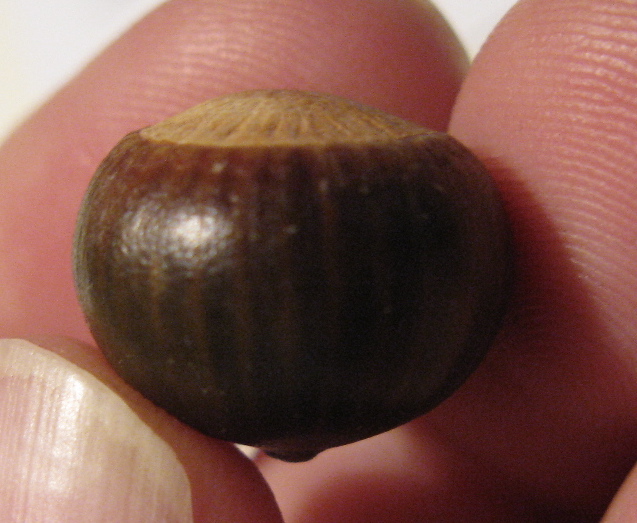 Pin oak, Quercus palustris. If you listen carefully while walking down the street, you can hear these bouncing off of parked cars. Unusually small and flattened, with delicate lines. One sprouted in a pot in the Back 40.
Native oaks are divided into two groups, the Red Oaks and White Oaks. There are a number of differences, but one of the major ones is that the Red Oaks take two years to mature their acorns, while the White Oaks do it in one growing season. The Pin Oak is a Red Oak Group member; the Chestnut Oak a White Oak Group member.
 Backyard and Beyond
Leave a comment