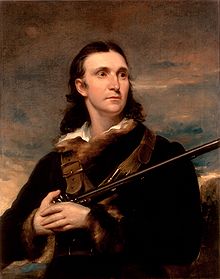
 While behind the locked doors of the American Museum of Natural History last week, I saw a hidden exhibition of John James Audubon’s mammals. It was an unexpected treat, but too brief. (The exhibit was open to the public between 2007-09 in the renovated Audubon Gallery, but I missed it then.)
Nowhere near as famous as the Birds of America, the Viviparous Quadrupeds of North America was Audubon’s final work. In partnership with naturalist Reverend John Bachman, Audubon worked on our live-birthed four-footed mammals during the 1840s, including during an expedition up the Missouri in 1843. The book was published serially, in three volumes. But the time the last volume came out, Audubon was dead; even before he passed away in 1851, he had succumbed to stroke and what was probably Alzheimer’s. His sons and Bachman completed the work.
Indeed, with half the original paintings — which were then lithographed and hand-painted by J. T. Bowen and company — done by John Woodhouse Audubon, it is not nearly as impressive a work as the Birds. Still, it should be better known. You can go through it page by page at NYPL’s Digital Library.
John James Audubon’s watercolors for the VQNA are the best part of the project. His head of a buffalo calf, which I couldn’t find on-line, in particular is magnificent.
Most portraits of Audubon, like the one above, show him posing with a gun. He promoted himself, especially for the Birds, as the American Woodsman, with buckskin, long flowing hair, and rifle at the ready; Natty Bumppo with a watercolor kit. The image was a great success in Europe, where they ate that stuff about America up. And it reminds us that the long 19th-century of natural science was a bloody enterprise. The million specimens in the ornithology collection at the AMNH (see my last post) — and that’s just the birds, at one museum — were all taken in the wild. Collection is an imperialist imperative. One of my favorite living artists, Walton Ford, who paints large-scale in an Audubonesque style, very much interrogates the contradictions inherent in such a view of nature.
*
Some local connections: born on Saint-Domingue (Haiti) in 1785, Audubon was buried in Manhattan at Trinity Cemetery at 155th & Broadway. His widow Lucy Bakewell Audubon lived nearby at the family home, Minnie’s Land, before she joined him at the family plot in 1874. Audubon Terrace – Manhattan’s loneliest cultural complex – is on the site of the Audubon farm now. George Bird Grinnell (1849-1938), who was born in Brooklyn and became an influential conservationist, got to know Lucy well as a youngster. He would end up founding the first Audubon Society.
 Backyard and Beyond
Leave a comment